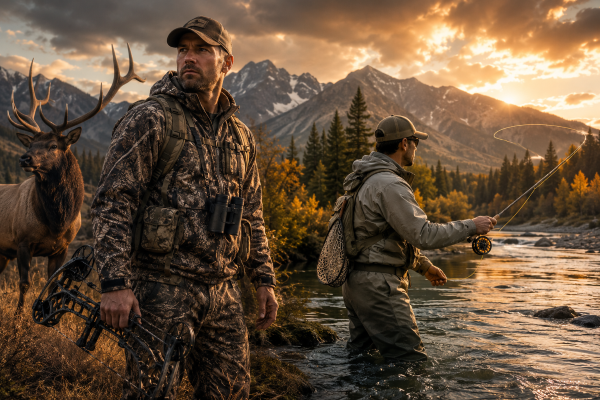
There is an old saying that wisdom is learning from someone else’s mistakes. Oregon appears determined to test the opposite theory.
For decades, hunters and fishermen have quietly funded wildlife conservation in America through a system that is arguably one of the most successful user-funded conservation models ever created. Nobody had to force them. Nobody had to create a federal bureaucracy to chase them around. They simply bought licenses, purchased equipment, paid excise taxes on firearms, ammunition, bows, tackle, boats, and gear, and the money flowed back into conservation.
In Oregon alone, hunters spend roughly $248 million annually. Anglers add another $646 million or more. Combined, sportsmen contribute nearly $900 million to Oregon’s economy every year. Hotels, gas stations, restaurants, sporting goods stores, guides, outfitters, campgrounds, and rural communities all benefit from that spending. Thousands of jobs depend upon it.
Then there is the Pittman-Robertson Act. Every box of ammunition, every rifle, every shotgun, every hunting bow contributes to a federal conservation fund. Oregon receives approximately $23.6 million annually from those excise taxes alone. Wildlife habitat, hunter education programs, shooting ranges, conservation projects, and countless other efforts are funded by people who willingly reach into their own pockets.
And yet, despite all this, Oregon lawmakers seem eager to treat hunters and gun owners as if they are a problem to be managed rather than partners in conservation.
It is a fascinating strategy.
Imagine running a restaurant and deciding the customers are the enemy. Imagine owning a farm and declaring war on the rain. Imagine being handed nearly a billion dollars in economic activity and deciding the people generating it are no longer welcome.
That appears to be the direction.
The irony is that many of the loudest voices demanding additional restrictions often portray themselves as champions of conservation. Yet they frequently oppose the very people who have been funding conservation for generations. Hunters have restored elk herds. Hunters helped bring back wild turkey populations. Hunters fund habitat improvements that benefit countless species that will never appear in a hunting regulation booklet. The average songbird, frog, turtle, and butterfly benefits from conservation dollars generated by people carrying deer rifles.
Nature itself doesn’t care about political slogans. Habitat requires funding. Land management requires funding. Biologists require funding. Conservation is not powered by hashtags and yard signs. It runs on money, and a substantial portion of that money comes from sportsmen.
Perhaps Oregon should continue down this road.
Not because it is wise.
Not because it will improve conservation.
Not because it will strengthen rural communities.
But because sometimes reality is the only teacher left in the room.
If enough hunters decide to hunt elsewhere, if enough fishermen choose friendlier waters, if enough outdoor businesses struggle, if enough conservation dollars disappear, the economic consequences will eventually become impossible to ignore. The numbers are stubborn things. They don’t care about ideology. They don’t bend to political narratives. They simply exist.
And when rural communities begin asking where the tourism revenue went, when wildlife agencies begin asking where the funding went, and when legislators begin wondering why conservation budgets suddenly became difficult to maintain, perhaps someone will remember the people who were quietly paying the bills all along.
The great tragedy is that none of this is necessary.
Hunters and fishermen are not enemies of wildlife. They are among its largest financial supporters. They are not obstacles to conservation. They are one of the primary reasons conservation works in America better than it does in many parts of the world.
Oregon still has time to recognize that reality.
If not, then perhaps the state should proceed exactly as planned and discover firsthand what happens when you spend years kicking the legs out from under the stool that has been holding you up.
The lesson may be expensive.
But apparently Oregon is willing to pay tuition.
If you enjoyed this article, then please REPOST or SHARE with others; encourage them to follow AFNN. If you’d like to become a citizen contributor for AFNN, contact us at managingeditor@afnn.us Help keep us ad-free by donating here.
Substack: American Free News Network Substack
Truth Social: @AFNN_USA
Facebook: https://m.facebook.com/afnnusa
Telegram: https://t.me/joinchat/2_-GAzcXmIRjODNh
Twitter: https://twitter.com/AfnnUsa
GETTR: https://gettr.com/user/AFNN_USA
CloutHub: @AFNN_USA
I spent the majority of my adult life in the Portland Metro Area. We escaped following the five-month Democrat-funded riots in 2020 when I was cited for “criminal harassment” of FIVE BLM/Antifa thugs who tried to beat me up. I was cited for one reason: I am white. Police had been told to allow the domestic terrorists to do what they wanted AND to NOT protect law-abiding residents. This bill to outlaw hunting & fishing is yet ONE MORE ASSAULT on “white” men because The Left perceives hunting & fishing as a “white male” activity. Once “white” mean are fully emasculated in the State of Oregon, the Marxists who run Portland believe they will take over the entire state, every city, every county. Keep in mind: Most of Oregon is hunting, fishing, boating, etc. territory. It is only the pasty-face men in Portland (have you seen a photo of the current mayor?) who are too weak to enjoy outdoor activities.