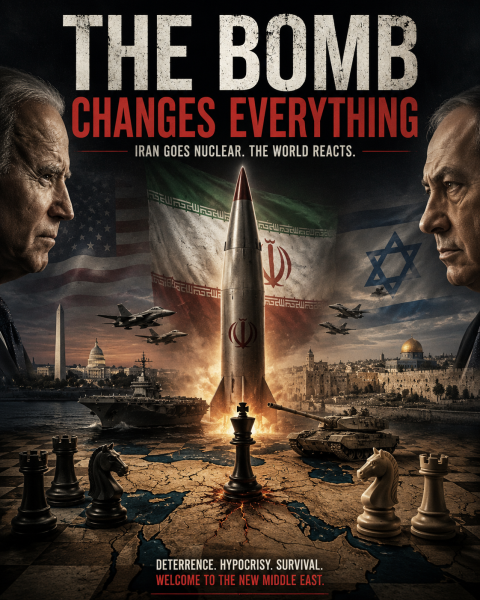
The Nuclear Club and the World’s Biggest Double Standard
Imagine waking up tomorrow morning to the headline every diplomat, intelligence analyst, and talking head on cable television spent the last twenty years warning about.
Iran has the bomb.
Not a theory. Not an intelligence estimate. Not a blurry satellite photo of suspicious activity in the desert. An actual nuclear weapon, tested and demonstrated for the world to see.
The reaction would be immediate and predictable. Politicians would demand action. News anchors would discover maps of the Middle East they had never looked at before. Experts who failed to predict every major geopolitical event of the last three decades would once again explain why everyone should listen to them now.
But buried beneath the panic would be an uncomfortable question nobody wants to answer honestly.
Who are we to say they can’t have one?
Before anyone starts throwing coffee mugs at the wall, let’s be clear. Nuclear weapons are terrible. They are perhaps the most destructive devices ever created by mankind. The world would be objectively safer if none existed.
But that isn’t the world we live in.
We live in a world where the United States maintains a nuclear arsenal. Russia maintains a nuclear arsenal. China maintains a nuclear arsenal. Britain has them. France has them. India has them. Pakistan has them. North Korea has them. Israel almost certainly has them.
The official argument is that these countries are responsible enough to possess civilization-ending weapons.
Iran is not.
That may be true.
It may also be exactly what every nuclear power says about every non-nuclear power.
The reality is that nuclear weapons have become the ultimate geopolitical insurance policy. They are the world’s most expensive “Do Not Disturb” sign.
Nobody seriously talks about invading North Korea anymore. Nobody discusses regime change in Beijing. Nobody is drawing up plans to liberate Moscow. Once a nation possesses a credible nuclear deterrent, the conversation changes instantly.
History has not been subtle about the lesson.
Libya gave up its weapons programs and eventually watched its government collapse.
Iraq never obtained nuclear weapons and was invaded.
North Korea got the bomb and suddenly became a permanent diplomatic problem instead of a military target.
You don’t have to like that lesson to recognize that nations around the world have noticed it.
That’s where the hypocrisy begins.
For decades, the United States has argued that nuclear weapons are necessary to preserve peace. The logic is simple. If an enemy knows you can retaliate, they are less likely to attack. It is the foundation of modern deterrence theory.
Fine.
But if deterrence is a legitimate reason for us to possess nuclear weapons, how do we explain that it is illegitimate when somebody else reaches the same conclusion?
Our argument essentially becomes this:
“We need these weapons to protect ourselves. You don’t.”
That may be strategically convenient, but it is not a particularly convincing moral argument.
Imagine applying that logic anywhere else.
My family needs locks on our doors.
Your family doesn’t.
My nation needs an army.
Your nation doesn’t.
My government can possess the ultimate deterrent.
Your government cannot.
At some point the rest of the world starts looking at the nuclear club the same way people look at a homeowners association. The rules always seem to benefit the people writing them.
Of course, none of this means Iran should have nuclear weapons.
It means the world created incentives that practically guaranteed countries would pursue them.
Every time a nuclear-armed nation survives because of its arsenal, every time a non-nuclear nation falls victim to military intervention, every government on earth quietly takes notes.
The lesson writes itself.
The irony is that the bomb is simultaneously the most dangerous weapon ever invented and one of the strongest arguments against using military force. Once everybody possesses the ability to inflict catastrophic damage, everyone becomes a little more careful.
Or at least that is the theory.
The truly frightening possibility isn’t that Iran gets a bomb.
The frightening possibility is that everyone else decides they need one too.
Because once the world accepts that nuclear weapons are the ultimate guarantee of sovereignty, the line to join the club gets longer.
And that brings us back to the question nobody likes to ask.
If nuclear weapons are essential for our security, on what basis do we claim they are unnecessary for someone else’s?
The answer may be strategic.
It may be practical.
It may even be correct.
But let’s stop pretending it isn’t also the world’s largest geopolitical double standard.
If you enjoyed this article, then please REPOST or SHARE with others; encourage them to follow AFNN. If you’d like to become a citizen contributor for AFNN, contact us at managingeditor@afnn.us Help keep us ad-free by donating here.
Substack: American Free News Network Substack
Truth Social: @AFNN_USA
Facebook: https://m.facebook.com/afnnusa
Telegram: https://t.me/joinchat/2_-GAzcXmIRjODNh
Twitter: https://twitter.com/AfnnUsa
GETTR: https://gettr.com/user/AFNN_USA
CloutHub: @AFNN_USA