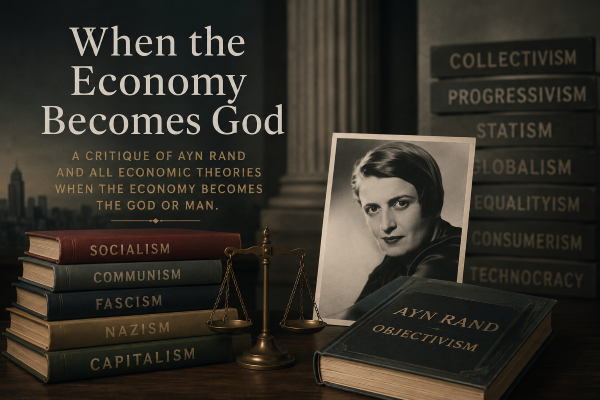
Americans have spent the last century arguing over economic systems with the zeal of medieval theologians debating angels. Capitalism versus socialism. Free markets versus central planning. Ayn Rand versus Karl Marx. Milton Friedman versus John Maynard Keynes. Every generation seems convinced that if we can just find the perfect economic formula, paradise will finally arrive.
It never does.
The reason is simple. Economic theories are tools. Human beings keep trying to turn them into religions.
Ayn Rand famously condemned collectivism. She argued that fascism, Nazism, communism, and socialism were all variations of the same disease: the subordination of the individual to the collective. History provides substantial evidence for her case. The twentieth century left a trail of mass graves stretching from Berlin to Moscow to Beijing, all justified by appeals to some greater social good.
Rand correctly identified a dangerous tendency in human nature. People often surrender freedom in exchange for promises of security, equality, national greatness, or historical destiny. The collective becomes sacred. Individuals become expendable.
But Rand’s own philosophy contained a flaw large enough to drive a Soviet Belarus tractor through.
In rejecting the worship of the collective, she came dangerously close to endorsing the worship of the individual.
Objectivism elevated rational self-interest to a moral virtue. Productive achievement became the highest expression of human purpose. Entrepreneurs became cultural heroes. The producer stood at the center of the moral universe.
The problem is that man makes a terrible god.
A society built entirely around self-interest eventually struggles to explain duty, sacrifice, charity, loyalty, or love. Why should a soldier risk his life for strangers? Why should a parent sacrifice for a child? Why should anyone care for the elderly, the disabled, or the poor if rational self-interest is the supreme moral principle?
Rand admired the builder, the inventor, the industrialist, and the creator. Fair enough. Civilization depends upon such people. But civilizations are also sustained by mothers, pastors, volunteers, teachers, nurses, and countless others whose contributions cannot be measured on a balance sheet.
The flaw is not unique to Rand.
Karl Marx turned economics into a religion of class struggle. The proletariat became the chosen people. History became a deterministic march toward salvation. The communist state became the priesthood. Tens of millions paid the price.
Meanwhile, modern capitalism often falls into a different trap. Gross Domestic Product becomes the measure of national virtue. Consumption becomes a civic duty. Markets become omniscient. Economic growth becomes the answer to every question.
Politicians from both parties routinely speak as though the economy exists to serve humanity while simultaneously acting as though humanity exists to serve the economy.
Need more workers? Import more workers.
Need more growth? Increase consumption.
Need more productivity? Restructure communities.
Need more efficiency? Automate the jobs.
Need more energy? Build the infrastructure.
Need more data? Build the data centers.
Need more growth? Repeat the process.
The machine always demands more fuel.
The irony is that both collectivist and individualist economic systems often arrive at the same destination. Human beings become economic units. They become workers, consumers, producers, taxpayers, demographics, labor pools, or economic indicators. Their value is measured by what they contribute to the system.
The language changes. The outcome often does not.
This is why debates over economic systems frequently feel unsatisfying. The participants are arguing over which idol deserves the larger temple.
One side worships the State.
The other worships the Market.
Both frequently forget the human person.
The Christian tradition offers a different perspective. Man is neither property of the collective nor master of the universe. He possesses inherent dignity because he bears the image of God. Economic activity matters, but it is not the highest good. Wealth matters, but it is not ultimate. Production matters, but it is not salvation.
The economy is supposed to be a servant.
Whenever it becomes a master, trouble follows.
History repeatedly demonstrates this truth. The Soviet Union worshiped production quotas. Nazi Germany worshiped national economic mobilization. Modern consumer societies worship growth and consumption. Each system promised prosperity, security, or greatness. Each demanded sacrifices upon the altar of economic necessity.
The names change.
The slogans change.
The graphs change.
The temptation remains the same.
When a society begins measuring everything in dollars, productivity, efficiency, or growth rates, it eventually forgets how to measure wisdom, virtue, courage, faith, beauty, and love.
The economy is a wonderful servant and a terrible god.
That may be the lesson both Karl Marx and Ayn Rand ultimately missed.
And it may be the lesson America needs to remember before the next grand economic theory arrives promising heaven on earth.
If you enjoyed this article, then please REPOST or SHARE with others; encourage them to follow AFNN. If you’d like to become a citizen contributor for AFNN, contact us at managingeditor@afnn.us Help keep us ad-free by donating here.
Substack: American Free News Network Substack
Truth Social: @AFNN_USA
Facebook: https://m.facebook.com/afnnusa
Telegram: https://t.me/joinchat/2_-GAzcXmIRjODNh
Twitter: https://twitter.com/AfnnUsa
GETTR: https://gettr.com/user/AFNN_USA
CloutHub: @AFNN_USA
One of your better essays, perhaps your best. I couldn’t agree with you more. Either God is our master or we are our own masters. We make terrible masters, because if we are masters, everyone else are slaves. Great essay!