History is often replaced by mythology. Sometimes those myths are designed to make us feel proud. Other times they are designed to make us feel guilty. Either way, they usually simplify a complex reality into something easy to memorize and difficult to question.
Few subjects suffer from this more than American slavery.
Let me be clear from the start: slavery was a moral evil. It denied human freedom, treated people as property, and left scars that remain visible today. None of what follows changes that fact. But if we truly care about history, we should care enough to get it right.
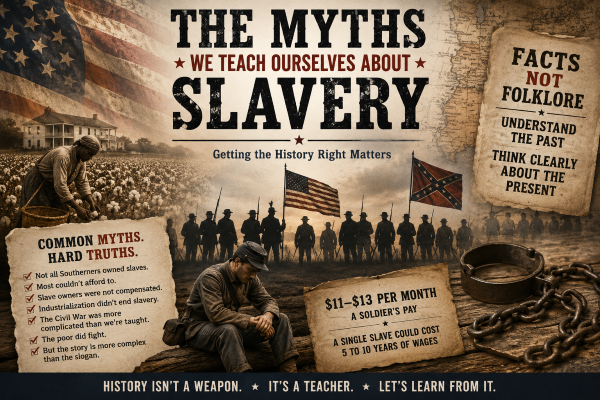
One of the most common myths is that all white Southerners owned slaves. They did not. In 1860, only about one-quarter of Southern households owned slaves. Most white Southerners were farmers, laborers, craftsmen, merchants, and soldiers who never owned a single slave. They lived in a slave society and many supported it, but they were not themselves slaveholders.
The second myth is that slave ownership was commonplace and easily attainable. It wasn’t.
A healthy field hand before the Civil War might cost $800 to $1,200. Adjusted for inflation, that’s roughly $16,000 to $24,000 today. A common soldier earned only about $11 to $13 per month. Purchasing a single slave could represent five to ten years of wages. To many ordinary Americans, slave ownership was economically out of reach.
This creates another uncomfortable question. If most Southern soldiers did not own slaves, why did they fight?
The popular modern answer is that poor men fought a rich man’s war. There is some truth in that statement. As the war dragged on, resentment grew against wealthy slaveholders who appeared insulated from some of the burdens of military service. The Confederate “Twenty Negro Law,” which allowed an exemption for one man on plantations with twenty or more slaves, became a symbol of class division. Many soldiers saw it as proof that the wealthy had influence unavailable to ordinary families.
Yet the slogan oversimplifies reality. Many wealthy men fought and died in the war. Many poor men volunteered willingly. Confederate soldiers often cited loyalty to their state, defense of their homes, community pressure, and regional identity as reasons for fighting. Human motivations are rarely as simple as the slogans that survive them.
Another myth is that slave owners were compensated after emancipation. They were not. Apart from a few limited exceptions, such as compensated emancipation in Washington, D.C., the federal government paid nothing for the loss of enslaved laborers. One of the largest concentrations of private wealth in the South disappeared almost overnight in 1865.
There is also a widespread belief that industrialization made slavery economically obsolete. In reality, the opposite occurred. The cotton gin dramatically increased the profitability of cotton production and expanded demand for slave labor. Slavery was not dying from economic irrelevance in 1860. It was profitable, politically powerful, and expanding westward.
Perhaps the most emotionally charged myth is that every slave owner was either a sadistic monster or a benevolent caretaker. The historical record supports neither extreme.
Because enslaved people represented valuable property, owners often had strong economic incentives to provide food, shelter, clothing, and medical care. Plantation records frequently tracked illnesses, births, deaths, productivity, and medical expenses with remarkable detail. At the same time, physical punishment, family separation, and the denial of basic human freedom were built into the institution itself. Some owners were relatively paternalistic. Others were brutally cruel. Most likely fell somewhere between those extremes.
The central evil of slavery was not that every owner behaved identically. The central evil was that human beings were legally classified as property at all.
Another misconception is that slavery was exclusively a Southern enterprise. Northern textile mills processed slave-grown cotton. Northern banks financed slave transactions. Northern insurers underwrote slave property. Northern shipping companies transported goods produced through slave labor. The profits flowed throughout the nation. Slavery may have been concentrated in the South, but its economic footprint stretched far beyond it.
So why do these myths endure?
Because myths are easier than history.
History forces us to wrestle with contradictions. Myths allow us to sort people neatly into heroes and villains. They provide certainty where reality provides complexity.
The danger is not simply that we misunderstand the past. The danger is that we develop a habit of thinking in myths rather than facts. Once we begin viewing history through simplistic narratives, we often start viewing current events the same way.
A mature nation should be able to condemn slavery without reservation while also discussing it honestly. Those goals are not in conflict. In fact, they depend upon one another.
The purpose of history is not to make us comfortable. It is not to make us feel righteous. It is to help us understand reality.
And reality is almost always more complicated than the stories we tell ourselves.
If you enjoyed this article, then please REPOST or SHARE with others; encourage them to follow AFNN. If you’d like to become a citizen contributor for AFNN, contact us at managingeditor@afnn.us Help keep us ad-free by donating here.
Substack: American Free News Network Substack
Truth Social: @AFNN_USA
Facebook: https://m.facebook.com/afnnusa
Telegram: https://t.me/joinchat/2_-GAzcXmIRjODNh
Twitter: https://twitter.com/AfnnUsa
GETTR: https://gettr.com/user/AFNN_USA
CloutHub: @AFNN_USA