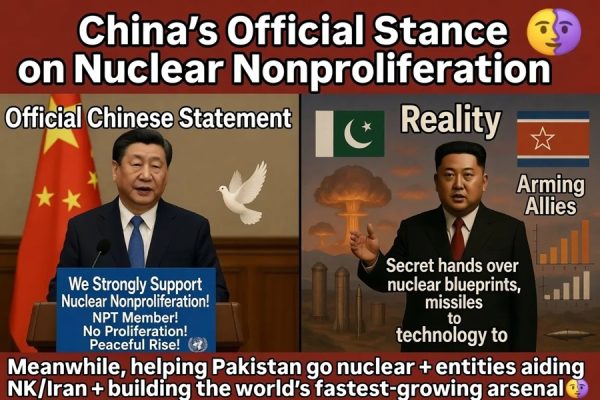
The Congressional Research Service has tracked Chinese nuclear and missile proliferation concerns across multiple decades and report iterations. The six editions examined here span from May 2021 through May 2026. Taken together, they reveal a consistent underlying pattern — Chinese government-level transfers have largely ended, but a persistent, arguably worsening problem of Chinese entity-level proliferation continues unabated — while the diplomatic and rhetorical framing around that problem has shifted considerably over time.
These transfers undermine the official Chinese position: China firmly opposes the proliferation of nuclear weapons, missiles, and related technologies/means of delivery and commits to rigorous export controls while balancing nonproliferation with the peaceful uses of dual-use technologies, especially for developing countries.
THE ENDURING HISTORICAL BASELINE
All versions of the CRS reports share an enduring historical baseline: during the 1980s and 1990s, China transferred nuclear and missile technology and assistance to Pakistan’s weapons program, cooperated with Iran, and exported missiles to Pakistan, Saudi Arabia, and Iran. This narrative consistently notes that China significantly curtailed such transfers in the 1990s, improved export controls, and made key commitments—including a 1996 pledge against assisting unsafeguarded nuclear facilities and 1997 policy changes—while maintaining the framing that progress occurred but problems persist. This structure has served as the unchanging scaffold for every subsequent edition.
FROM STATE TO ENTITY-LEVEL PROLIFERATION
Official U.S. government reports indicate that the Chinese government has apparently ended its direct involvement in the transfer of nuclear- and missile-related items, but Chinese-based companies and individuals continue to export goods relevant to those items, particularly to Iran and North Korea.
2021 – The Foundational Edition
The 2021 report introduced a key analytical qualifier about Beijing’s culpability: Former Deputy Assistant Secretary of State Vann Van Diepen told Politico in 2017 that, even if the transfers are not directly state-sponsored, “China hasn’t devoted the priority, effort, or resources to thwart” such activity, adding that “when that continues to be the case over 20 years, even when they have been criticized, over time it becomes a choice, and you have to wonder what’s going on.” This observation has been carried verbatim through every subsequent version — a remarkable editorial choice that signals CRS’s view that it remains unrebutted.
2023 — Expanding the Sanctions Record
The August 2023 update shows an expanding sanctions footprint. On June 6, 2023, the Department of the Treasury imposed sanctions on several Chinese entities for procuring items for use in Iran’s ballistic missile program. Similarly, on October 3, 2022, the U.S. government imposed sanctions on a Chinese company and a Chinese individual for transferring controlled weapons technology to Iran, North Korea, and/or Syria. On January 21, 2021, the State Department announced that it was imposing sanctions on three Chinese entities for unspecified “missile technology proliferation activities.”
The 2023 report also expanded the Pakistan reactor discussion, noting that China’s reactor construction at the Chashma site had reached five units, with the United States arguing that only the first two reactor projects are consistent with Beijing’s NSG commitments, since China and Pakistan concluded contracts for those reactors before China joined the NSG in 2004.
2024 — Escalating Sanctions, A Troubling Reporting Gap
The October 2024 update marks an important inflection point. The sanctions list grew substantially — including a September 12, 2024, State Department action sanctioning a Chinese entity for assisting Pakistan with procuring equipment used to test “large diameter rocket motors,” along with three additional China-based entities and a Chinese individual for unspecified “ballistic missile proliferation activities.”
Critically, the 2024 report noted a gap in official U.S. compliance reporting: the 2024 edition of the State Department’s arms compliance report does not address the issue of Chinese missile-related transfers — even as a separate State Department report confirmed that Chinese firms and individuals continued to supply WMD-relevant technology to programs of concern. This divergence between what different State Department reports say represents a meaningful analytical tension.
The 2024 report also added a new Treasury action: on July 24, 2024, the Treasury Department imposed sanctions on a network of China-based individuals and entities “involved in the procurement of items supporting” North Korea’s ballistic missile and space programs.
2025 — The Compliance Reporting Gap Widens, Sanctions Surge
The November 2025 update confirmed that the omission from the compliance report was not a one-time occurrence: neither the 2024 nor 2025 editions of the report address the issue of Chinese missile-related transfers — even while the 2024 and 2025 editions of a different State Department report confirmed that Chinese “firms and individuals” during 2023 and 2024 “worked to supply technology and equipment that could be used to develop weapons of mass destruction (WMD) and their missile delivery systems to programs of concern,” including programs in North Korea, Iran, and Pakistan.
New sanctions in 2025 showed intensifying activity: on March 28, 2025, the Department of Commerce announced the addition of a China-based company to the Entity List for “contributions to Pakistan’s unsafeguarded nuclear activities.”
2026 — Iran Elevated to Primary Source, Domestic Manufacturing Concern Emerges
The May 2026 update adds the most alarming new finding in the series: a State Department report stated in April 2026 that “entities in China” are Iran’s primary source for “a range of equipment, goods, and technology” used in Tehran’s ballistic missile program.
The 2026 report also documents a qualitative escalation in what Chinese entities have been doing for Iran — no longer merely exporting components, but apparently helping Iran build domestic manufacturing capacity. Treasury announced sanctions on May 14, 2025, on four Chinese individuals and six China-based entities for their “involvement in efforts to help the Iranian regime domestically source the manufacturing of critical materials needed for Tehran’s ballistic missile program.” A related April 2025 Treasury action targeted five China-based entities for “their role in a network procuring ballistic missile propellant ingredients on behalf of Iran’s Islamic Revolutionary Guard Corps.”
The 2026 report also uniquely adds a diplomatic data point: a November 2025 Chinese white paper posits “an urgent need to reinvigorate multilateral arms control” — Beijing’s public rhetoric of nonproliferation commitment continuing even as entity-level proliferation intensifies.
MAJOR TRENDS ACROSS THE REPORTS
Below are some major trends identified in the updates over the past five years.
Trend 1: The Sanctions List Has Grown Dramatically in Volume and Specificity
The 2021 report cited only one or two sanctions episodes. By the 2026 report, the sanctions list runs to at least eight discrete actions from 2022–2025 alone, with multiple actions in 2024 and 2025. This reflects either a genuine increase in Chinese entity-level proliferation activity, a more aggressive U.S. enforcement posture, or both.
Trend 2: Pakistan Has Risen Alongside Iran as a Sanctions Focus
Earlier editions focused primarily on Iran and North Korea as recipients of Chinese proliferation assistance. By 2023–2026, Pakistan emerged as an equal-priority concern — with multiple sanctions actions specifically targeting Chinese entities supplying Pakistan’s ballistic missile program, including large rocket motor testing equipment, a particularly sensitive category.
Trend 3: The Compliance Reporting Gap Is a Significant Policy Concern
The disappearance of China from the State Department’s arms compliance reports in 2024 and 2025 — even as a different State Department report simultaneously confirmed ongoing Chinese proliferation — is one of the most notable developments documented in the series. CRS flags this tension without explaining it, leaving open the question of whether it reflects diplomatic accommodation, a change in methodology, or a deliberate policy choice to reduce friction with Beijing.
Trend 4: Chinese Proliferation Activity Is Becoming More Sophisticated
The 2026 addition about helping Iran develop domestic manufacturing capability for ballistic missile materials is qualitatively different from the earlier pattern of simply exporting controlled components. If accurate, it suggests Chinese entities are helping adversaries become more self-sufficient in WMD-relevant production — a more durable and harder-to-interdict form of proliferation.
CONCLUDING THOUGHTS
There are several US national security concerns from these reports.
Strengthening adversary missile programs: China-based entities have been documented providing components to Iran’s, North Korea’s, and Pakistan’s ballistic missile programs consistently across the entire decade. The April 2026 finding that China had become Iran’s primary source of ballistic missile materials is the most direct expression yet of the operational impact on U.S. regional security interests.
Domestic manufacturing transfer: The 2025–2026 emergence of Chinese entities helping Iran develop indigenous manufacturing capability for missile propellants and critical materials is a significant escalation. As a result, U.S. and allied interdiction efforts could become less effective over time.
Nuclear reactor exports to Pakistan: The ongoing construction of Chinese reactors at Pakistan’s Chashma site — which the U.S. argues violates NSG rules — contributes to Pakistan’s broader nuclear infrastructure, in a country with an unsafeguarded weapons program.
Financial system exploitation: North Korean WMD procurement networks operating through China represent a systemic vulnerability in international sanctions enforcement, with Beijing explicitly noted as unwilling to act on U.S.-provided intelligence about these networks.
Erosion of compliance reporting transparency: The withdrawal of China from the State Department’s arms compliance reporting in 2024 and 2025, without public explanation, raises questions about whether diplomatic management of the U.S.-China relationship is coming at the cost of nonproliferation transparency before Congress.
Lastly, that Van Diepen quote about Chinese inaction amounting to a deliberate choice has been preserved verbatim across every edition. This is significant: CRS is implicitly signaling that the official U.S. assessment of Chinese intent has not improved. China’s verbose declarations of support for nonproliferation norms — also dutifully quoted in every version — are at odds with the reality of continuing Chinese proliferation actions. And actions speak louder than words.
The end.
StuinSD is a reader-supported publication. To receive new posts and support his work, consider becoming a free or paid subscriber.
This article originally appeared in Stu Cvrk’s Substack. Reprinted here with permission
If you enjoyed this article, then please REPOST or SHARE with others; encourage them to follow AFNN. If you’d like to become a citizen contributor for AFNN, contact us at managingeditor@afnn.us Help keep us ad-free by donating here.
Substack: American Free News Network Substack
Truth Social: @AFNN_USA
Facebook: https://m.facebook.com/afnnusa
Telegram: https://t.me/joinchat/2_-GAzcXmIRjODNh
Twitter: https://twitter.com/AfnnUsa
GETTR: https://gettr.com/user/AFNN_USA
CloutHub: @AFNN_USA