The globalist Wall Street Journal published a two-part series on European resentment of Trump and hence, America. It was pretty good stuff.
It was almost midnight in Brussels and the leaders of Europe were locked in their fifth hour of an emergency meeting with a single theme for discussion: how to manage a breakup with America.
The new year was only three weeks old and President Trump, after removing Venezuela’s autocratic strongman, had briefly threatened to seize Greenland from Denmark. Around a circular table in the European Council headquarters known as “The Space Egg,” heads of government were venting so emotionally about the 47th president that some of the nearly 30 leaders present would later call the session “therapy night.” There were no cameras or recordings and each of the presidents and prime ministers was told to come alone, no phones allowed, for a moment to speak candidly.
Why would removing Maduro—a narco-terrorist whom no one recognized as a legitimate president—cause such hyperventilating by our European allies?
They should be glad that Superamerica removed another threat to world peace. Instead, our friends held a five-hour therapy session.
The story said:
“We are drawing a line here,” began Emmanuel Macron, president of France, according to several leaders present and their most senior aides. For a year, America’s closest allies had tried to placate Trump with a mix of flattery and concessions on mutual-defense and trade issues, hoping to buy time. Now, French soldiers were in Greenland, alongside Danish special forces equipped for a shooting war with America. The French president repeated an argument he’d been pressing for years, with mounting urgency: that Europe’s overreliance on America was a security risk. “There is no going back,” he said.
Ah yes, Greenland.
We cannot invade Greenland because we already are there. U.S. military forces have been there longer than Denmark’s because we went in after the Danes surrendered to the Germans, exhausted from 6 hours of fighting in 1940.
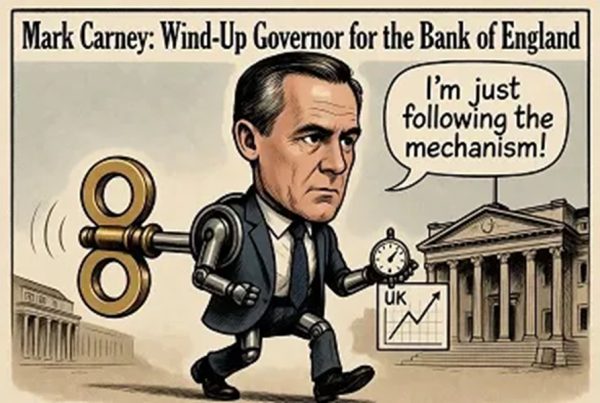
The WSJ piece propped up a former governor of the Bank of England, Mark Carney.
Several participants mentioned a man who wasn’t in the room. Mark Carney, the new Canadian prime minister, had been regularly messaging Europe’s major leaders using a British phone number from his time in London, trying to persuade them that “the old America isn’t coming back.” Now, on the heels of a blistering speech at the annual Davos gathering, his arguments were gaining ground. “Canada,” said the prime minister of Spain, “is openly saying what we should do.”
In the months to come, the January crisis meeting would be remembered by Europe’s most powerful figures as the moment that countries bound together by blood and a sense of shared destiny since the aftermath of World War II began to explore separate paths.
The Wall Street Journal series framed its narrative as a wrestling match with the heroic Carney leading Europe to rally against the evil Trump with NATO chief Mark Rutte, former prime minister of Netherlands, as the referee.
Why are they miffed?
In his first presidency, Trump pushed NATO allies to fulfill their obligation—their vow—their promise—their sacred oath to dedicate 2% of their GDPs to defending themselves.
Like Americans, Europeans, too. question why they should pay to defend Europe.
The average NATO ally was spending 1.4% of GDP on its military when he took office on January 20, 2017.
Nine years later, it is 2.3%. Rutte calls the increase in spending the Trump Trillion.
We still lead the league in both dollars and percents as we spend more than Europe on the military. Way more.
Our government also spends more on health care. Europe spends ~€1.25 trillion a year on universal health care for 420 million people.
The U.S. government spends ~€2.19 trillion on Medicaid, Medicare and other health programs. That figure includes ~€300 billion from the states for Medicaid.
The difference in medicine is the United States does not consider assisted suicide health care. Rodney Dangerfield used to joke, “I don’t get no respect. I called Suicide Prevention. They tried to talk me into it.”
That’s now policy in Canada where medically assisted suicide accounts for 5% of its deaths.
Trump wants NATO allies to increase their military spending 3.5% so he called for a 5% minimum as he opened negotiations. Europe balked. They held a meeting last June. WSJ recalled it a year later:
On June 24, Trump landed in The Hague, Rutte’s hometown, where the NATO secretary-general handed him a huge foreign-policy win. The alliance, Trump said, was no longer a rip-off for the U.S. One after the next, the West’s most powerful politicians took turns praising Trump in a closed-door session for strengthening the alliance he had threatened to leave. But Carney was more restrained—Trump would see through the praise, his aides reasoned, and think less of them for it.
Some leaders tried to lighten the mood. The Slovenian prime minister congratulated Trump for pressuring his country to raise defense spending, saying that if anybody knew how stubborn Slovenians could be, it was the husband of Melania Trump. Trump smiled at the joke. Bulgaria’s prime minister couldn’t help but notice how forced the whole performance felt.
“There was laughter in the room, but it masked deep anxiety,” said Rosen Zhelyazkov, the then-prime minister. “European leaders still clung to the belief that they could manage Donald Trump through diplomatic flattery and personal charm.”
The Wall Street Journal failed to state exactly why 29 assumed allies want to manage the president of the United States.
Part two of this epic journalism was all about praising Carney as the savior of Europe. Part two said:
As Carney took charge in early 2025, he commissioned a sensitive review that he would discuss one-on-one with his closest aides, in his office or aboard the jet officially call-signed CanForce 1: How dependent was Canada on one particular country for its data storage, military hardware, payments processing and even food?
It was Carney’s first crack at a riddle that would come to bedevil governments on both sides of the Atlantic. What to do when your closest ally turns into a threat?
His prescription in large part would lay in Europe, where Carney, a former Bank of England governor, had made his past and now saw Canada’s future. The Canadian banker who never before held elected office would emerge as an unexpected central figure in a high-stakes project to reshape the economic and military community known as the West.
Since World War II the alliance had worked like a wheel: The U.S. as the indispensable hub and the rest as spokes. Carney argued that Canada and Europe would have to build an alternative model, a “dense web of connections” that wouldn’t overly depend on any single country. His approach contrasted to that of another influential leader, NATO Secretary-General Mark Rutte, who was encouraging Europe to double down on its relationship with Trump—whatever it took to keep America from abandoning the alliance.
So the first action of the newly elect head of an ally was to cut off ties with its neighbor and top trading partner.
That tells you who is his boss. He went from Governor of the Bank of Canada to the same job at the Bank of England. That’s 14 years of running a central bank.
After his term ended, he ran for Parliament?
He did not take presidency at some private financial institution that would easily pay 10 times what he made at the bank?
Instead he ran for a seat in Parliament. Amazingly, he became prime minister just five years later. The wheels were greased. As I said, his first act was to go after the United States.
He negotiated a trade agreement with Trump and then at the last moment announced he would slap a $1.4 billion-a-year digital tax on American Internet companies.
Trump walked away. This cost Canada an $11 billion drop in exports to the USA. I don’t believe Carney cares because even for a passive-aggressive despot, governance is is all about power.
WSJ said:
The first prime minister born in Canada’s Northwest Territories, Carney was an unlikely radical, a picture of the global elite Trump campaigned against. An alumnus of Harvard, Oxford and Goldman Sachs who became the first foreigner to run the Bank of England, he kept two cellphones, even as prime minister: one Canadian and another with a British number, and list of contacts, from his time in London.
Steering the British pound after the European debt crisis delivered a lasting lesson in how a global economy engineered for efficiency had grown dangerously dependent on a single fragile point: America and its greenback. As bank governor, he proposed a “synthetic hegemonic currency” that middle-sized economies could use as a dollar alternative. The IMF’s chief economist in Washington called the idea “intriguing,” but “improbable,” saying the U.S. dollar’s strength flowed from America’s “institutions, the rule of law.”
Globalists hate the institutions and they are knocking them one by one. Tony the Beagle Beater Fauci destroyed America’s trust in public health. Boasberg and his fellow kangaroo jurists are destroying faith in the judiciary. Teachers destroyed public schools. Obama destroyed the rule of law by letting Hillary walk while coordinating a rule-busting lawfare campaign against Trump.
The Europeans are after America. Trump is just in their way. WSJ reported:
The allies began accelerating investment in space, defense, quantum computing and payments systems—to build cloud networks, data centers and defense systems that could function without U.S. technology. On nearly every count, Europe was far behind.
Elon Musk’s 10,000 Starlink satellites were handling some of Europe’s most sensitive governmental conversations, and data their weapons used in Ukraine. The EU sped up its schedule to launch several hundred European satellites for governments to communicate securely over non-American networks.
Europe was going to have to spend hundreds of billions of dollars replicating systems America traditionally supplied. Carney, in another lunch with Macron at the Élysée Palace and during a jog through London’s Hyde Park with Finland’s Stubb, was discussing how Canada could better integrate into—and augment—those systems. In February, Canada joined a new €150 billion EU defense fund and launched the Sovereign Technology Alliance with Germany, to deepen collaboration on AI security and compute capacity.
Canadian and European officials began to meet more frequently for discussions that would have once included their American counterparts. During preparations for the G-7, officials met in the French city of Toulouse in March, discussing quantum computing, food security and AI between conversations on how Canada would join Europe’s student-exchange program, Erasmus, or its song contest, Eurovision.
Ahead of it, some of Carney’s top national security officials stopped using Starlink.
France meanwhile ordered its 2.5 million civil servants to replace Microsoft Teams and Zoom with Visio, a domestically built videoconference platform. Germany, France, Luxembourg, the Netherlands, and Belgium started rolling out their own homegrown texting services—discouraging civil servants from conducting official business on Meta Platforms’ WhatsApp. German officials complained about the clunkiness of the non-American software they were now expected to use. Germany’s parliament passed an act favoring European suppliers for its defense needs.
Well, good for them. It is about time they got off their davenports and did something to defend themselves, but unless they encourage capitalists, European leaders are doomed to mediocrity.
Elon Musk found a way to recycle rockets, not NASA or the European Space Agency. The idea of minimizing costs does not enter the picture when you are on the government dole.
Not every NATO leader ids nuts. The former Warsaw Pact nations mainly stand pretty tall with Trump. And German Chancellor Friedrich Merz said at this week’s NATO Summit in Ankara:
Trump often applies pressure through a very forceful approach. The last American presidents politely asked us, “Please, finally do a little more for your own defense,” but across Europe those requests largely fell on deaf ears. Now there is an American president who says, rather bluntly, “Enough is enough.” And I cannot blame him. Just look at the numbers: the United States spends around 80% of NATO’s defense resources, while Europe accounts for only about 20%. That is unacceptable. It has always been unacceptable.
In his second presidency, Trump grabbed Europe by the eyeteeth and shook real hard. We’ll see how the wussies handle it.
You can subscribe to Don’s Daily Substack Here.
This article first appeared on Don Surber’s Substack. Reprinted here with permission.
If you enjoyed this article, then please REPOST or SHARE with others; encourage them to follow AFNN. If you’d like to become a citizen contributor for AFNN, contact us at managingeditor@afnn.us Help keep us ad-free by donating here.
Substack: American Free News Network Substack
Truth Social: @AFNN_USA
Facebook: https://m.facebook.com/afnnusa
Telegram: https://t.me/joinchat/2_-GAzcXmIRjODNh
Twitter: https://twitter.com/AfnnUsa
GETTR: https://gettr.com/user/AFNN_USA
CloutHub: @AFNN_USA