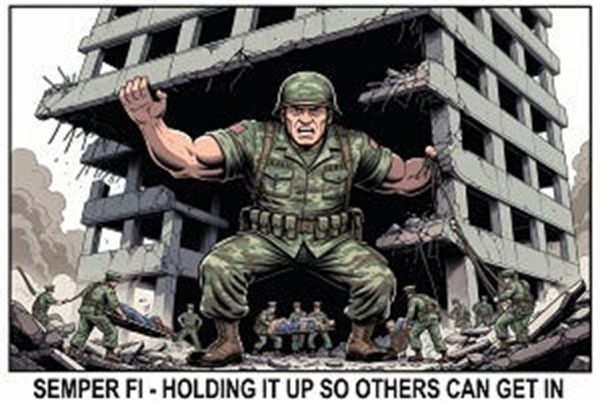
On June 24, 2026, two earthquakes hit Venezuela back-to-back. They registered 7.2 and 7.5, numbers that are pretty high on the Richter scale. The military sent in the Marines (and other branches). The State Department worked with charities such as Samaritan’s Purse, World Vision and Catholic Relief Services to avoid the confusion that occurred in the successful response to the January 12, 2010, earthquake in Haiti.
Trump put Marco Rubio in charge. He initially pledged $100 million in support. That’s since been upped to $386 million.
On July 2, the military’s Southern Command reported:
Marking the first visit by a U.S. Navy vessel to Venezuela in decades, Fort Lauderdale safely arrived pierside in La Guaira on the evening of June 28. The historic port call, executed at the direct request of the Venezuelan government, was preceded by U.S. Sailors and Marines delivering critically needed disaster relief supplies to the port via landing craft.
“Being directed at a moment’s notice to transit into Venezuela presented a vast number of unknowns, but the one absolute certainty was the unmatched professionalism and work ethic of the Fort Lauderdale team,” said Capt. Jiwan Mack, commanding officer of USS Fort Lauderdale. “We were able to safely arrive pierside and deliver immediate assistance to the Venezuelan people because of the incredible dedication of our crew.”
The presence of embarked Sailors and Marines is strictly humanitarian. As a highly capable and self-sustaining platform designed for extended expeditionary operations, Fort Lauderdale requires minimal local security, logistical support or port resources while pierside. This minimal footprint ensures that all local Venezuelan assets can remain entirely focused on domestic recovery efforts.
Beyond cargo transport, Fort Lauderdale brings advanced onboard medical facilities, heavy-lift capabilities and robust command-and-control infrastructure. Functioning as a primary coordination hub, the ship recently hosted the Venezuelan chargé d’affaires and serves as a vital communications node. This enables SOUTHCOM to work seamlessly with the State Department, interagency partners and interim Venezuelan authorities to direct rapid relief operations across the affected areas.
A month earlier, the U.S. military carried out a strike that killed the leader of Venezuelan prison gang Tren de Aragua.
In this mission, the Pentagon sent in 900 servicemen. At its peak in Haiti, the USA had 22,000 servicemen in country.
But the two events were different and lessons from Haiti were applied in Venezuela. One of the lessons was less is more when it comes to sending in military personnel. Another was better coordination with charities.
The Christian Post gave a shout out to the State Department working with various charities to get relief to the Venezuelans.
As part of the logistics strategy, the State Department announced the creation of a humanitarian air bridge to facilitate the entry of supplies into the South American country.
Amazon will provide weekly flights from Miami, Florida, to Maiquetía, Venezuela, covering the transportation costs. Cargo management and flight planning are handled by Airlink, a non-governmental organization specializing in connecting aviation with humanitarian efforts.
Once the supplies arrive in Venezuelan territory, the logistics cluster led by the World Food Program is responsible for coordinating the delivery to the organizations operating on the ground.
The operation includes the participation of the Department of War to address logistical challenges in coastal areas. The USS Fort Lauderdale is positioned off the coast of La Guaira state. Sailors and Marine Corps personnel are using amphibious and landing craft to transport supplies directly to hard-to-reach areas.
Meanwhile, the U.S. Southern Command is supporting operations at Simón Bolívar International Airport, where repairs were made to a runway to enable the arrival of humanitarian flights.
Haiti’s earthquake in 2010 killed more than 300,000 people. Estimates are 4,490 died from the earthquakes in Venezuela. The placement of an earthquake matters more than the Richter scale. Haiti’s was closer to a population center.
Also, Haiti is a shithole with no building codes. Little thought was given to the possibility of an earthquake.
Shithole is an objective assessment. It was a deadlier disaster but did at best $8.5 billion in damage. Early estimates in Venezuela are $10 billion to $37 billion because Venezuela is a land worthy of investment and building codes.
Buildings can be replaced. People cannot.
Rather than praising the administration’s efforts, the New York Times reported, “U.S. Mobilizes for Venezuela Despite Trump’s Disdain for Foreign Aid.”
Helping out a devastated nation indeed is foreign aid, but throwing billions to Democrat Party NGOs and overseas dictators is graft and corruption.
The story tried to do a gotcha, NYT got itself.
The most urgent priority after an earthquake is the deployment of search-and-rescue teams able to find survivors, who have just hours to live if trapped in rubble. The State Department has sent three such teams totaling 300 people. The teams are from Los Angeles, the Miami area and Fairfax, Va.
The size and speed of the U.S. deployment to Venezuela were on par with previous efforts, said Jeremy Konyndyk, the president of Refugees International and a director of disaster response at USAID during the Obama administration.
So ending USAID did not lead to catastrophe.
Instead, the disaster response proved that ending USAID had no effect on the world.
Well, except for the grifters going penniless.
Oh and there’s one last difference between Haiti and Venezuela. This time our Secretary of State does NOT have a fake charity to launder foreign donations in the name of earthquake relief.
You can subscribe to Don’s Daily Substack Here.
This article first appeared on Don Surber’s Substack. Reprinted here with permission.
If you enjoyed this article, then please REPOST or SHARE with others; encourage them to follow AFNN. If you’d like to become a citizen contributor for AFNN, contact us at managingeditor@afnn.us Help keep us ad-free by donating here.
Substack: American Free News Network Substack
Truth Social: @AFNN_USA
Facebook: https://m.facebook.com/afnnusa
Telegram: https://t.me/joinchat/2_-GAzcXmIRjODNh
Twitter: https://twitter.com/AfnnUsa
GETTR: https://gettr.com/user/AFNN_USA
CloutHub: @AFNN_USA