The immigration debate has become so politically charged it is difficult to discern the facts through the rhetoric. Competing influence campaigns project an image of tireless and appropriate effort on our behalf. Yet we cannot help but wonder if their efforts are on our behalf or theirs. Since past motivations speak to the veracity of current promises, we must strip away the layers of misleading rhetoric to determine the truth. A clear examination of immigration history is the solvent we need.
This is part 4 in that history. Parts 1 and 2 traced legal immigration from the 19th century through the passage of the Hart-Celler Act in 1965. Part 3 studied the origins and progression of illegal immigration up until 1960. This article examines how legal and illegal immigration policy collided spectacularly under the Johnson administration and the political response.
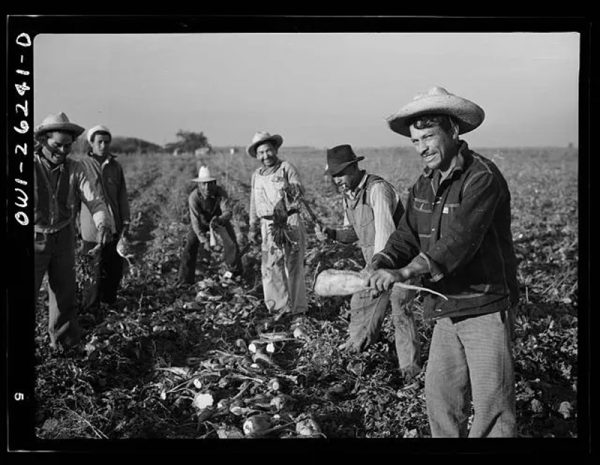
Part 3 concluded with the acknowledgement that strong southern border enforcement in combination with a hefty legal worker program worked. The enforcement part of the equation was Operation Wetback which was launched in 1954 and was largely concluded by 1956. The legal workers were supplied via the Bracero program, an arrangement between America and Mexico launched in 1942 due to labor shortages in America and unemployment in Mexico. Both programs invited valid criticism due to methodology and civil rights abuses.
The Bracero Program Under Attack
Shortcomings of the Bracero program included dangerous working conditions, substandard housing, wage theft, and lack of basic legal protections. Instead of addressing specific concerns, the entire program came under attack.
The Department of Labor Secretary under Eisenhower, James Mitchell believed the growers preferred braceros rather than recruiting domestic, higher priced labor. In July 1960, hoping to steer the growers towards domestic workers, Mitchell canceled the “specials” program within Bracero to make the program less desirable. “Specials” were specific experienced workers that growers relied on year after year. Being able to reliably recontract with trained workers helped ameliorate the notable bureaucratic shortcomings of Bracero discussed in Part 3. Cancellation of the “specials” program accomplished Mitchell’s goal – the program became significantly less desirable.
Bracero also came under attack from special interest groups who applied significant political pressure. Like their counterparts from the 1920s, they believed domestic workers would fill the growers’ labor demands if cheap Mexican labor were unavailable:
- Labor unions viewed large-scale temporary worker programs as inherently exploitative and damaging to domestic workers’ wages. Growers frequently used braceros to undermine union organizing efforts which made unionization more difficult than it already was since agricultural interests were already excluded from many New Deal labor protections.
The union position is curious since historical patterns clearly demonstrated that domestic workers would not fully satisfy the growers labor demands.
- Mexican American groups fought against Bracero due to worker exploitation, discrimination and poor working conditions. They also believed Mexican Americans competed with braceros for these jobs.
- Civil rights activists supported unionization and believed Bracero created an oppressed vulnerable underclass. James Farmer, whose voice carried immense moral weight, the founder of The Congress of Racial Equality (CORE), was particularly vocal. He framed Bracero cancellation as a racial justice issue for black workers suggesting any politician who defended the program was against the civil rights movement. The implication was that any supporters of Bracero were defenders of slavery.This position is also curious since most of the black workers were employed on cotton farms not in the farm industries of the southwest. These workers were displaced by their own migration northward into better work combined with mechanization.
Public opinion was also a factor. The CBS documentary “Harvest of Shame” aired November 25, 1960, the day after Thanksgiving. There was an immediate and massive public backlash against the growers’ exploitive treatment of the braceros.
Public outrage combined with political pressure from the unions and other special interest groups became a formidable counterbalance to the growers’ entrenched political power. Growers’ influence was evidenced by the lack of serious border enforcement and penalties for hiring illegal workers.
In October 1961 in an apparent compromise between the growers, unions and civil rights activists, Kennedy reluctantly extended the Bracero program for two years. He stated, “Studies of the operation of the Mexican labor program have clearly established that it is adversely affecting the wages, working conditions, and employment opportunities of our own agricultural workers”. Note this statement was an assumption, not something that had been demonstrably proved.
Kennedy’s 1961 extension tightened program regulations, increased bureaucratic hurdles while simultaneously raising the wages farmers were required to pay both domestic and bracero workers.
Once again, the Bracero program was made more burdensome without a corresponding increase in border protections, penalties for hiring illegal workers or acknowledgement that domestic workers would not supply the extensive demand for part time labor. This perverse incentive system had the same predictable results we examined in Part 3 after the border was regulated in 1924. Many growers reverted to long established illegal Mexican labor networks.
The End of the Bracero Program
In 1963, the Bracero program was extended for another year. It was allowed to expire on December 31, 1964 on the advice of W. Willard Wirtz, Secretary of Labor under President Johnson. Wirtz was convinced that domestic workers would fill the labor gap. His labor solution was the A-TEAM — Athletes in Temporary Employment as Agricultural Manpower. Wirtz launched a publicity blitz featuring sports celebrities with advertisements blaring “Farm Work Builds Men!”. Over 18,000 teenagers signed up but fewer than 3,300 ever made it to the farms. Most quit within the first two weeks. His failed experiment proved once again that domestic workers would not satisfy the growers’ full demand.
Less than ten months after, Johnson signed the Hart-Celler Act into law on October 3, 1965. In short, Hart Celler established annual hemispheric quotas: 170,000 visas for the Eastern hemisphere and 120,000 for the Western hemisphere. A 20,000 per country limit was imposed for the eastern hemisphere with strict preference categories heavily focused on family reunification. Country quotas and preference categories were not established for the western hemisphere initially, and green cards were issued on a first come, first serve basis. The program became operational in 1968. Its enduring legacy has been unmitigated chain migration of low-skilled immigrants. Hart-Celler had the full support of labor unions, civil rights activists and most members of both parties. For more details, please refer to Part 2.
According to the National Bureau of Economic Research (NBER) “During the 1950s, an average of 30,000 legal Mexican immigrants entered the United States each year, comprising about 12 percent of the immigrant flow”. This level was easily accommodated within the overall 120,000 quota for legal permanent residence.
What was not accommodated in Hart-Celler or any legislation after the cessation of the Bracero program was the growers’ need for high volume, part time, seasonal labor. Other than a transitional band aid (the green card commuterarrangement that allowed approximately 100,000 former braceros to obtain permanent residence while continuing seasonal work) a grower could only sponsor a worker under Hart-Celler by certifying it was full time permanent employment. It wasn’t.
A worker willing to follow crops across multiple regions could find 6-8 months of work annually. Most workers stayed in one area and worked 2-4 months per year for a specific employer’s harvest and then went back home. Bracero contracts typically ran four weeks to six months with a renewal option. The actual large volume labor needs of the growers were ignored.
The worker volume was significant. In 1956 the legal Mexican workforce entering under Bracero reached a peak of 445,000. After the modifications to Bracero and a corresponding shift towards illegal workers, the legal workforce had declined to approximately 200,000 in 1964. No reliable estimate exists for the total annual number of legal and illegal workers present when Hart Celler was debated. Whether it was 200,000 or 500,000 workers is immaterial since Hart-Celler did not create sufficient legal channels for either number.
The conventional explanation blames Hart-Celler’s Western Hemisphere quota for the surge in illegal agricultural labor. This is inaccurate. The primary problem was that Hart-Celler required full time permanent employment certification, making sponsorship structurally impossible for part-time seasonal work. More damning still, Hart-Celler included no temporary worker program despite the administration’s full knowledge that growers were already substituting illegal workers for braceros throughout the early 1960s. The Border Patrol had warned of this exact outcome in writing in 1958.
It was profoundly illogical for politicians and union lobbyists to assume the growers’ labor demand would simply vanish on December 31,1964 when Bracero was allowed to expire. The historical record and Secretary of Labor Willard Wirtz’s failed “A-Team” domestic recruitment program confirmed it was pure wishful thinking to expect domestic workers to leave steady full-time jobs for part-time, low paying, stoop farm work.
The expectation of immediate mechanization was also flawed. The tomato industry provides an interesting case study. Research began in 1942 on a mechanical harvest, a project that was viewed as a laughingstock at the time. While research progressed, it did not go into high gear until Bracero was cancelled. In 5 years, from 1963 to 1968, processing tomatoes went from mostly manual to primarily mechanical. Necessity was the mother of invention, but it is equally important to understand that invention took time and did not happen overnight with the stroke of a politician’s pen.
The logical and totally predictable result was that growers ramped up long-established Mexican labor networks regardless of legal status, a trend that had already begun. It was legal for growers to hire illegal workers, and border enforcement was lax. Rotting crops versus additional illegal workers made the choice easy. Mechanization was not yet feasible for most crops. Growers chose the easiest solution that avoided immediate financial disaster. Illegal immigration became the norm, and everyone knew it.
There were sporadic successes after cancellation of Bracero. Wages did rise and unions organized successfully in specific sectors. The United Farm Workers landmark 40% wage increase ($1.25 to $1.75 per hour) for California table grapes in 1966 is the most notable example. Some growers accelerated mechanization and in specific areas more professional crews of domestic workers formed with higher earnings and longer employment. These were actual gains, as documented in this UC Davis historical overview. The apprehension data tells us, however, that illegal labor substitution overwhelmed the localized gains within a decade and continued climbing.
Illegal Immigration Accelerants
The Bracero cancellation, strong emphasis on family reunification in Hart-Celler, unlimited immediate family green cards, birthright citizenship, expansion of welfare programs and political inaction served as effective accelerants to illegal immigration.

The above chart tells many obvious stories but there is a subtle one that requires our attention. The green circle indicates the census count for the number of Mexican born people living in the US, legal or illegal. The green triangle represents the total number of people of Mexican origin whether born in Mexico or US, legal or illegal, data the census began collecting in 1980. Both correspond to the right axis. Recall that apprehensions were used to estimate illegal crossings. For each person who was apprehended, scholarly estimates suggest 2 entered successfully.
The 1980 values, 2.2 million Mexicans born and 8.7 million of Mexican origin suggest that a notable percentage of illegal workers had settled permanently and had children during the 1960s and 1970s. People with children are not part time migratory workers who return home. The shift towards permanent settlement observed in the 1950s during Operation Wetback began trending upwards in the 1960s and 70s.
These numbers challenge the conventional storyline that Mexican migration between 1965 and 1986 was mostly circular. There is a widely cited claim, based on a 1995 study by Massey and Singer, that 86% of people who entered illegally from 1965 to 1986 returned back to Mexico. The data above suggests their study underestimated the number of those who entered illegally and decided to stay.
Johnson administration policy incentivized illegal entry and settlement. First, the Johnson administration removed the legal pathway for temporary workers. As they have done for decades, hundreds of thousands continued to enter for farm work, but now illegally. Some decided to settle and seek full time work in other industries such as construction or meatpacking. They marry and have a child who is automatically an American citizen due to birthright citizenship. This allows the family to utilize Johnson’s welfare programs. When the child reaches 21, the child can sponsor their parents via Hart Celler. An unlimited number of children can do this every year since Hart-Celler does not have a cap on immediate family visas. After the parents receive green cards, they can then sponsor their siblings via Hart-Celler’s family reunification provisions although these applications would be subject to the quota and preference system.
In summary, birthright citizenship connected illegal entry directly to the legal immigration system, converting every illegal worker who settled into an anchor for future legal chain migration. It also allowed families to avail themselves of welfare assistance. This is essentially the same system that operates today.
The welfare usage of early illegal settlers and displaced domestic workers is unclear. The data, however, is suggestive. The chart below shows the combined total enrollment for Aid to Families with Dependent Children (AFDC), Food Stamps and Medicaid. This is overstated since some families were on more than one program. Even assuming a 30% reduction, the trend is remarkable.

After Mexicans settled and became full time workers, the adage that “Americans won’t do these jobs” was no longer applicable. This is clearly demonstrated by a historical review of the meatpacking industry that changed its business model initially to avoid the unions and eventually to accommodate illegal workers. Americans were absolutely displaced, notably low-skilled black Americans. This NBER article summarizes George Borjas’s study: “The 1980-2000 immigrant influx, therefore, generally ‘explains’ about 20 to 60 percent of the decline in wages, 25 percent of the decline in employment, and about 10 percent of the rise in incarceration rates among blacks with a high school education or less.” An analysis of the meatpacking industry suggests this trend began earlier than 1980.
According to Department of Health Education and Welfare studies of AFDC recipients, Black families represented approximately 44% of AFDC caseloads from 1967 through the mid-1970s despite comprising approximately 11% of the total US population. While there are many factors that impacted black American welfare usage, the displacement that resulted from sustained high levels of immigration is likely one of them.
Perhaps the greatest accelerant of all was political inaction. Politicians knew by 1968 that results were inconsistent with stated intent. They did nothing until 1986.
Before we dive into the 1980s, Part 5 will include observations from the 1960s mosh pit and questions we should have front of mind as we continue through history.
DETAILS
Below is information for those who would like a deeper dive. Normally I include references in support of the information above. While I have done that, I have also included differing positions plus my view of same.
The earlier segments of this series provide helpful context to fully appreciate the above.
The Clash Over Immigration, Part 1
The Clash Over Immigration, Part 2
The Clash Over Immigration, Part 3
The Clash Over Immigration, Part 4 – the article above
The Clash Over Immigration, Part 5
The Clash Over Immigration, Part 6
- A more detailed examination of Bracero, its cancellation and consequences can be found in this National Foundation for American Policy paper by Stuart Anderson. It is odd that the paper’s conclusion, which is clearly supported by the data, is rarely discussed in current debates. “The evidence is clear: By providing a legal path to entry for Mexican farm workers the bracero program significantly reduced illegal entry into the United States. The end of the bracero program in 1964 and its curtailment in 1960 saw the beginning of the increases in illegal immigration that we see up to the present day.”
- It is curious how some scholarly papers report on the results of Bracero cancellation. For example, this 2006 Rural Migration News from UC Davis states Bracero cancellation led to 1) modifications to business models 2) mechanization and 3) unionization, but is silent on the most consequential result of bracero cancellation – illegal immigration which shifted from circular to permanent. It overstates the unionization, which was localized, mechanization which was only applicable to certain crops, and business model modifications which most farmers did not do because they had access to cheap illegal labor. Why does anyone ignore the elephant in the room? To solve this problem a clear-eyed view will be necessary.
- Another example is this academic examination of the Bracero program. “The Struggle to Organize Farm Workers Has Been Going on for Decades” by Jeff Schuhrke, August 30, 2022. It is misleading. One excerpt states: “Although the importation of Mexican guestworkers through the Bracero program was ostensibly meant to cover agricultural labor shortages, growers exploited the program’s decentralized enforcement mechanisms to simply replace US farmworkers (many of them Mexican Americans) with lower-paid braceros.” Emphasis mine. This article dismisses the labor gap and perpetuates the myth that the growers did not have real labor needs that domestic workers would not entirely fill at any wage. What is true is that many growers did exploit braceros which was often enabled by the decentralized enforcement mechanisms.
- “Mexican Braceros and US Farm Workers” overview of the Bracero program is a useful reference, but readers should note that its opening discussion of post-cancellation wage gains reflects short term outcomes in specific organized sectors. The article’s own concluding paragraph more accurately captures the medium and long-term consequences.
- The Kennedy quote regarding Bracero was sourced from Public Papers of the Presidents: John F. Kennedy, 1962, p. 639.
- An H-2 temporary worker visa category existed since 1952 but processed an average of only 12,000 workers annually between 1960 and 1980, less than 3% of Bracero’s volume at expiration, and was primarily used for sugar cane harvesting in Florida and apple picking on the eastern seaboard. On December 19, 1964, the Department of Labor published regulations making H-2 more expensive and burdensome than Bracero had been, ensuring most growers would not use it as a substitute. H-2 was divided into H-2A for agricultural workers and H-2B for non-agricultural workers under IRCA in 1986.
- Labor unions primary argument was that the use of braceros resulted in lower wages for Americans and cancellation of the program would remedy that situation. “Immigration Restrictions as Active Labor Market Policy: Evidence from the Mexican Bracero Exclusion” by Clemens, Lewis and Postel suggested they were wrong. They concluded that cancellation of Bracero did not result in significant increased employment or wages of domestic workers. Reasons given for this included increased mechanization and reduced output. However, this study also was silent on the shift to illegal workers and had a short window of study. Without including this reality over a longer period, the study is flawed in my opinion.
- A 1958 Border Patrol document warned that if there was “a restriction placed on the number of braceros allowed to enter the United States, we can look forward to a large increase in the number of illegal alien entrants.”
- Labor union influence was significant before, during and after this period. For more detail, consider this companion piece.

Sue Seboda is a photographer, writer, and adventurer exploring nature, travel, and the human experience. From the wild beauty of the Everglades to thoughtful reflections on our changing world, my work invites you to see, think and connect.
If you enjoyed this article, then please REPOST or SHARE with others; encourage them to follow AFNN. If you’d like to become a citizen contributor for AFNN, contact us at managingeditor@afnn.us Help keep us ad-free by donating here.
Substack: American Free News Network Substack
Truth Social: @AFNN_USA
Facebook: https://m.facebook.com/afnnusa
Telegram: https://t.me/joinchat/2_-GAzcXmIRjODNh
Twitter: https://twitter.com/AfnnUsa
GETTR: https://gettr.com/user/AFNN_USA
CloutHub: @AFNN_USA