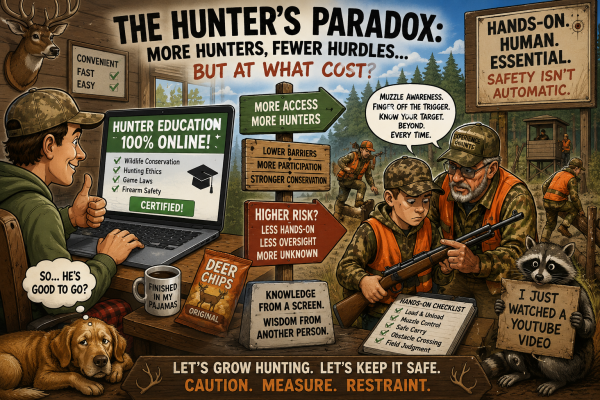
America needs more hunters.
That’s not a controversial statement. Hunters fund wildlife conservation through license fees and excise taxes. They help manage wildlife populations. They mentor young people, preserve traditions, and keep the outdoors alive. If we want hunting to flourish for another century, we need to make it accessible.
That’s where the paradox begins.
Across the country, states have lowered barriers to entry by moving hunter education online. The reasoning is understandable. Busy schedules, long drives to classes, limited instructor availability, and fewer volunteers all discourage new hunters. If someone can complete the course from their living room in an evening instead of giving up an entire Saturday, more people may buy licenses and enter the sport.
That’s a real benefit.
But firearms are not driver’s ed videos or workplace compliance modules. Hunting involves a tool capable of taking a life in an instant. There is a difference between knowing the four rules of firearm safety and demonstrating them with another human watching.
As both a Hunter Education instructor and a retired U.S. Army lieutenant colonel with 25 years of military service, I’ve spent much of my adult life teaching civilians and soldiers to safely handle firearms. Whether it was basic rifle marksmanship, military qualification, or Hunter Education, one lesson never changed: safe gun handling is a physical skill.
You cannot watch someone manipulate a firearm through a computer screen.
You cannot see whether they instinctively sweep another person with the muzzle.
You cannot correct a poor trigger finger discipline.
You cannot stop an unsafe loading procedure.
You cannot coach them across a fence, through heavy brush, or into a tree stand.
Those habits are learned through repetition, demonstration, correction, and mentorship. One human passes those skills to another. That’s how safe gun culture has always worked.
To be fair, the supporters of online hunter education make valid points. Most hunting accidents involve experienced hunters (and treestands), not first-time students. Online courses reach people who otherwise might never take a class. Rural instructors are becoming harder to recruit. Removing unnecessary barriers may help reverse decades of declining hunter participation.
Those are real concerns.
But so is this one.
If someone has never physically demonstrated safe firearm handling to another human before stepping into the woods, should we automatically assume they’re ready?
I don’t.
That doesn’t mean online education has no place. Quite the opposite. Online coursework is excellent for teaching wildlife conservation, ethics, game laws, species identification, and the science behind hunting. It may even improve knowledge retention because students can work at their own pace.
What concerns me is eliminating the practical evaluation entirely.
Imagine earning a scuba certification without ever entering the water.
Imagine receiving a driver’s license without ever operating a vehicle.
Imagine qualifying as a welder after only watching videos.
We instinctively understand why those ideas make us uncomfortable.
Firearms deserve the same respect.
Perhaps the answer isn’t choosing between old and new. Perhaps it’s combining the strengths of both. Let students complete the classroom material online. Then require a short, hands-on field session where an instructor verifies safe gun handling, muzzle awareness, loading, unloading, obstacle crossing, and judgment under realistic conditions.
Knowledge can come from a screen.
Wisdom usually comes from another person.
I sincerely hope hunter numbers grow. I want more young people outdoors. I want more families discovering hunting together. I want conservation funding to remain strong for generations to come.
But I also want every hunter I meet in the woods to have demonstrated—not merely clicked through—that they can safely carry the means of lethal force.
Sometimes the shortest path isn’t the safest one. And when it comes to firearms, caution, measure, and restraint have served hunters and the military remarkably well for generations.
If you enjoyed this article, then please REPOST or SHARE with others; encourage them to follow AFNN. If you’d like to become a citizen contributor for AFNN, contact us at managingeditor@afnn.us Help keep us ad-free by donating here.
Substack: American Free News Network Substack
Truth Social: @AFNN_USA
Facebook: https://m.facebook.com/afnnusa
Telegram: https://t.me/joinchat/2_-GAzcXmIRjODNh
Twitter: https://twitter.com/AfnnUsa
GETTR: https://gettr.com/user/AFNN_USA
CloutHub: @AFNN_USA