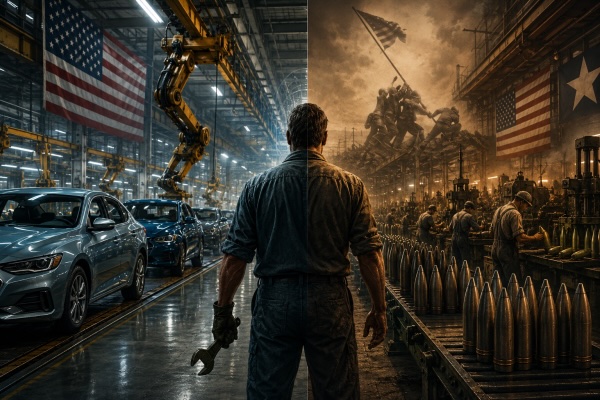
For decades we’ve been arguing over the wrong object.
The Second Amendment has been reduced to a debate over rifles, magazines, and cosmetic features—as if the Founders gathered in Philadelphia to write a constitutional amendment about barrel lengths and pistol braces. That’s like saying the First Amendment is about printing presses instead of free speech.
The Second Amendment was never fundamentally about a firearm. It was about power.
The Founders had just fought the most powerful military empire on Earth. They understood a truth modern societies conveniently forget: once the government possesses an overwhelming monopoly on force, the relationship between citizen and state changes. You are no longer a citizen with rights. You become a subject with privileges.
That distinction matters.
When the Bill of Rights was written, the average American farmer owned a musket that was remarkably similar to the one carried by a British regular. Private citizens owned cannon. Merchant ships were armed. The technological gap between government and citizen was relatively small. That wasn’t an accident. It reflected the belief that ultimate sovereignty rested with the people—not with the government.
The musket was simply the cutting-edge technology of its day.
Fast-forward nearly 250 years.
Today the argument has become trapped in a legal and political hamster wheel. One side argues over “assault weapons.” The other argues over magazine capacities. Meanwhile, the government has quietly accumulated technologies the Founders could never have imagined: artificial intelligence, autonomous drones, facial-recognition systems, satellite surveillance, electronic monitoring, cyber capabilities, and data collection on a scale that would make King George III blush.
Here’s the question almost nobody wants to ask:
If liberty depends on an informed and empowered citizenry, why should the government alone possess the technologies that increasingly define power?
The issue isn’t simply firearms anymore.
Should citizens have access to encryption as strong as the government’s? Many would argue yes, because privacy means little if only the state can keep secrets.
Should private citizens be allowed to develop advanced artificial intelligence? If AI becomes the most powerful decision-making tool in history, should only governments and trillion-dollar corporations control it?
Should civilians have access to sophisticated drones for lawful purposes? Should they possess defensive cyber tools capable of protecting themselves from digital attacks?
These questions sound futuristic, but they all revolve around the same principle.
Technology determines who holds power.
History repeatedly demonstrates that governments rarely surrender power voluntarily. Emergency authorities become permanent. Temporary surveillance becomes routine. New bureaucracies rarely disappear. Every generation is told, “Trust us. This new authority will only be used for your protection.”
Until it isn’t.
None of this means every citizen should own every conceivable weapon or technology. Constitutional rights have always existed alongside legitimate limits. Even the strongest defenders of individual liberty recognize that society has compelling interests in preventing catastrophic misuse of extraordinarily destructive technologies.
But there’s a difference between reasonable regulation and accepting the idea that citizens should become permanently dependent on the state for their security, privacy, communication, and increasingly, even their information.
A free republic cannot afford a future where government and a handful of massive corporations possess all meaningful technological power while ordinary citizens are left with yesterday’s tools and tomorrow’s restrictions.
The First Amendment protects our ability to speak.
The Fourth Amendment protects us from unreasonable searches.
The Second Amendment, viewed through its original purpose, reminds us that the people themselves—not merely their government—are sovereign.
That principle doesn’t become obsolete because technology changes. If anything, it becomes more important.
The debate of the next century may not be fought over rifles. It may be fought over artificial intelligence, quantum computing, biotechnology, autonomous systems, and technologies we haven’t even imagined yet.
If citizens are systematically denied access to every transformative technology while government agencies and corporate monopolies accumulate them without meaningful competition, constitutional rights risk becoming ceremonial. You may still have freedom of speech, but what if every platform, every algorithm, every communications network, and every powerful AI system is controlled by institutions far larger than the individual?
Freedom written on paper is one thing.
Freedom backed by independent capability is another.
The Founders understood that rights without the means to defend or exercise them are fragile. They had seen governments promise liberty while consolidating power. Their answer wasn’t blind trust in those who governed. It was a constitutional system that dispersed authority and recognized that the people themselves were the ultimate source of sovereignty.
Perhaps the greatest lesson of the Second Amendment isn’t that Americans should forever debate one particular type of firearm.
It’s that no free people should ever become technologically inferior to the government that serves them.
The day citizens no longer possess the tools necessary to preserve their own liberty is the day they cease being citizens in the fullest sense of the word.
History has another name for them.
Subjects.
If you enjoyed this article, then please REPOST or SHARE with others; encourage them to follow AFNN. If you’d like to become a citizen contributor for AFNN, contact us at managingeditor@afnn.us Help keep us ad-free by donating here.
Substack: American Free News Network Substack
Truth Social: @AFNN_USA
Facebook: https://m.facebook.com/afnnusa
Telegram: https://t.me/joinchat/2_-GAzcXmIRjODNh
Twitter: https://twitter.com/AfnnUsa
GETTR: https://gettr.com/user/AFNN_USA
CloutHub: @AFNN_USA