Every generation thinks it’s the smartest that has ever lived.
We split the atom. We landed on the moon. We carry more computing power in our pockets than NASA used to reach the moon. We can edit genes with astonishing precision, grow human tissue in laboratories, and teach artificial intelligence to perform tasks that once required years of education.
We have become masters of how.
The question is whether we’ve forgotten why.
Jesus gave an unusual warning about the last days. He didn’t compare them to Sodom. He didn’t compare them to Babylon or Rome. He said, “As it was in the days of Noah, so shall it be at the coming of the Son of Man.”
Most sermons stop there. People were eating, drinking, marrying, and carrying on with life until judgment came unexpectedly. That lesson is undeniably true.
But Jesus specifically invoked Noah, and Noah’s world wasn’t merely distracted—it was profoundly corrupt.
Genesis 6 is one of the Bible’s most mysterious chapters. Depending on one’s theological interpretation, the passage describes either angelic rebellion producing the Nephilim or a catastrophic collapse of humanity’s moral order. Faithful Christians disagree on the details, but they agree on the outcome: mankind had become so violent and corrupt that God declared the earth was filled with wickedness.
Whatever happened in Genesis 6, one thing is clear.
Humanity crossed lines it was never meant to cross.
Now fast forward several thousand years.
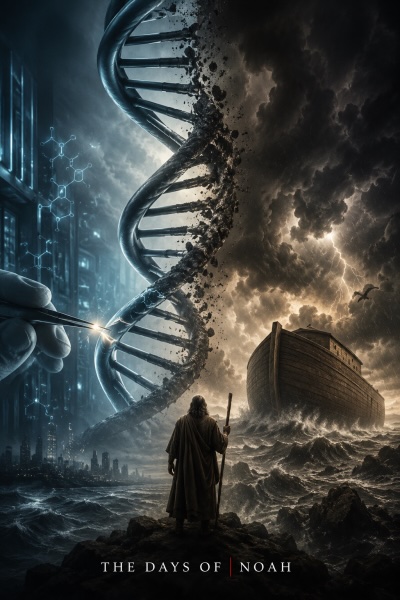
For the first time since the Tower of Babel, mankind possesses technologies capable of fundamentally altering the future of the human race itself.
CRISPR allows scientists to edit genes.
Researchers create human-animal chimeras to study disease.
Artificial intelligence accelerates genetic discovery at breathtaking speed.
Synthetic biology allows us to build life in ways previous generations could scarcely imagine.
Most of these technologies are being pursued for legitimate medical purposes. Countless researchers are sincerely trying to cure terrible diseases, and many advances have already saved lives. That deserves recognition.
But here’s the uncomfortable question.
Can we do something before we’ve decided whether we should?
That has always been humanity’s Achilles’ heel.
The first temptation in Eden wasn’t ignorance.
It was knowledge divorced from obedience.
The serpent didn’t promise Adam and Eve more compassion.
He promised them more power.
“You shall be like God.”
That temptation has never gone away.
Every civilization eventually convinces itself that because it possesses the ability to rewrite the rules, it therefore possesses the wisdom to rewrite them correctly.
History laughs at that assumption.
The twentieth century gave us antibiotics—and Auschwitz.
It gave us nuclear energy—and Hiroshima.
It gave us spaceflight—and industrialized genocide.
Scientific advancement has never guaranteed moral advancement.
Today we increasingly behave as though ethics can simply be patched in after the software update.
The Bible paints a different picture.
Wisdom must come before power.
Character must come before capability.
Otherwise, civilization becomes an eighteen-wheeler with a Ferrari engine and bicycle brakes.
This is why Jesus’ reference to the days of Noah continues to resonate.
Whether one interprets Genesis 6 as describing supernatural corruption, widespread human depravity, or both, the underlying principle remains the same.
When mankind rejects God’s design, it eventually begins redesigning everything—including itself.
That doesn’t mean every scientific breakthrough is evil.
It means every breakthrough requires humility.
Unfortunately, humility is in short supply.
Our culture increasingly treats every ethical boundary as merely another engineering problem waiting to be solved. If something can be built, someone argues it should be built. If something can be modified, someone insists it must be modified. Progress has become its own religion, complete with high priests in white lab coats and unquestioning disciples convinced that every new capability is automatically a moral victory.
The Bible offers a sobering alternative.
Power without wisdom leads to destruction.
Technology without character becomes dangerous.
Knowledge without God eventually convinces man that he no longer needs God.
That isn’t anti-science.
It’s profoundly pro-human.
The greatest danger facing civilization isn’t that we’ll invent too little.
It’s that we’ll invent faster than we mature.
Perhaps that’s why Jesus pointed back to Noah instead of forward to some futuristic dystopia.
The warning wasn’t primarily about floods.
It was about human nature.
Our tools have changed.
Our hearts have not.
Whether today’s headlines ultimately fulfill biblical prophecy is something sincere Christians continue to debate. Scripture cautions us against claiming certainty where God has not spoken plainly. But no one can deny that we are living through an age of unprecedented technological power coupled with extraordinary moral confusion.
That combination should make every thoughtful Christian pause.
Maybe the real lesson of Noah isn’t that God feared mankind’s intelligence.
It’s that mankind feared no longer needing God’s wisdom.
That’s a civilization standing on very thin ice.
And history—both biblical and secular—suggests the ice rarely holds for long.
If you enjoyed this article, then please REPOST or SHARE with others; encourage them to follow AFNN. If you’d like to become a citizen contributor for AFNN, contact us at managingeditor@afnn.us Help keep us ad-free by donating here.
Substack: American Free News Network Substack
Truth Social: @AFNN_USA
Facebook: https://m.facebook.com/afnnusa
Telegram: https://t.me/joinchat/2_-GAzcXmIRjODNh
Twitter: https://twitter.com/AfnnUsa
GETTR: https://gettr.com/user/AFNN_USA
CloutHub: @AFNN_USA