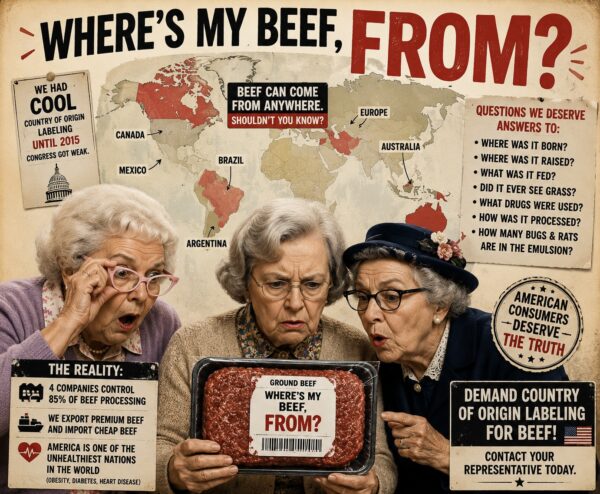
Some of us are old enough to remember the Wendy’s commercials.
Three little old ladies stared suspiciously at a hamburger bun roughly the size of a manhole cover, lifted the top and discovered a hamburger patty approximately the diameter of a quarter.
Then came the immortal question:
“Where’s the beef?”
America laughed.
Forty years later, maybe we need to bring the ladies back.
Except this time, don’t ask where the beef is.
Ask:
WHERE’S MY BEEF FROM?
Seriously.
Where did this cow come from?
Nebraska?
Texas?
Michigan?
Brazil?
Argentina?
Australia?
Was it born on a ranch?
Raised on grass?
Finished in a feedlot?
What was it fed?
What veterinary drugs were permitted where it was raised?
How was it processed?
And perhaps the most important question of all:
Why the hell aren’t we allowed to easily know?
Welcome to the American meat counter in 2026.
Pick up a package of hamburger and you’ll find calories, fat, protein, sodium, weight, cooking instructions, a sell-by date and probably enough legal fine print to refinance your house.
But the simple question—
“What country did this cow come from?”
—may not have a simple answer on the retail package.
That’s not an accident.
America actually had mandatory Country of Origin Labeling for retail beef.
Then Congress repealed it in December 2015 after Canada and Mexico successfully challenged the rules through the World Trade Organization.
Congress blinked.
The labels disappeared.
And somewhere Clara Peller should have risen from the grave, slapped a package of hamburger on the congressional lunch table and demanded:
“WHERE’S MY BEEF FROM?”
Because here’s the thing.
This isn’t some argument that all foreign beef is poisonous.
It isn’t.
USDA requires countries exporting meat to America to maintain inspection systems providing an equivalent level of public-health protection. Imported meat is subject to reinspection, and USDA conducts microbial and chemical-residue testing.
Good.
That’s exactly what government should be doing.
But “it passed inspection” and “I know what I’m buying” are two completely different statements.
I can legally buy a shirt made in Vietnam.
The tag tells me it was made in Vietnam.
I can buy a wrench made in China.
China is stamped right on it.
I can buy a German chainsaw, Japanese motorcycle, Mexican television or Italian pair of shoes.
Apparently the global economy believes country of origin is useful information right up until somebody asks:
“Where did my cow come from?”
Then suddenly we’re asking too many questions.
And maybe Americans should start asking more questions about food.
Because we’re not exactly crushing the world health rankings.
The United States spends more on health care than other wealthy countries while producing comparatively poor health outcomes. Recent international comparisons put American life expectancy below the OECD average. Roughly 42 percent of American adults have obesity, compared with about 26 percent across other high-income countries, and chronic illnesses including diabetes, hypertension and coronary disease remain widespread.
In other words, perhaps the nation washing down a double bacon cheeseburger with 64 ounces of carbonated corn syrup shouldn’t be smug about nutrition.
Maybe we should become curious.
What’s in this?
Where did it come from?
How was it raised?
How was it processed?
Those aren’t hippie questions anymore.
Those are Grandma questions.
Grandma wanted to know where the food came from because Grandpa probably knew the guy who raised it.
Today the supply chain can stretch halfway around the planet.
And we’re supposed to shrug and say:
Eh. Beef-ish.
No.
I want the Wendy’s ladies back.
Put three suspicious grandmothers in the meat aisle with reading glasses and absolutely no tolerance for corporate public-relations nonsense.
Lady Number One grabs the hamburger:
“WHERE’S MY BEEF FROM?”
Lady Number Two adjusts her glasses:
“WHAT DID YOU FEED IT?”
Lady Number Three looks toward the multinational meat conglomerate:
“DID THIS COW EVER ACTUALLY SEE GRASS?”
Now we’ve got a commercial.
Then Grandma starts reading the ingredient panel.
“Ground beef.”
Fine.
“But where was the animal born?”
Nobody knows.
“Where was it raised?”
Stop asking questions, Grandma.
“What drugs were permitted during production?”
Ma’am, you’re holding up the line.
“Was it imported?”
Security!
And eventually Grandma reaches the question every suspicious American has silently wondered while watching industrial food being pulverized into something resembling pink Play-Doh:
“How many bugs and rats are in this stuff?”
Relax, Grandma.
Ground beef isn’t legally allowed to contain a complimentary rat.
USDA standards say ground beef is beef, with or without seasoning, and it can’t contain added water, phosphates, binders or extenders. Food-safety regulations exist precisely because nobody wants Mickey Mouse becoming an involuntary ingredient in Tuesday’s tacos.
That’s the joke.
But underneath the joke is something serious.
Modern industrial food processing is enormous, complicated and increasingly disconnected from the consumer.
And America’s beef-processing industry is extraordinarily concentrated.
Four giant processors handle roughly 85 percent of fed-cattle processing.
Meanwhile America exports valuable American beef while also importing substantial quantities of lean beef and beef trimmings used in hamburger.
That’s perfectly explainable economically.
Premium American beef can command high prices overseas. Lean imported beef can be combined with fattier domestic trimmings to produce the hamburger Americans consume by the truckload.
Economists call that comparative advantage.
Grandma calls it:
“WAIT. YOU SOLD OUR GOOD BEEF OVERSEAS AND BROUGHT WHAT BACK?”
And that’s where this stops being merely funny.
Nobody needs Washington bureaucrats deciding what Americans are allowed to eat.
Nobody needs government deciding that Brazilian, Argentine, Australian, Canadian or Mexican beef is inherently bad.
And nobody needs politicians pretending every foreign cow arrives carrying a syringe full of antibiotics and a suitcase full of salmonella.
That’s nonsense.
What Americans need is much simpler.
INFORMATION.
Tell me where the animal came from.
Then I’ll decide.
If Argentine beef is cheaper and you want it?
Buy it.
If Brazilian beef tastes better to you?
Buy it.
If Australian grass-fed beef is exactly what you’re looking for?
Fantastic.
Buy two.
But if another American looks at two packages and says:
“I’ll pay another dollar for beef from an American rancher,”
he ought to have that choice too.
That’s what makes the repeal of mandatory beef COOL in 2015 so maddening.
We already had the information.
Then Washington took it away.
Not because Americans suddenly stopped caring where their food came from.
Because international trade politics became more important.
Which brings us back to Theodore Roosevelt.
Teddy went after the Beef Trust more than 120 years ago because he understood something politicians periodically forget:
Capitalism requires competition, and competition requires information.
A market where four enormous processors dominate the pipeline and the consumer can’t easily identify the origin of the product isn’t exactly Adam Smith’s village marketplace.
It’s capitalism after three bourbons and a corporate merger.
Donald Trump talks constantly about America First.
Good.
Here’s an easy one.
Bring back mandatory Country of Origin Labeling for beef.
Don’t ban foreign beef.
Label it.
Don’t demonize foreign ranchers.
Identify their product.
Don’t tell Americans what beef they’re allowed to buy.
Tell Americans what they’re buying.
That’s free-market capitalism.
Put the information on the package and get government out of the way.
And while we’re at it, enforce the antitrust laws, encourage independent American processors, reduce unnecessary barriers to small packing operations and make sure the American cattleman actually has enough competing buyers to constitute a market.
The question for 2026 is:
WHERE’S MY BEEF FROM?
And if Washington doesn’t think Americans deserve to know the answer, call your representative and senators and ask them why.
Then tell them:
RESTORE COUNTRY OF ORIGIN LABELING FOR BEEF.
We’re adults.
Give us the information.
We’ll decide what goes on the grill.
_________________________________
If you enjoyed this article, then please REPOST or SHARE with others; encourage them to follow AFNN. If you’d like to become a citizen contributor for AFNN, contact us at managingeditor@afnn.us Help keep us ad-free by donating here.
_________________________________
Substack: American Free News Network Substack
Truth Social: @AFNN_USA
Facebook: https://m.facebook.com/afnnusa
Telegram: https://t.me/joinchat/2_-GAzcXmIRjODNh
Twitter: https://twitter.com/AfnnUsa
GETTR: https://gettr.com/user/AFNN_USA
CloutHub: @AFNN_USA