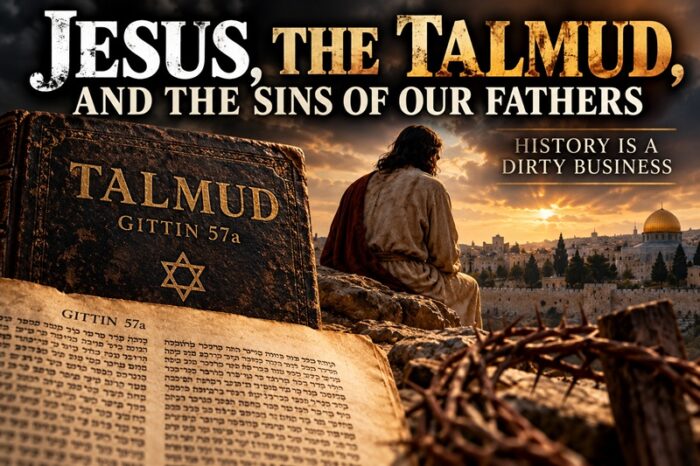
The truth about an ancient religious text, inherited prejudices, and mankind’s remarkable talent for self-righteousness.
I’ve spent a lifetime studying history, warfare, politics, and religion. I’ve watched governments manufacture narratives, politicians rewrite history, and otherwise intelligent people swallow propaganda like it’s communion wine.
Yet somehow, after decades of studying Christianity, I stumbled across something this week that genuinely surprised me.
The Babylonian Talmud contains a passage describing Jesus Christ being punished in the afterlife in boiling excrement.
Yes. Boiling excrement.
Apparently, theological disagreements weren’t always settled with coffee, doughnuts, and a friendly discussion after Sunday service.
And before the internet fact-checking brigade starts hyperventilating, the passage is real. It’s found in Gittin 57a, available through the Jewish textual library Sefaria.
But before anybody grabs a pitchfork, there’s a much bigger lesson here.
History is a dirty business. And we’re all remarkably good at pretending our ancestors smelled like roses.
The Babylonian Talmud is an enormous collection of Jewish religious law, commentary, debate, and storytelling. Its development stretched across centuries, with much of its material compiled between approximately AD 200 and 500 and further editing afterward.
This wasn’t written by someone interviewing witnesses outside the empty tomb.
It emerged centuries after Christ, when Christianity and rabbinic Judaism had developed profoundly different understandings of God, salvation, and the Messiah.
In Gittin 57a, a character named Onkelos summons spirits from the dead. One figure, identified as Jesus the Nazarene in a widely used translation, describes his punishment as boiling excrement.
The stated reason? Mocking the words of the sages.
That’s quite a theological disagreement.
However, the same narrative also portrays Jesus advising Onkelos to seek the welfare of the Jewish people. Scholars debate aspects of the identification and transmission of these traditions, and the Talmud contains many competing arguments rather than one universally binding declaration.
Context matters. Even when it ruins a perfectly good outrage campaign.
For Christians, Jesus is the resurrected Son of God. For Judaism, Jesus is not the promised Messiah. That’s a fundamental theological disagreement, not a minor misunderstanding that can be resolved by changing the church bulletin.
But here’s where modern humanity demonstrates its astonishing ability to miss the point.
Some people discover this passage and immediately conclude that modern Jews must answer for something written fifteen centuries ago.
Really?
Are we now holding every living person responsible for every offensive thing their ancestors believed?
Because if that’s the standard, Christianity has some explaining to do.
Crusades. Religious persecutions. Forced conversions. Christians killing other Christians over theological differences that would leave most modern churchgoers scratching their heads.
And let’s not pretend American history was assembled by a committee of Sunday school teachers.
Our ancestors conquered territory, displaced populations, fought brutal wars, and built a nation through a mixture of extraordinary courage, genuine ideals, political ambition, and occasionally breathtaking cruelty.
That’s history.
War has always been an extension of politics. Religion has frequently supplied the banners, and human ambition has supplied the bodies.
Yet modern Americans love climbing onto their moral high horses and condemning people who lived centuries before them.
We judge the past using today’s moral vocabulary while conveniently forgetting that future generations may find our own behavior equally barbaric.
Perhaps they should.
But understanding history is not the same as apologizing for it.
Ezekiel 18:20 tells us:
“The son shall not bear the iniquity of the father, neither shall the father bear the iniquity of the son.”
That’s a rather inconvenient verse for anyone demanding hereditary guilt.
We are responsible for our own actions, not every sin committed by somebody who happened to share our ancestry, nationality, or religion.
And we shouldn’t remain prisoners of inherited ideas merely because generations before us accepted them.
Paul offered another useful instruction in 1 Thessalonians 5:21:
“Prove all things; hold fast that which is good.”
Notice he didn’t say, “Believe everything your tribe tells you.”
He said test it.
That includes religious traditions, political narratives, historical interpretations, and our own comfortable assumptions.
Then there’s Ecclesiastes 7:16:
“Be not righteous over much; neither make thyself over wise: why shouldest thou destroy thyself?”
A biblical warning against excessive self-righteousness.
Imagine that.
Perhaps the greatest danger isn’t discovering that ancient people held offensive beliefs. It’s becoming so convinced of our own moral superiority that we stop examining ourselves.
Jesus addressed that problem rather directly in Matthew 7:3, asking why we notice the speck in our brother’s eye while ignoring the beam in our own.
Two thousand years later, mankind is still running around with lumber sticking out of its face, lecturing everybody else about sawdust.
So what should Christians conclude from Gittin 57a?
First, read it. Understand it. Recognize the profound theological divide between Christianity and Judaism.
Second, recognize that an ancient rabbinic narrative doesn’t establish what every Jewish person believes today, any more than the medieval Crusades define every modern Christian.
Third, stop confusing historical understanding with inherited guilt.
We don’t need to apologize for the sins of our fathers. We need to learn enough from them to avoid repeating their stupidity.
And perhaps most importantly, we should abandon the comfortable fantasy that human civilization has somehow evolved beyond tribalism, cruelty, and religious arrogance.
We’ve simply upgraded the technology.
Rome had the Colosseum. We have algorithms.
Our ancestors burned heretics. We destroy reputations online.
They fought over religious authority. We fight over political identities with nearly identical religious enthusiasm.
Different costumes. Same fallen humanity.
The Talmud passage surprised me. But the more important discovery wasn’t what an ancient rabbinic writer thought about Jesus.
It was another reminder of how little we know, how much we assume, and how quickly righteous indignation becomes its own form of blindness.
History isn’t a morality play where our tribe always gets to be the hero.
It’s the record of fallen human beings doing what fallen human beings have always done.
And if we really believe we’re better than our ancestors, perhaps we should start by demonstrating a little humility.
That would be a refreshing historical development.
If you enjoyed this article, then please REPOST or SHARE with others; encourage them to follow AFNN. If you’d like to become a citizen contributor for AFNN, contact us at managingeditor@afnn.us Help keep us ad-free by donating here.
Substack: American Free News Network Substack
Truth Social: @AFNN_USA
Facebook: https://m.facebook.com/afnnusa
Telegram: https://t.me/joinchat/2_-GAzcXmIRjODNh
Twitter: https://twitter.com/AfnnUsa
GETTR: https://gettr.com/user/AFNN_USA
CloutHub: @AFNN_USA