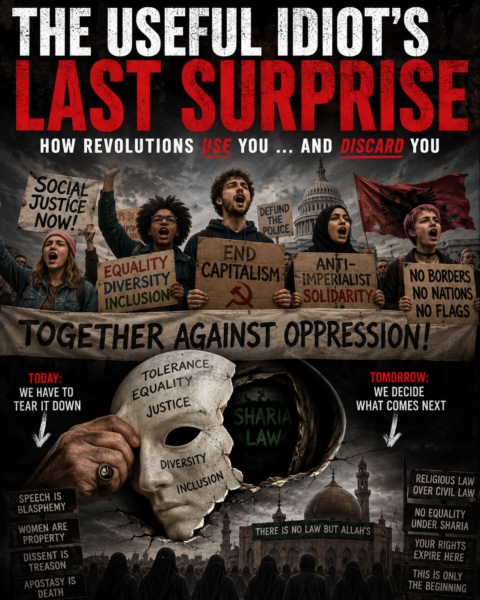
The most dangerous political movement isn’t necessarily the one standing across the street screaming that it wants to destroy you. At least that guy is honest.
The dangerous one is standing beside you.
He carries your sign. He chants your slogan. He hates the people you hate. He tells you capitalism is corrupt, traditional institutions are oppressive, Western civilization is guilty, and the old order must be torn down.
You look over and think, Hey, this guy gets it.
Congratulations. You may have just met your replacement.
Americans who know the Iranian Revolution only from grainy footage of Ayatollah Khomeini, blindfolded American hostages and angry crowds have missed the most useful part of the story. Iran did not simply wake up one morning in 1979 and decide, “You know what would really brighten up the place? A theocracy.”
The revolution was messy. Liberals, nationalists, Marxists, communists, Islamists, students and assorted revolutionaries opposed the Shah for different reasons. A contemporary U.S. government assessment described the first stage as a “broad and very large anti-Shah coalition.”
They didn’t agree about the destination.
They agreed about what they wanted destroyed.
That distinction should scare the hell out of anyone who studies political revolutions.
Consider Iran’s Tudeh Party, the country’s major communist organization. In January 1979, just before the Shah fell, its leadership formally declared support for both the revolution and Khomeini. After the revolution, Tudeh went even further, adopting what Encyclopaedia Iranica describes as an almost unconditional policy of support for the new Islamic Republic because the communists considered it revolutionary and anti-imperialist. They supported the new constitution. They cooperated with the new government. At one point the party even encouraged its members to report information about opponents of the regime to the authorities.
Read that again.
Communists were helping an emerging Islamic government identify its enemies.
You couldn’t write better political satire.
Apparently the Tudeh leadership believed it was playing three-dimensional revolutionary chess. Iranica says its leaders hoped to infiltrate civilian and military institutions and ultimately position themselves to seize power.
Everybody thought somebody else was the useful idiot.
Then came the punchline.
The Islamic Republic consolidated power, and in 1983 Tudeh’s leadership was arrested. The party was suppressed.
Thanks for your assistance, comrades. We’ll take it from here.
That is what makes Iran worth studying today. Not because 2026 America is Iran in 1979. It isn’t. Not because every Muslim secretly wants Sharia government. They don’t. Not because every Democrat is a Marxist. That’s obviously nonsense.
Iran matters because it demonstrates something much more universal and therefore much more dangerous: political movements with completely incompatible end states can cooperate extremely effectively when they share an enemy.
And America should recognize that phenomenon.
Look at the strange ideological marriage developing on parts of the American left.
Democratic socialists march beside muslim religious conservatives from cultures whose views on sexuality would horrify them. Secular progressives defend movements containing religious factions that would reject much of secular progressivism. Anti-capitalists, DEI activists, LGBTQ activists, revolutionary socialists and Islamist activists can sometimes occupy the same protest coalition because they share vocabulary about oppression, colonialism, imperialism and Western power.
Everyone is smiling for the group photograph.
I want to see the photograph ten years after the revolution.
That’s when things get interesting.
Ask the socialist and the Islamist what the economy should look like.
Ask the feminist and the religious traditionalist what constitutes women’s liberation.
Ask the LGBTQ activist and the theological conservative to jointly write the country’s sexual morality laws.
Ask the atheist Marxist and the religious revolutionary whether God gets a vote.
Ask whether religious law or civil law gets the final word.
Ask whether blasphemy is protected speech.
Ask whether someone may leave the faith.
Ask whether religious doctrine can overrule an elected legislature.
Suddenly the solidarity march gets considerably quieter.
That is the bait-and-switch Americans ought to understand.
The bait isn’t Islam.
The bait is the common enemy.
The switch comes when victory forces everyone to reveal what they actually wanted.
Iran even had a comparatively moderate government immediately after the revolution. Prime Minister Mehdi Bazargan and other liberals occupied important positions in the official government. Meanwhile, revolutionary committees, the Revolutionary Guards and other organizations were developing a parallel structure of power. Iranica describes this period as a brief “revolutionary honeymoon.”
Honeymoons are wonderful.
Then somebody gets the credit-card bill.
By August 1979, Khomeini had banned twenty-one newspapers belonging to liberal-nationalist and secular-leftist groups that criticized elements of the proposed constitution. The fundamental argument was becoming unmistakable: Would Iran be governed ultimately through popular sovereignty, or would supreme authority belong to the Islamic jurist?
There was your end state.
The constitution eventually institutionalized velayat-e faqih, the guardianship of the Islamic jurist, placing clerical authority above ordinary republican government. The original constitutional proposal had been considerably less theocratic; the Assembly of Experts transformed it.
The people who thought they were merely overthrowing the Shah discovered that overthrowing something and replacing it are two entirely different military operations.
That is where I look at today’s America and become uncomfortable.
We have spent years teaching young Americans to view much of their civilization primarily through the language of oppressor and oppressed. DEI ideology frequently sorts society through identity categories. Woke politics can turn disagreement into moral guilt. Democratic socialism increasingly presents capitalism not merely as an economic system requiring reform but, in its harder versions, as an inherently exploitative structure.
Those ideas did not originate with Islamism, and they do not automatically lead to it.
But they can provide common political language for people whose ultimate objectives are radically different.
That’s the part everyone should understand.
An Islamist doesn’t need a socialist to become an Islamist.
He only needs him to remain useful long enough.
Likewise, the socialist may believe the Islamist is useful to him. The progressive may believe both will eventually assimilate into liberal democracy. Everyone thinks he is driving the bus.
History occasionally reveals that nobody bothered checking who owned the bus.
An American Muslim who believes the Constitution is the supreme civil law, supports freedom of religion, accepts the right to leave or criticize a religion, believes elected government derives authority from the people, and accepts equal citizenship is defending the same constitutional ground I am.
An Islamist—meaning someone seeking political supremacy for religious law over those constitutional principles—isn’t.
That’s the line.
And Americans should have enough confidence in their civilization to draw it.
The First Amendment protects Islam precisely because it protects Christianity, Judaism, atheism and every other belief. It also protects my right to criticize Islam, Christianity, Marxism, DEI, socialism, capitalism and the government itself.
That isn’t intolerance.
That’s the deal.
The mistake Iran’s revolutionaries made wasn’t simply trusting Muslims, Marxists or liberals. It was believing that shared enemies meant shared principles.
They don’t.
America’s radical left should understand this better than anyone. The Iranian communists were not political amateurs. They had theory. They had organization. They had revolutionary credentials. They understood Marx and Lenin. They believed they were manipulating circumstances toward their own eventual seizure of power.
And they still got played.
That is the historical warning worth shouting from the rooftops.
Before joining someone’s revolution, don’t merely ask what he wants destroyed.
Ask what he intends to build afterward.
Ask what happens to you when you disagree.
Ask who writes the constitution.
Ask who controls the courts.
Ask whether elections can remove the new rulers.
Ask whether your rights remain rights when you become unpopular.
And above all, ask whether the freedoms you’re using to help your revolutionary partner obtain power will still exist once he has it.
Iran answered those questions 47 years ago.
Some of the people who helped make the revolution apparently didn’t like the answers.
Unfortunately, by then the revolution no longer needed them.
That’s the problem with being a useful idiot.
You usually don’t discover which word describes you until you’re no longer useful.
_________________________________
If you enjoyed this article, then please REPOST or SHARE with others; encourage them to follow AFNN. If you’d like to become a citizen contributor for AFNN, contact us at managingeditor@afnn.us Help keep us ad-free by donating here.
_________________________________
Substack: American Free News Network Substack
Truth Social: @AFNN_USA
Facebook: https://m.facebook.com/afnnusa
Telegram: https://t.me/joinchat/2_-GAzcXmIRjODNh
Twitter: https://twitter.com/AfnnUsa
GETTR: https://gettr.com/user/AFNN_USA
CloutHub: @AFNN_USA