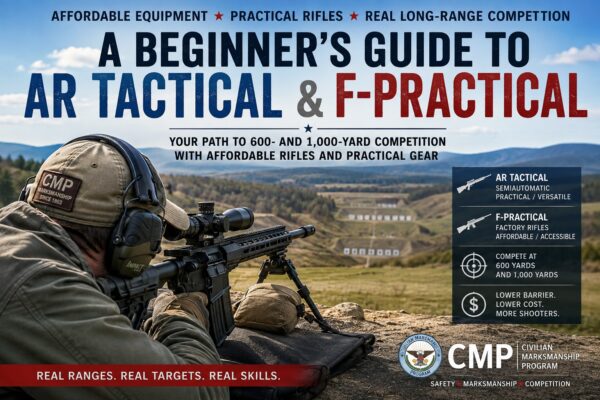
Welcome to Long-Range Shooting Without Taking Out a Second Mortgage
For decades, one of the biggest problems facing competitive rifle shooting has been remarkably simple: the equipment can scare people away before they ever fire their first shot.
Walk down the firing line at a serious long-range match and you may see custom actions, hand-fitted barrels, elaborate rests, high-magnification optics and rifles that look like they were designed jointly by NASA and a Formula One engineering team. They’re wonderful pieces of equipment, but to somebody standing behind the firing line wondering how to get started, the immediate reaction can be: *I can’t afford this.*
The Civilian Marksmanship Program is trying something different.
Two relatively new categories—AR Tactical and F-Practical—are creating a much easier doorway into CMP Mid-Range and Long-Range competition. The idea is refreshingly simple: bring a reasonably priced rifle that resembles something you might already own, put a sensible optic on it, shoot it from a bipod or practical support, and come see what you can do at 600 and 1,000 yards.
No shooting coat. No sling gymnastics. No $5,000 front rest with enough adjustment knobs to land the space shuttle.
Just you, a rifle, ammunition, wind and a target a surprisingly long way away.
What Is AR Tactical?
AR Tactical is essentially CMP’s practical long-range category for the AR-platform rifle.
Under the 2026 CMP Highpower Rifle Rules, the rifle must be an AR-type rifle chambered for a cartridge with a bullet diameter between 5.56mm/.223 and 7.62mm/.308. Maximum barrel length is 22 inches, maximum rifle weight is 14 pounds, including sights, sling if used and bipod, and minimum trigger pull is 4.5 pounds.
Optics are allowed, but magnification is limited to 16X. A variable-power scope can be used as long as it is set—and when necessary taped—at 16X or below.
The rifle may use a conventional folding bipod, but here’s where the “tactical” part becomes especially interesting: CMP also permits a field-expedient front rest such as a backpack or range bag. A simple rear bag is permitted as well.
In other words, you don’t necessarily need an elaborate benchrest system. Your rifle, scope, ammunition, bipod or pack and rear bag can get you onto the firing line.
There are additional technical requirements concerning stocks, grips and buttplates, and competitors should always read the current CMP rulebook before buying or modifying equipment. Muzzle brakes and compensators are prohibited, while suppressors are permitted under the current rule.
The important part for the beginner is this:
You may already own most of what you need.
A decent AR-15 with a suitable barrel and optic can potentially become a 600-yard competition rifle. An AR-10-type rifle can play too. You don’t have to commission a gunsmith to build something from a billet of unobtainium before you’re allowed to participate.
What Is F-Practical?
If AR Tactical asks, “What can we do with the AR you already own?” F-Practical asks an equally important question:
What can we do with the factory bolt rifle you already own?
F-Practical is new for 2026, and CMP specifically says the category is intended to provide an affordable and accessible F-Class option using readily available factory-production rifles and equipment.
That philosophy is built directly into the rules.
The rifle must be a factory-production rifle that is or has been a cataloged rifle readily available to the public. It can be a manually operated magazine-fed repeater or single-shot rifle. Cartridges may not exceed .30 caliber, and magnum cartridges aren’t permitted.
Again, maximum rifle weight is 14 pounds and optical magnification is limited to 16X. The minimum trigger pull is 2 pounds.
Most importantly, CMP has placed an equipment-cost ceiling on the category. The combined current manufacturer’s suggested retail price of the rifle, scope and bipod cannot exceed $3,000.
That rule may be one of the most important developments in competitive long-range shooting.
The equipment race hasn’t disappeared from shooting sports, but CMP has essentially put up a fence and said: Not in this category.
F-Practical is supposed to be about what a shooter can accomplish with equipment ordinary people can realistically purchase.
Think Ruger Precision Rifle, Savage, Tikka, Bergara and similar factory-production precision rifles rather than a custom-built F-Class machine costing as much as a used pickup truck. Always check a specific rifle and configuration against the current rules, but that’s the neighborhood CMP is trying to create.
So What Do We Actually Shoot?
This is where things become fun.
CMP Mid-Range competition includes 600-yard shooting, while Long-Range competition stretches to 1,000 yards.
A common Mid-Range format is the 3×600: three strings of 20 record shots, all fired at 600 yards. CMP’s Talladega program, for example, fires exactly that format on electronic targets.
At the 2026 National Matches, CMP’s Mid-Range 3×600 consists of three 20-shot slow-fire strings at 600 yards. The Long-Range program includes individual 20-shot matches at 1,000 yards, along with Palma-style shooting at 800, 900 and 1,000 yards.
And AR Tactical and F-Practical competitors are standing on the same ranges participating in that world of competition.
That’s the beauty of this concept.
You aren’t shooting a watered-down 100-yard imitation of long-range competition.
You’re shooting long range.
Six hundred yards is six football fields.
One thousand yards is ten.
The wind doesn’t care how much your rifle cost.
What Does a Beginner Actually Need?
Surprisingly little.
You need a legal rifle, a legal optic, appropriate ammunition, a bipod or other permitted support depending upon your category, a rear bag, eye and hearing protection and the normal miscellaneous range equipment necessary to keep yourself comfortable.
You’ll also want some method of keeping track of your scope settings and ammunition performance.
But don’t make the classic beginner’s mistake of believing you need to purchase everything you’ve ever seen on somebody else’s firing point.
Start simple.
Get the rifle shooting reliably. Establish a good 100-yard zero. Determine your elevation adjustment to 600 yards (most rifles it’s approximately 13-15 inches above your 100 yard impact). Learn how your scope works. Learn how many minutes or mils you need to reach the target. Then start learning the hardest piece of equipment in long-range shooting:
the atmosphere.
At 600 yards, wind becomes important.
At 1,000 yards, wind becomes your new supervisor.
And your supervisor is frequently drunk.
That is where the real competition begins.
AR Tactical or F-Practical?
The choice is fairly straightforward.
If you enjoy AR-platform rifles and want to compete with a semiautomatic rifle, AR Tactical is probably your game.
If you own or prefer a factory bolt-action precision rifle and like shooting prone from a bipod and rear bag, F-Practical may be one of the easiest pathways into serious long-range competition CMP has ever created.
Neither category means “beginner” in the sense that the shooting is easy.
It isn’t.
A 10-mph wind does not check your classification card before moving your bullet.
These categories simply mean that the financial barrier to discovering whether you’re good at it has been dramatically reduced.
That’s an important distinction.
Don’t Be Intimidated by Your First Match
This may actually be the most important advice in this entire guide.
You are probably going to show up and see people with better rifles, better ammunition, better wind-reading skills and decades more experience.
Good.
That’s exactly where you want to be.
Competitive shooters are an enormous source of free information. Tell the person next to you that this is your first 600-yard match and there’s a good chance you’ll receive more advice than you know what to do with.
Ask questions.
Tell the match director you’re new.
Don’t pretend you understand a range command if you don’t.
And don’t worry about winning.
Your first objective is considerably simpler:
Get all your shots safely onto YOUR target and finish the match.
Then come back.
The second time, things won’t seem nearly as complicated.
Soon you’ll start worrying about elevation.
Then wind calls.
Then X-count.
Then ammunition.
Then chronograph data.
Then standard deviations.
Then bullet seating depth.
And eventually you’ll find yourself at midnight weighing powder charges while wondering how the inexpensive beginner sport somehow turned you into an amateur atmospheric physicist.
Welcome to competitive shooting.
Why These Events Matter
Competitive shooting has spent too many years unintentionally convincing prospective competitors that they need specialized equipment before they’re allowed through the front door.
AR Tactical and F-Practical turn that equation around.
Come shoot first. Upgrade later if you want to.
CMP’s 2026 National Matches demonstrate just how seriously the organization is taking these categories. AR Tactical and F-Practical are included alongside Match Rifle, Service Rifle, Palma, F-Open and F-T/R in CMP Mid-Range and Long-Range competition.
These aren’t sideshows.
They’re another road onto the same firing line.
And that may be exactly what competitive rifle shooting needs.
The guy with a factory precision rifle in his gun safe shouldn’t have to spend $7,000 before discovering that he loves shooting at 600 yards. The woman with an accurate AR shouldn’t have to buy a leather shooting coat and learn traditional sling positions before she’s allowed to see what she can do at distance.
Give them a firing point.
Give them an electronic target.
Give them 600 yards.
Then give them 1,000.
The rest tends to take care of itself.
Because the first time you watch a shot leave your rifle and then see a 10 or X appear on an electronic target 1,000 yards away, something unfortunate happens.
You’re probably coming back.
And that’s exactly the point.
If you enjoyed this article, then please REPOST or SHARE with others; encourage them to follow AFNN. If you’d like to become a citizen contributor for AFNN, contact us at managingeditor@afnn.us Help keep us ad-free by donating here.
Substack: American Free News Network Substack
Truth Social: @AFNN_USA
Facebook: https://m.facebook.com/afnnusa
Telegram: https://t.me/joinchat/2_-GAzcXmIRjODNh
Twitter: https://twitter.com/AfnnUsa
GETTR: https://gettr.com/user/AFNN_USA
CloutHub: @AFNN_USA