Teddy Roosevelt Built a Nation of Riflemen. Then Democrats Tried to Kill It.

Theodore Roosevelt believed America was stronger when ordinary citizens knew how to shoot. For nearly a century, the federal government agreed—supporting the DCM, the National Matches, and even helping selected junior riflemen travel to Camp Perry to represent their states. Then came the 1990s, when Washington decided a program designed to create disciplined American marksmen was something that needed to be “terminated.” They killed the old DCM, but they failed to kill American marksmanship. The CMP survived—and the riflemen kept shooting.

I’m sorry Honey, this M14 followed me home! Can I keep it?

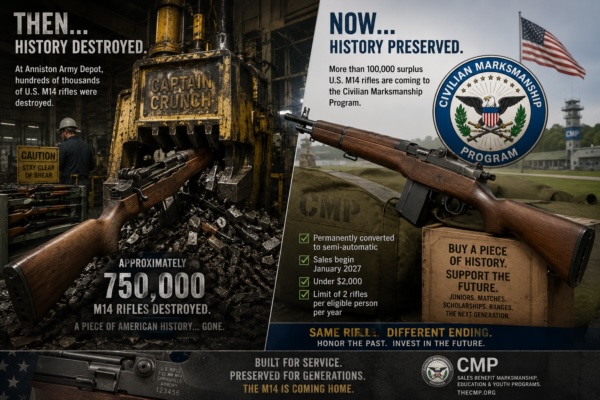
Nearly 750,000 U.S. M14 rifles were destroyed after the Cold War, many meeting their end at Anniston Army Depot in the jaws of a hydraulic shear known as “Captain Crunch.” Now, history is taking a different path. Beginning in January 2027, the CMP expects to offer permanently converted semi-automatic M14s to qualified Americans for under $2,000. Every rifle sold preserves a piece of American military history while helping fund junior shooting programs, Camp Perry, scholarships, and the future of competitive marksmanship. Sometimes, the best way to honor history isn’t to put it in a museum—it’s to put it back on the firing line.

The Day the Military Stopped Believing in Marksmanship

In 1956, the Army created the U.S. Army Marksmanship Unit. In 1958, General Curtis LeMay established the Air Force Marksmanship School and pushed competitive shooting across the service because America’s military leaders believed one simple truth: a warrior should master his weapon. Today, many of the skeet fields, rifle ranges, and MWR shooting facilities that once flourished on military bases have disappeared. We call it modernization. Previous generations might have called it forgetting the purpose of a military in the first place.

The Older You Get, the Better You Might Shoot

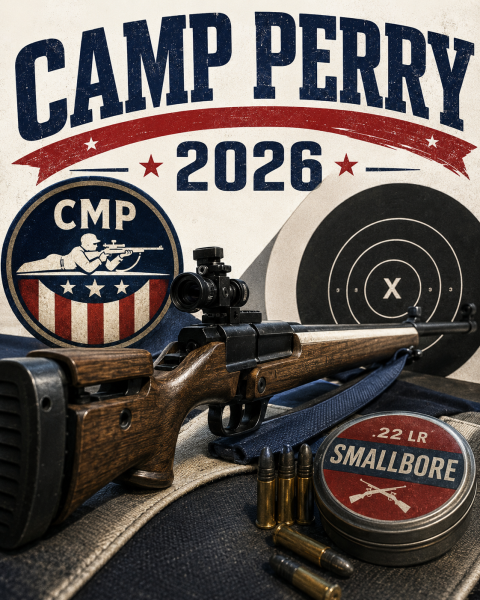
Most sports belong to the young. Smallbore prone is different. At Camp Perry this July, competitors will fire 640 record shots over four grueling days, plus a practice day and a team championship, all while trying to keep every bullet in a tiny X-ring at 50 and 100 yards. The winner won’t necessarily be the strongest or the fastest—it will be the one who can stay mentally sharp after nearly a week of relentless precision. In one of America’s oldest sports, experience isn’t a handicap. It just might be the greatest competitive advantage of all.

The Great CMP/NRA Shooting Divorce: Why It’s Time to Reunite for the Sport’s Survival

We, the competitors, spectators, and lifelong fans of marksmanship, have already voted—with our feet, our wallets, and our participation. We want a future with meaningful national championships, access to historic national trophies, and a legitimate path to international teams like the Palma, Dewar, Pershing, and Roberts.