If Colonel Townsend Whelen Had an iPhone

Colonel Townsend Whelen spent a lifetime proving that only accurate rifles are interesting. But imagine handing him an iPhone and asking ChatGPT for a 6.5 Creedmoor load. After staring at it for thirty seconds, he’d probably ask, “What the hell is Wi-Fi?” Then he’d type, “Best accuracy load. 140 Berger. H4350. Go.” After 41 years behind a rifle, I did exactly that—and one of the best first-round load developments of my career popped out. Luck? Maybe. Or maybe AI just read a hundred years of load manuals, match reports, and internet arguments in about half a second. Either way, it didn’t pull the trigger. It just saved a little barrel life. And these days, that’s worth its weight in powder.

Compulsive Precision Disorder: Why Long-Range Shooters Are Not Normal

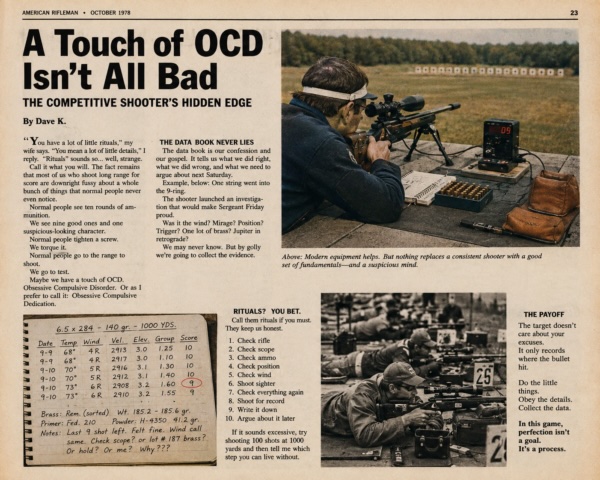
Compulsive Precision Disorder (CPD) – Spend enough time around long-range competitive marksmen and you’ll notice something curious. They all have a little… something. They measure powder to the kernel, torque screws to inch-pounds, record weather conditions like NOAA meteorologists, and can spend an hour investigating a single 9-ring hit like it’s the JFK assassination.

To the average person, this borders on insanity.

To a competitive marksman, it’s called Tuesday.

The funny part? Those obsessive personality traits that might seem excessive everywhere else are exactly what the sport rewards. The target doesn’t care about excuses—it only rewards consistency. Maybe that’s why engineers, machinists, scientists, and military veterans seem to thrive on the firing line. In one of the few places on Earth where perfectionism actually pays dividends, a little Compulsive Precision Disorder isn’t a bug…

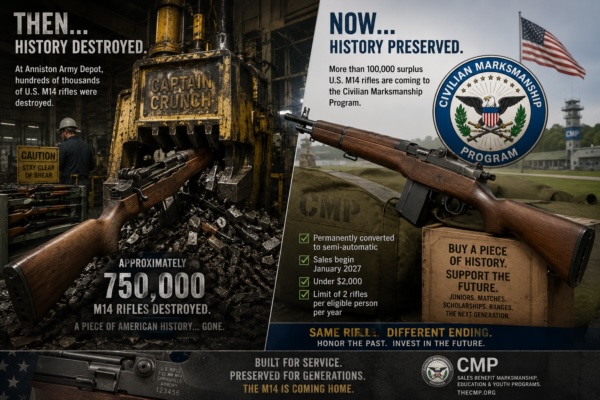
I’m sorry Honey, this M14 followed me home! Can I keep it?

Nearly 750,000 U.S. M14 rifles were destroyed after the Cold War, many meeting their end at Anniston Army Depot in the jaws of a hydraulic shear known as “Captain Crunch.” Now, history is taking a different path. Beginning in January 2027, the CMP expects to offer permanently converted semi-automatic M14s to qualified Americans for under $2,000. Every rifle sold preserves a piece of American military history while helping fund junior shooting programs, Camp Perry, scholarships, and the future of competitive marksmanship. Sometimes, the best way to honor history isn’t to put it in a museum—it’s to put it back on the firing line.

The CMP: America’s Quiet National-Security Insurance Policy

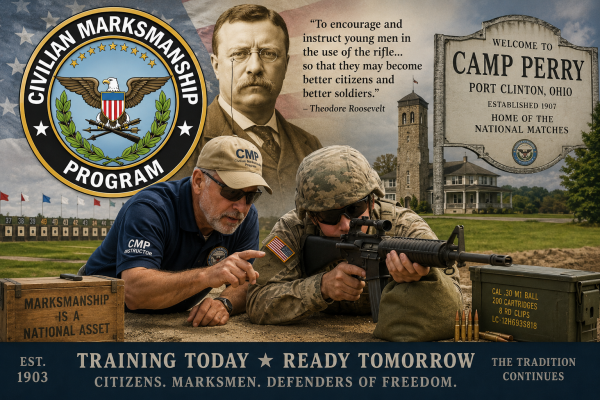
The Civilian Marksmanship Program is more than a shooting organization. It is a self-funded national-security asset that preserves firearms safety, competitive marksmanship, and a reserve of civilian expertise. During the Iraq War, CMP volunteers even traveled to military installations such as Fort Campbell to help the U.S. Army Marksmanship Unit train deploying soldiers as Squad Designated Marksmen. What looks like recreation on Saturday can become battlefield capability when the nation needs it.

The Human Benchrest: The Enduring Legacy of MAJ Ernie Vande Zande

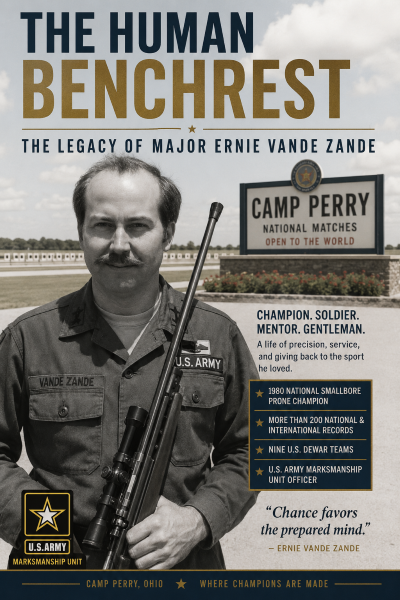
Ernie Vande Zande was more than a national champion and record-setter; he was the rare competitor who made everyone around him better. Known as “the Human Benchrest,” the Army major and Camp Perry champion combined world-class precision with a quiet willingness to help any shooter who genuinely wanted to improve. His classic article Sights, Wind and Mirage still teaches competitors how to read conditions decades after it was written. Smallbore lost more than a legend when Ernie passed in 2018—it lost a mentor, a gentleman, and one of the finest ambassadors the sport has ever known.

The 10-to-4 Problem: What Rimfire Teaches That Centerfire Hides

At distances out to 100 yards, the differences between rimfire and centerfire aren’t subtle—they are foundational. A .22 LR match round leaves the muzzle at roughly 1050 feet per second, already flirting with the sound barrier and quickly settling into subsonic flight. Compare that to a typical centerfire round—say a .308—moving at nearly three times that speed, carrying significantly higher ballistic efficiency, and backed by a rigid, jacketed bullet designed to punch through the air rather than cooperate with it.

Last of the Deer Camps: Saving America’s Hunting Heritage Before It’s Gone, Part I

When Congress passed the Pittman–Robertson Act of 1947, it did something rare: it trusted ordinary citizens more than bureaucrats. Hunters agreed to tax themselves—an excise on firearms, ammunition, and archery gear—to restore the nation’s wildlife. Every box of shells, every rifle sale, sent dollars straight to state conservation agencies. No congressional earmarks, no political games.