Jack O’Connor Would Have Loved the 6.5 Creedmoor
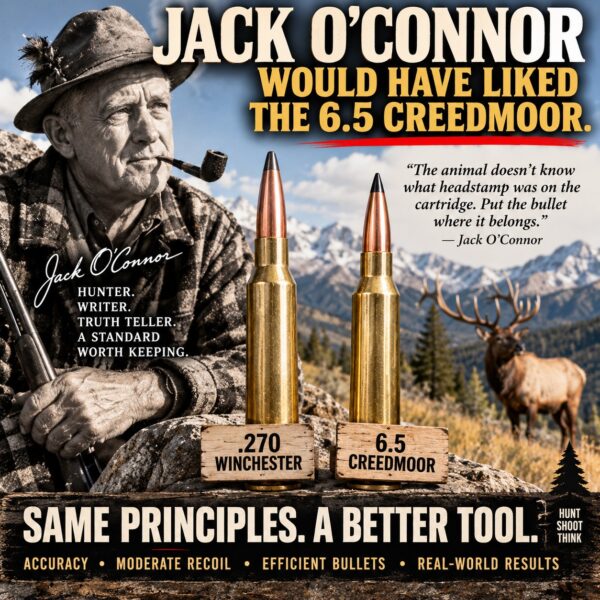
Jack O’Connor died in 1978, nearly 30 years before the 6.5 Creedmoor appeared, but judged by the standards he championed in The Hunting Rifle and decades of Outdoor Life writing, he probably would have loved it—even if it never displaced his beloved .270 Winchester. O’Connor valued accuracy, moderate recoil, flat-enough trajectory, high sectional density, efficient bullets, penetration, and above all the hunter’s ability to put a bullet precisely where it belonged. The Creedmoor checks virtually every box: a 140-grain 6.5mm bullet has excellent sectional density, modern high-BC bullets retain velocity remarkably well, recoil is lighter than the .270, and the cartridge is famously easy to shoot accurately. Where O’Connor would still favor the .270 is raw velocity and its flatter trajectory at ordinary hunting distances—especially important in his era, when hunters estimated range rather than pushing a button on a laser rangefinder. Ironically, O’Connor also admired cartridges such as the mild-mannered 7×57 Mauser and repeatedly argued that shot placement mattered more than horsepower. The funniest conclusion, then, is that the old-school hunters who dismiss the 6.5 Creedmoor as some newfangled fad might be surprised by their own patron saint: the Creedmoor is essentially an O’Connor hunting cartridge designed 30 years too late—accurate, efficient, mild to shoot, and powerful enough to kill what you’re hunting if you quit arguing about caliber and put the damned bullet where it belongs.