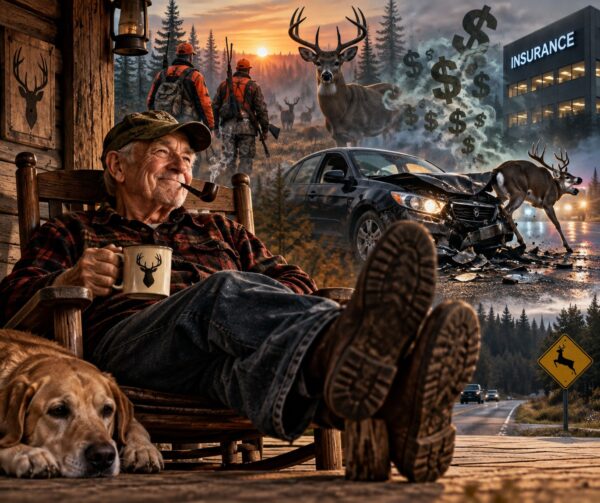
My dad, (Tom, 1941-2011) had a theory.
Dad believed automobile insurance companies would eventually destroy Michigan deer hunting.
Not because insurance executives hated hunting. Not because State Farm executives were secretly vegans. And not because a shadowy cabal of claims adjusters met beneath Lansing every full moon wearing little khaki vests.
His theory was much simpler.
Deer hit cars.
Insurance companies pay for cars.
Insurance companies don’t enjoy paying for cars.
Therefore, insurance companies would eventually prefer fewer deer.
Dad wasn’t an economist. He just possessed that increasingly rare ability known as common sense.
And several decades later, I’m beginning to think the old man may have been onto something.
According to State Farm, American motorists filed more than 1.6 million animal-collision claims from July 2025 through June 2026. State Farm alone reported approximately $1.9 billion in costs associated with those claims. Michigan motorists faced roughly 1-in-68 odds of hitting an animal, putting us among the highest-risk states in America.
That’s a lot of Bambi and wasted venison…
More importantly, that’s a lot of bumpers.
Hunters and insurance companies therefore view the same deer somewhat differently.
I drive past a nice eight-point buck and think:
“Good Lord. I hope he’s still there November 15, opening day.”
An insurance actuary presumably thinks:
“Hood. Grille. Radiator. Headlight. Airbag deployment. Rental vehicle. $8,700.”
Same deer.
Different financial ecosystem.
To a hunter, he’s a magnificent Michigan whitetail.
To an insurance company, he’s a claim with antlers.
This is where Dad’s theory becomes interesting.
Michigan’s Department of Natural Resources actually considers deer-vehicle collisions when evaluating deer populations and management objectives. That’s perfectly reasonable. Nobody wants 200-pound woodland mammals randomly entering traffic at 75 mph.
Farmers don’t want deer eating crops.
Foresters don’t want excessive browsing.
Homeowners don’t want hostas converted into venison.
Motorists don’t want a twelve-point buck sitting in the passenger seat.
Insurance companies certainly don’t want to buy you another F-150.
Everybody has an economic interest in deer numbers.
Except hunters have a peculiar interest.
We actually want more deer…
This occasionally puts us at odds with the spreadsheet.
And somewhere in Lansing sits the Michigan DNR, attempting to satisfy everyone simultaneously.
The DNR must maintain enough deer for hunters, but not so many that motorists complain. Enough deer for recreation, but not enough to damage crops. Enough predators for ecological objectives, but not enough that hunters blame them for everything missing from the woods.
Then there’s habitat.
And disease.
And winter.
And hunter harvest.
And public opinion.
And probably seventeen committees.
Eventually somebody produces a 146-page PDF explaining why everything is proceeding according to plan.
This is government wildlife management.
No northern Michigan deer discussion can proceed more than seven minutes without somebody mentioning wolves.
Dad’s insurance theory inevitably wandered there too.
The story usually goes something like this:
Insurance companies want fewer deer. Government wants fewer deer-car collisions. Wolves eat deer. Therefore somebody introduced wolves to reduce the deer herd.
It’s an outstanding theory. I haven’t found evidence that insurance companies engineered it.
Apparently Progressive did not parachute wolves into Ironwood under cover of darkness.
That doesn’t mean wolves don’t eat deer.
They do.
Coyotes eat deer.
Bears kill fawns.
Hunters kill deer.
Cars kill deer.
Winter kills deer.
And occasionally the Michigan DNR issues a regulation complicated enough that the deer apparently die while trying to understand it.
The U.P. deer herd consequently exists inside a remarkably complicated system.
Which brings us back to economics.
How many deer should Michigan have?
Ask ten hunters and you’ll receive eleven answers.
Ask a farmer and you’ll get another.
Ask an insurance company and, theoretically, the economically perfect number of deer is easy:
Zero.
No deer means no deer collisions.
Problem solved.
Of course, that’s ridiculous. Insurance companies aren’t advocating exterminating Michigan’s deer herd.
But that’s precisely why Dad’s theory remains interesting.
He wasn’t necessarily predicting a secret meeting where insurance executives decided to eliminate deer hunting.
He was predicting pressure.
Economic pressure.
And economic pressure is far more powerful than conspiracy because nobody has to coordinate it.
Insurance companies want fewer collisions.
Farmers want less crop damage.
Foresters want less browsing.
Motorists want safer highways.
Suburban homeowners want their landscaping back.
Every one of those interests pushes against high deer density.
Hunters provide the counterweight.
We want healthy forests and safe roads too.
But we’d also occasionally like to see a deer.
Preferably while actually deer hunting.
Crazy concept.
Here’s the problem wildlife managers eventually encounter:
You can have too many deer…. But, you can also have too few.
Michigan has recognized concerns about U.P. deer numbers after difficult winters and has responded with more restrictive antlerless opportunities and other regulation changes.
That’s because when deer numbers fall, hunters eventually respond.
They quit.
This should surprise absolutely nobody except perhaps a government economist.
A man will spend $1,500 on a rifle, $1,200 on an optic, $600 on clothing, $300 on ammunition, $40,000 on a pickup and enough money on deer camp to qualify as a minor infrastructure project.
He’ll wake up at 4:30 a.m.
He’ll walk a mile through snow.
He’ll sit motionless in 18-degree weather.
He’ll eat a sandwich that’s partially frozen.
He’ll urinate into an empty Gatorade bottle.
And he’ll describe the entire experience as “relaxing.”
Hunters are not normal consumers.
But even we have limits.
If a guy sits in the same blind for five seasons and sees three chickadees, a red squirrel and one DNR conservation officer, eventually he starts wondering whether golfing might be more exciting.
Then something important happens.
He doesn’t buy a license.
He doesn’t bring his son.
The son doesn’t learn to hunt.
The deer camp doesn’t open.
The sporting-goods store doesn’t sell ammunition.
The restaurant doesn’t sell breakfast.
The gas station doesn’t sell fuel.
The butcher doesn’t process the deer.
Twenty years later everyone holds a symposium asking why hunter participation declined.
Probably another PDF.
The irony is magnificent.
Hunters may be the greatest deer-management program government ever discovered.
We provide our own equipment.
We buy our own fuel.
We train ourselves.
We manage private habitat.
We remove deer.
We report harvest information.
And then—this is the brilliant part—we pay the government for permission to do it.
Imagine pitching that business model anywhere else.
“We need 500,000 seasonal employees.”
“What will salaries cost?”
“Nothing.”
“Benefits?”
“None.”
“Equipment?”
“They buy their own.”
“Transportation?”
“Their own.”
“Workers’ compensation?”
“Nope.”
“Then what’s the catch?”
“They pay us.”
Promote that man immediately.
Yet the entire arrangement depends upon one critical ingredient.
Sufficent Supply of Deer.
Hunters need a reasonable expectation that something with hooves might eventually walk past.
Destroy that expectation and you don’t merely lose deer hunters.
You lose the people paying to manage deer.
So was Dad right?
I still haven’t found the secret memorandum titled Operation Bambi: An Insurance Industry Plan to Destroy Deer Hunting.
I’m disappointed.
That would have been a fantastic document.
But Dad understood something more important.
He understood incentives.
A deer has completely different values depending upon who’s looking at it.
To the hunter, it’s tradition.
To the restaurant owner, it’s November business.
To the farmer, it’s crop damage.
To the forester, it’s browsing pressure.
To the DNR, it’s approximately seventeen different population models and a public meeting where everybody is angry.
To the motorist, it’s a hood ornament approaching at 40 mph.
And to an insurance company?
It’s an actuarial liability standing beside the highway eating grass.
Dad’s warning wasn’t really that insurance companies would deliberately destroy deer hunting.
It was that once wildlife becomes expensive enough, economic pressure begins determining how much wildlife society is willing to tolerate.
That’s a much more interesting problem.
Because nobody has to hate deer.
Nobody has to hate hunters.
Nobody even has to make a deliberate decision to destroy deer hunting.
All we have to do is continually manage deer downward in response to every group that considers them a liability while forgetting about the people who consider them a resource.
Eventually the balance tips.
The hunters quit coming.
The camps close.
The traditions disappear.
And twenty years later somebody in Lansing will commission a study to determine what happened.
Dad could have saved them the trouble.
He figured it out thirty years ago.
While sitting at deer camp, nursing a cold adult beverage… Without an MS Excel spreadsheet.
If you enjoyed this article, then please REPOST or SHARE with others; encourage them to follow AFNN. If you’d like to become a citizen contributor for AFNN, contact us at managingeditor@afnn.us Help keep us ad-free by donating here.
Substack: American Free News Network Substack
Truth Social: @AFNN_USA
Facebook: https://m.facebook.com/afnnusa
Telegram: https://t.me/joinchat/2_-GAzcXmIRjODNh
Twitter: https://twitter.com/AfnnUsa
GETTR: https://gettr.com/user/AFNN_USA
CloutHub: @AFNN_USA