Jack O’Connor Would Have Loved the 6.5 Creedmoor
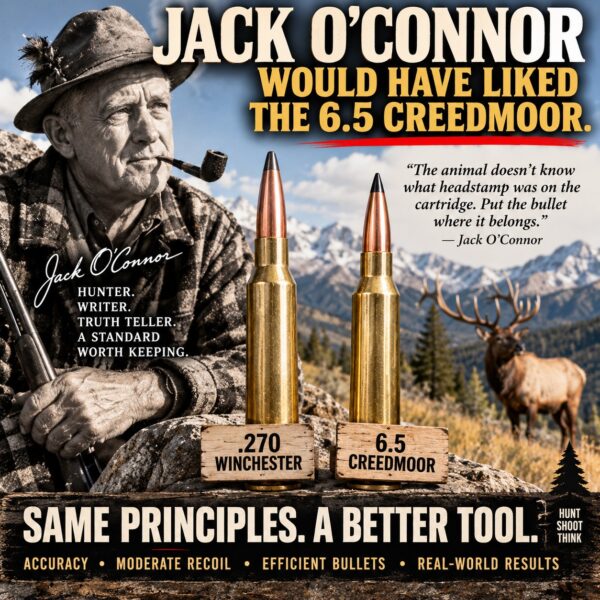
Jack O’Connor died in 1978, nearly 30 years before the 6.5 Creedmoor appeared, but judged by the standards he championed in The Hunting Rifle and decades of Outdoor Life writing, he probably would have loved it—even if it never displaced his beloved .270 Winchester. O’Connor valued accuracy, moderate recoil, flat-enough trajectory, high sectional density, efficient bullets, penetration, and above all the hunter’s ability to put a bullet precisely where it belonged. The Creedmoor checks virtually every box: a 140-grain 6.5mm bullet has excellent sectional density, modern high-BC bullets retain velocity remarkably well, recoil is lighter than the .270, and the cartridge is famously easy to shoot accurately. Where O’Connor would still favor the .270 is raw velocity and its flatter trajectory at ordinary hunting distances—especially important in his era, when hunters estimated range rather than pushing a button on a laser rangefinder. Ironically, O’Connor also admired cartridges such as the mild-mannered 7×57 Mauser and repeatedly argued that shot placement mattered more than horsepower. The funniest conclusion, then, is that the old-school hunters who dismiss the 6.5 Creedmoor as some newfangled fad might be surprised by their own patron saint: the Creedmoor is essentially an O’Connor hunting cartridge designed 30 years too late—accurate, efficient, mild to shoot, and powerful enough to kill what you’re hunting if you quit arguing about caliber and put the damned bullet where it belongs.

Bambi Is an Insurance Company Actuarial Liability

My dad, Tom, always had a theory that automobile insurance companies would eventually destroy deer hunting. Not because they hated hunters or because a shadowy cabal of claims adjusters met beneath Lansing every full moon, but because Dad understood basic economics: deer hit cars, insurance companies pay for cars, and insurance companies don’t enjoy paying for cars. To a hunter, a big Michigan whitetail is November tradition. To an insurance actuary, he’s a hood, grille, radiator, two airbags and a rental vehicle standing beside the highway eating grass. Dad didn’t need a conspiracy theory. He understood something far more powerful—incentives. Eventually, somebody was going to put Bambi into MS Excel.

The Original Deer-Camp MRE: The Lost Art of Canning Venison

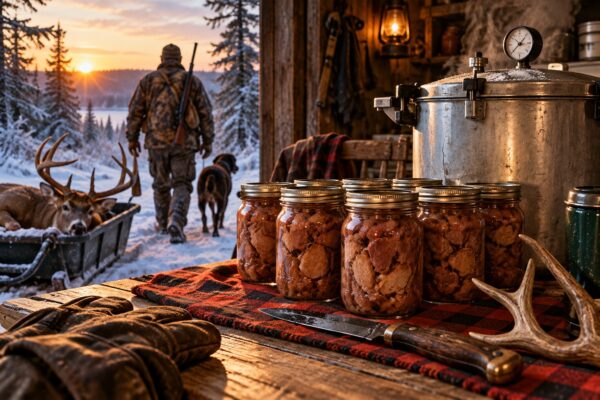
Before freezers and generators, Michigan hunters had another way to make November’s deer feed the family all winter: the Mason jar. Pressure-canned venison may be the original deer-camp MRE—simple, shelf-stable, already cooked, and requiring no refrigeration. It’s a nearly forgotten skill worth bringing back.

The Michigan Deer Debacle: How the DNR Managed to Fail Hunters, Farmers, and the Deer Herd All at Once

For generations, deer hunting has been woven into Michigan’s identity. Opening day used to look like a state holiday. Orange jackets in diners at 4 a.m., rifles leaning in pickup trucks, kids learning from their dads and grandfathers that hunting wasn’t just about venison—it was about discipline, stewardship, and tradition. But if you look at the numbers today, something has gone badly wrong. The Michigan Department of Natural Resources has spent decades regulating, restricting, tweaking, and “managing” the deer herd, yet the results speak for themselves: declining harvests, shrinking hunter participation, and a system so tangled that it now struggles to produce enough hunters to even keep the herd under control.

Loud Guitars, Sharp Broadheads: Why Ted Nugent Still Matters to Michigan Hunters

There are rock stars… and then there are Michigan rock stars—the kind forged in cold air, hard miles, deer sign, and a stubborn refusal to apologize for loving the outdoors. Ted Nugent is that kind of animal.