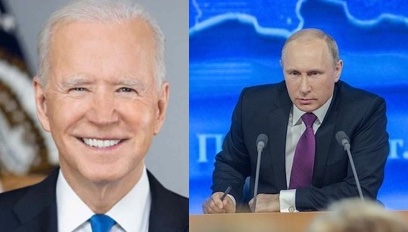

The US wants to avoid war with Russia. But is our Ukraine policy achieving that goal or pushing us closer to war?
As the mother of several boys, I am incredibly opposed to the United States taking part in any war for the next forty years or so. I’ve already been through deployments as a spouse; I have no desire to do so as a mother. However, for the first time in my motherhood, I can easily envisage a scenario where my teenaged son could end up going to war. May the Lord have mercy upon us.
So how do we avoid a war with an aggressive Russia?
Most western nations seem to believe it is by helping Ukraine a little bit but not too much. In other words, they are sending weapons to Ukraine but refuse to shoot any guns themselves. They will levy economic sanctions at Russia but won’t secure a no-fly zone above the Ukraine. There are many articles predicting the outcome of this policy on this war. Perhaps Russia will win a long, drawn-out scorched earth conflict. Perhaps Russians will rise up and overthrow Putin because of the economic sanctions and an unpopular war. And every prediction in between.
I have a different question.
What are the long-term consequences of our policies?
Will we avoid a war with Russia? I don’t believe so. The cold, hard truth is: If Russia wants a war, Russia will get a war. Obviously, Russia is not afraid to be the aggressor. We can side-step and do the bare minimum forever and Russia will start a war when they feel like it. A good example of this is all of the neighboring countries to Russia who are afraid to join NATO. Vladimir Putin excels at applying pressure and outright threatening states that want to secure their own interests and join a security alliance. Ukraine did the safe thing; they chose not to join NATO so they wouldn’t provoke Russia – it didn’t work. Russia was provoked by their very existence and now they do not have the protection of NATO.
Will we discourage Russia from further invasions? I don’t believe so. If anything, Russia has only learned to commit more resources, faster. He should have ensured a blitz victory instead of holding back for self-defense. Of course, the rest of the world will not strike back. Throwing his whole might against poor Ukraine at the first would have been a sure bet to defeat the Ukrainians and the rest of the world would have still been scratching their heads and setting up video conferences between western nations. Russia has only been further emboldened by our lack luster response.
Will we encourage the other Eastern European countries to resist Russia? What on earth are Sweden, Finland and Belarus to do? We can judge Belarus for their limited support of Russia but what other options do they have? To wait their turn until Russia turns their gun sights on them? No one will come to their aid. The West has made that abundantly clear. So where are these border states left? They can defend themselves against one of the most militarized countries in the world with a miniscule possibility of success but absolute assurance of abundant death and destruction or they can capitulate.
Will we encourage other countries around the world to trust our security assurances for purposes of nonproliferation? In the 1991 Budapest Memorandum, the US, Russia and the UK agreed that if Ukraine gave up the nuclear arsenal that they inherited from the USSR (an arsenal that would have made them the third greatest nuclear power in the world) that their sovereignty and independence would be respected with the understanding (although not the implicit promise) that the US and UK would come to their aid, through lethal means if necessary. So, if Belarus invaded Ukraine, the US, UK and Russia agreed to aid the Ukraine. Even worse, one of the signatories of the Memorandum, Russia, is violating it. Ukraine regrets trusting the US with its security. If they were the third largest nuclear power in the world, Russia would not be invading them right now. Other countries are taking notice. Japan has considered a nuclear program in the recent past, this situation has certainly demonstrated that such a program might be essential to their security in the future. The world is not safer for having more nuclear powers in it. Therefore, we should be discouraging other countries to begin nuclear programs instead of encouraging them.
I understand that we do not want to provoke another nation into war. Neither do we want to appease another nation into war. Nor do we want to walk a line down the middle that destroys a nation we promised to protect, encourages Russia to invade whoever they want, pushes countries into the arms of our enemy, or forces other nations to take nuclear paths to ensure their own security.
My point is merely that Russia does not require provocation in order to start a war so that should not be our main position in how we respond to this Russia-Ukraine War. And I am very concerned that our response is ensuring a future war with Russia instead of discouraging it.
Follow AFNN
Facebook: https://m.facebook.com/afnnusa
Telegram: https://t.me/joinchat/2_-GAz…
Twitter: @AFNNUSA
GETTR: @AFNN_USA
CloutHub: @AFNN_USA
Patriot.Online: @AFNN