
Of, By and For the People: The Dangers of Entangling Alliances
“Peace, commerce and honest friendship with all nations – entangling alliances with none.” – Thomas Jefferson, First Inaugural Address, 1801
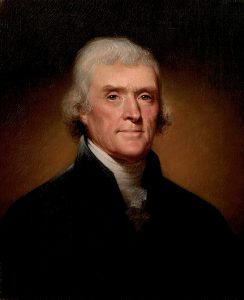
Such are the words which embodied the spirit of our Founders regarding America’s presence and influence on the world stage. As I addressed recently in my AFNN series on the 28 Founding Principles of Liberty, the framers of our Constitution fully understood the need for a strong national defense, and for transacting with other nations as a member of the world community. They also passionately believed that their framework for a nation of, by and for the people would be highly desired of many around the globe, and the adoption of its philosophy would be organic: Humans would naturally gravitate toward the American way of being as it was proven to be the greatest opportunity for freedom and prosperity.
All of us alive today were born into a world which had already diverged from those words of Jefferson’s, “entangling alliances” amongst nations quite well established. It has felt natural to many of us as patriots to support the actions of our military overseas. Many troops have fought and died under the American flag to fight existential threats abroad to freedom and liberty, both at home and abroad; their patriotism and service should be duly applauded and honored.
Though by no means the first example of our abrogation of this founding principle, recent events in Afghanistan exemplify the consequences of our extraconstitutional reach into the affairs of other nations, in the name of “peace-keeping” or “spreading democracy.” These well-intentioned objectives fly in the face of what the United States was intended to represent with its original American approach. Yes, “manifest destiny” was in the minds of the early Americans, but global methods of force, conquest and/or occupation for the sake of that destiny was anathema to that early vision.
We were attacked on 9/11; I defer for now on to what extent our unconstitutional overreach into international political affairs prior to 9/11 provoked this event. When we are attacked on our own soil, we do have a constitutional and divine right to defend ourselves, and to take action against a direct imminent threat to prevent further harm. We took early and swift action in Afghanistan to retaliate against those who invaded our borders to harm fellow citizens; this was legal and justified according to our founding charter. Focusing on fully dismantling the apparatus of that particular enemy, and then just as swiftly and promptly returning home, would still likely have been sanctioned by our Founders.
Why then, were we still there some 20 years later? For that matter, why do we still have “permanent” military bases anywhere outside our borders? What has been/is the mission of these occupying forces? By all accounts I’ve seen from those outside the military leadership in the Pentagon, the answer appears to be one massive shrug of the shoulders, and not just for the current situation in Afghanistan.
Long-term and unwelcomed military occupation of another land or nation, for peacekeeping or any other noble purpose, was never a part of the founding charter of the United States of America. With that statement I anticipate that some would respond with “but the world is politically much more complex and nuanced than it was in the 18th Century.” While I don’t disagree with this sentiment, nor desire to try to disprove the pragmatism of it at this point, I can’t help but consider the cause-effect relationship of these complications compared to the series of military actions taken by the United States which violated its founding principle of relative neutrality, especially since the early 20th Century. The United States stayed true to this principle for the first 150 years of its existence; how “complex and nuanced” would the world be today had we not strayed from it in the last 100? How many unintended negative political consequences (and standing enemies) have been produced around the globe because the United States exercised its military power in ways which were anathema to its original non-invasive policies of “peace through strength” and “leading by example?” How many American lives have been unnecessarily lost or permanently altered through well-intentioned yet fundamentally un-American military exercises?
All of this said, withdrawing from Afghanistan was the American thing to do, but how this has been done could not have been conducted more poorly. Following bad policy with horrendous policy will not only harm our global identity, but cost even more American lives (and not just in Afghanistan). We absolutely need to return to the roots of our Founders where national security and military strategy is concerned, but telegraphing our every move and then turning tail in the face of a fight sends the wrong message to the entire world, let alone our standing enemies. Seems the shoulder-shrugging is, and will continue to be, just as vigorous over the strategy and objectives of such withdrawals. I pray that the founding principle of “peace through strength” be more strenuously abided, and the general security of our nation and its immediate borders given much greater consideration, in the future than these appear to have been with our latest withdrawal from the Afghan theater.
If you enjoyed this article, then please REPOST or SHARE with others; encourage them to follow AFNN
Truth Social: @AFNN_USA
Facebook: https://m.facebook.com/afnnusa
Telegram: https://t.me/joinchat/2_-GAzcXmIRjODNh
Twitter: https://twitter.com/AfnnUsa
GETTR: https://gettr.com/user/AFNN_USA
Parler: https://parler.com/AFNNUSA
CloutHub: @AFNN_USA
““Peace, commerce and honest friendship with all nations – entangling alliances with none.” – Thomas Jefferson First Inaugural Address, 1801
Yes, the world is more complex… in part because in the position of power and the reach of this nation in the world… but, like understanding what Jefferson’s elegant statement means, I think it’s important to go back to the original conditions that the statement flowed from and intentions behind Jefferson’s statement.
Our fledgling nation was a small player on the world stage and, worse yet, the rest of the main power players in the world were entwined with each other in ways that put all players, not just the main ones, at the risk of debilitating conflicts. But, for this country… a new, vulnerable, nation trying to prove out a new form of government… for our nation those “entangling alliances” would have likely been the means for its destruction.
Today’s world holds different dangers for our nation, ones that call for a different guiding principle, naively falling back on Jefferson’s words in today’s environment is too much like fighting yesterdays wars, today.
NATO is the ultimate entangling alliance. If Vladimir Putin and Russia, with her strategic nuclear arsenal, decide to send the tanks rolling into tiny Latvia, we are obligated, by the North Atlantic Treaty, to consider ourselves at war with Russia.
In April of 1949, when the USSR had no nuclear weapons, and was not projected to obtain any for about five more years, an alliance to deter Soviet forces from pouring through the Fulda Gap to attack West Germany made some sense.
Of course, the USSR tested its first atomic bomb 4½ months after the North Atlantic Treaty was signed.
Now, without the buffer states of the Warsaw Pact, we have pushed NATO nations, and our entangling alliance, directly to Russia’s borders. I’m not sure that this has been a wise idea.
It seems to me that, if words have specific meaning… especially in the context that they were used, then I think that what Jefferson meant by ‘entangling alliance’, including with NATO, isn’t what is meant when Jefferson uttered that phrase.
In 1801 this country was a babe in the world and the 4 or so more established… much bigger… powers than this country had relationships with each other, both familial and as countries, that had resulted in 100s of years of conflict and wars and as the primary powers in the world.
Aligning with any one of these countries created the existential risk that one or more of any alliance could have created enough animosity to have brought about an unholy alliance of a those powers to destroy our country. If we entangled ourselves to any one power or power block and that power became the target of the remaining powers and thus a fight we didn’t pick ourselves, we would have created a real existential risk for this country.
Today, the problem isn’t, like in Jefferson’s time, entangling alliances that will suck us into a fight that we couldn’t control, because we are the dominant power alliances like NATO prevent fights we don’t want or disentangle us from the dangers of other powers picking a fight that we don’t want.