
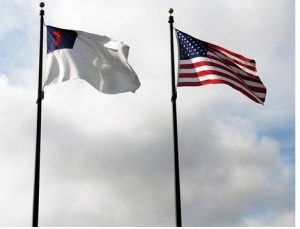
“We have no government armed with power capable of contending with human passions unbridled by morality and religion” – John Adams, Second President of the United States of America
Greetings my fellow Americans!
On the heels of celebrating the 246th Year of our declaration of independence from the British monarchy, I thought this would be a good time to reflect on the spiritual foundations of that declaration, as well as the divine providence which enabled that relatively small band of revolutionaries to prevail over a much larger and heavily armed Army of the Commonwealth, and enable the authoring and adoption of our national Constitution. Such an introspection would also be woefully incomplete were it not to include at least a brief analysis of a seminal moment in our history in which we egregiously deviated from the source of that providence, perhaps never to return as a United States of America.
As I’ve alluded to here, and in numerous others of my writings for AFNN, the Founders of our great nation recognized the crucialness of a shared belief in, and reverence of, a supreme Creator in establishing and maintaining a well-ordered and highly-civilized society that was also relatively free of, and unencumbered by, the whims and edicts of a ruler or ruling class. They knew that guardrails for proper and socially appropriate human behavior were necessary for sustaining that national order and civilization, but deferred to We the People to generally employ the self-discipline (or at least the state- and local-level election sobriety) to preclude the need for strong central oversight and policing of domestic affairs. Further, the People (and the States) would take care to send people to represent them in the national government who would seek to respect and preserve their individual sovereignty, and to hold them accountable to do so with each election. The People, and their representatives, would be sufficiently moral and virtuous to hold an otherwise lightly-defined central government in check and maintain their relative freedom and liberty.
While it’s hard to identify a seminal moment in the decoupling of our American culture from its self-governing vision, the emergence of the mantra of “separation of church and state” could be considered a top candidate for signifying the wholesale untethering of our government from any moral or virtuous anchors based on the notions of piety rooted in the belief in a Creator to whom we would all be equally and ultimately accountable. First coined in 1947 in its current form by then-Supreme Court Justice Hugo Black in his opinion on Everson v. Board of Education, it was purported to have been based on a phrase penned by Thomas Jefferson in a letter to the Danbury, CT Baptist Association in which he referred to the “wall of separation of church and state” which had been erected by virtue of the First Amendment to the Constitution, specifically the Establishment Clause. Regardless of the intent of either of these men in their phraseology, the modern meaning of this utterance has grotesquely morphed away from what the American founders’ stated beliefs about the character of those holding elected office in the national government very clearly imply.
I’m intending to take a deeper dive into the Bill of Rights in a future series of articles for AFNN, so I will defer on a direct analysis of the wording of the Establishment Clause here; what I will address in the meantime is the founders’ clear intent regarding any “walls” therefrom—that a state-sponsored or mandated national church was never to be established; i.e., the national government was never to specify nor instruct who, what, when, where, why or how the citizenry should or would acknowledge or worship as their supreme authority. It was NEVER meant (as it has come to mean today) that executive, legislative and judicial governance was to be completely devoid of any implicit or explicit expression of belief, by those elected to represent others and the governance thereof, in a supreme authority other than the government itself.
That this “separation” has come to mean the latter is not only a gross bastardization of the intent of the First Amendment, it is also a gross denial of what it means to be human. That people have generally come to believe, and expect, that, regardless of how one has lived, the guiding principles to which he, or she, claim to adhere, and the extent to which their daily actions are consistent with those stated principles, they will check any and all such guidelines, sense of right and wrong, biases, etc., at the doors of their public offices, in favor of some esoteric and whitewashed standard for how people in government should think that is completely detached from the people they truly are and have become by virtue of those guiding principles is both highly fantastic and fraught with disaster. We would do well to start re-injecting people into our governments at all levels who have actually demonstrated that they have guiding principles for life outside of government, and that those principles are consistent with ours, as those are bound to show up in how they govern and represent us, regardless of what they claim to believe or how high the wall between their “church” (which can also be quite secular or demonic) and their capacity to make decisions which impact the integrity and stability of our civilization, supposedly is.
If you enjoyed this article, then please REPOST or SHARE with others; encourage them to follow AFNN
Truth Social: @AFNN_USA
Facebook: https://m.facebook.com/afnnusa
Telegram: https://t.me/joinchat/2_-GAzcXmIRjODNh
Twitter: https://twitter.com/AfnnUsa
GETTR: https://gettr.com/user/AFNN_USA
CloutHub: AFNN_USA