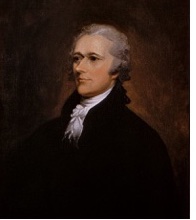
In Federalist 9 Hamilton tells us why it was important that we spent the time understanding the lessons of the Greeks and Romans.
“It is impossible to read the history of the petty republics of Greece and Italy without feeling sensations of horror and disgust at the distractions with which they were continually agitated, and at the rapid succession of revolutions by which they were kept in a state of perpetual vibration between the extremes of tyranny and anarchy.” [1]
At first this would seem to be an admission that the republican form of government is destined for failure, but Hamilton goes on to point out that from the failures of the ancient republics the advocates for “despotism have drawn arguments, not only against the forms of republican government, but against the very principles of civil liberty. They have decried all free government as inconsistent with the order of society.” You will recall that Plato believed that a monarchy, albeit one ruled by a monarch of great wisdom, was necessary for an ordered society, and even Aristotle who first broached the possibility of a republic, was not entirely convinced that it would work, only that it was better than everything else that had been tried.
In a nod to the Aristotle’s ‘Political Science’ as well as the enlightenment period, Hamilton points out that, “science of politics, however, like most other sciences, has received great improvement.” In particular, you can see how the founders intended to address the failures of human nature by, “The regular distribution of power into distinct departments; the introduction of legislative balances and checks; the institution of courts…”. This separation of power was designed to address the flaw of human nature where people in authority, no matter how noble their intents, tend to become more autocratic.
We can see the influence of the enlightenment in Federalist 9 where Hamilton mentions how the Baron de Montesquieu felt that the answer to the separate factions of the various states would be a balance of powers.[2] According to Hamilton, it has been pointed out that Montesquieu felt that this balance was designed only for smaller republics. But Hamilton goes on to quote more broadly from Montesquieu that, “It is very probable,” (says he) “that mankind would have been obliged at length to live constantly under the government of a single person, had they not contrived a kind of constitution that has all the internal advantages of a republican, together with the external force of a monarchical government. I mean a CONFEDERATE REPUBLIC.” (Emphasis in the original). Please note that Hamilton here is arguing for a republic as both a way for the various interests of the individual states to be balanced, as well as for the powerful way that it would be seen by potential enemies of the new proposed republic.
And here again Hamilton draws a distinction between a confederation of states and a republic, and once again we hear about Lycia as being an excellent model of a republic according to Montesquieu. [3]
Federalist 10, is a critical document in that James Madison uses it to explain how the design of the republic that is in the proposed constitution will protect the rights of minorities against organized factions of the majority. Madison defines these factions thusly, “By a faction, I understand a number of citizens, whether amounting to a majority or a minority of the whole, who are united and actuated by some common impulse of passion, or of interest, adversed to the rights of other citizens, or to the permanent and aggregate interests of the community.” He then proposes that the new constitution would mitigate this problem by both removing its causes and lessening their effect.
Madison points out that you can remove the cause of factions by taking away the rights of those with whom you disagree. That is, of course, the antithesis of liberty. The other way would be, “by giving to every citizen the same opinions, the same passions, and the same interests.” He admits that the second way is unlikely to happen because man, in his fallen state, will see that a “connection subsists between his reason and his self-love, his opinions and his passions will have a reciprocal influence on each other; and the former will be objects to which the latter will attach themselves.”
Madison correctly predicts that man will always find an excuse to support that which he wishes to do, even if he knows that to be unreasonable because “his wants will prevail upon his reason.” In addition, in a phrase that is as applicable today as it was over 200 years ago, “The diversity in the faculties of men, from which the rights of property originate, is not less an insuperable obstacle to a uniformity of interests. The protection of these faculties is the first object of government.” We should remember that the founders, like Plato, understood that different people had different abilities and that those abilities would result in different outcomes. Because of their experience with the British, the founders were very keen to preserve property rights.
What does Madison recommend we do to thwart the very “nature of man”? In another nod to Plato, Madison states that, “… the most common and durable source of factions has been the various and unequal distribution of property. Those who hold and those who are without property have ever formed distinct interests in society”. It is the primary task of any legislation to manage this conflict. Of course, unlike Plato, Madison realizes that, “Enlightened statesmen will not always be at the helm.”
The answer of course is that in a republic, factions, even if they are part of a majority, would be held in check by the others who hold the benefit of the republic to be a higher cause than their individual parties. There would not be any direct democracy, but rather “…the delegation of the government…to a small number of citizens elected by the rest” which would tame the passions of democracy and “secondly, the greater number of citizens, and greater sphere of country, over which the latter may be extended.” By uniting, the effect of any bad idea would be diluted.
In that way, “A rage for paper money, for an abolition of debts, for an equal division of property, or for any other improper or wicked project, will be less apt to pervade the whole body of the Union than a particular member of it; in the same proportion as such a malady is more likely to taint a particular county or district, than an entire State.”
If you enjoyed this article, then please REPOST or SHARE with others; encourage them to follow AFNN. If you’d like to become a citizen contributor for AFNN, contact us at managingeditor@afnn.us Help keep us ad-free by donating here.
Substack: American Free News Network Substack
Truth Social: @AFNN_USA
Facebook: https://m.facebook.com/afnnusa
Telegram: https://t.me/joinchat/2_-GAzcXmIRjODNh
Twitter: https://twitter.com/AfnnUsa
GETTR: https://gettr.com/user/AFNN_USA
CloutHub: @AFNN_USA
2 thoughts on “Parillo Examines Federalist 9 and 10”