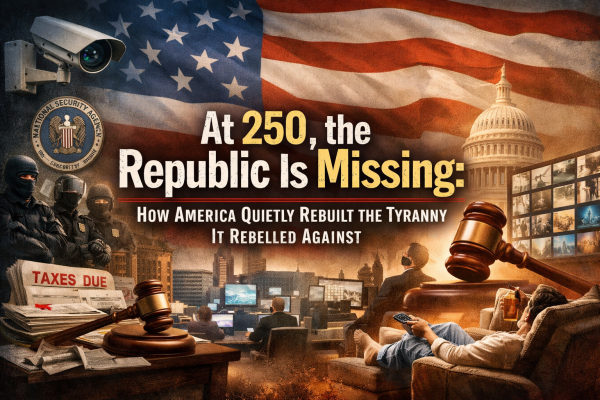
History has a dark sense of irony. Revolutions begin with liberty on their lips and end with compliance on a clipboard. They start with righteous outrage against tyranny and conclude with bureaucrats calmly explaining why your rights must be limited—temporarily, of course—for your own good.
At 250 years old, the United States has not collapsed. There are no tanks in the streets or dictators on balconies. Instead, America has done what nearly every revolution before it has done: it defeated an obvious form of tyranny and then slowly reconstructed a more efficient, more sophisticated version of it.
History is remarkably consistent on this point.
The French Revolution overthrew a king in the name of liberty and equality. Within a few short years, liberty gave way to revolutionary tribunals, mass executions, and eventually an emperor. The monarchy fell, but centralized power returned with a sharper blade and better justification.
The Russian Revolution promised to free the people from aristocracy and secret police. It replaced the Tsar with a party elite, created a new secret police, and perfected political repression on an industrial scale. The rhetoric changed; the prisons did not.
The Iranian Revolution toppled an autocrat in the name of justice and dignity. It installed a theocracy that polices speech, belief, clothing, and dissent. The revolution succeeded—and then reproduced the same control mechanisms under a different ideology.
Different centuries. Different slogans. Same outcome.
Revolutions do not eliminate power. They redistribute it. And over time, it always reconcentrates.
Americans like to believe we were the exception. Our revolution was grounded in Enlightenment thought. Our Constitution was engineered to restrain government. Our system was built on separation of powers, federalism, and deep suspicion of authority. As James Madison warned, the accumulation of power in the same hands was the very definition of tyranny.
For a time, the system worked.
Then came the drift—not sudden, not dramatic, but relentless. The federal government expanded under the income tax authorized by the Sixteenth Amendment. It exploded in size and scope during the New Deal. Emergency wartime powers normalized central planning. Agencies multiplied, writing regulations with the force of law while Congress quietly outsourced responsibility.
All of it came wrapped in good intentions. Stability. Fairness. Security.
After 9/11, the surveillance state accelerated. The Patriot Act expanded government reach into private life. The National Security Agency collected data on Americans. The FISA Court operated largely in secrecy. None of this required a revolution or a suspension of elections. It required fear, urgency, and trust that power would be used responsibly.
And here we are.
We still vote. We still argue. We still invoke the Constitution. But functionally, we no longer live in the republic the Founders designed. We live in an administrative state—rule by agencies, regulations, and “temporary” authorities that never quite go away.
The modern American is taxed at nearly every stage of life. Regulated in business, property, education, healthcare, finance, land use, speech, and movement. Monitored through financial reporting systems, digital platforms, and data aggregation that would have stunned any 18th-century monarch.
You are not ruled by decree. You are managed.
This is the genius of modern power. It does not crack whips. It sends invoices. It does not issue proclamations. It publishes guidance. It does not demand loyalty. It requires compliance—and assures you it’s all for your own protection.
We are freer than most people in history, no doubt. But freedom measured against past tyrannies is a low bar. The real question is whether we are as free as the Constitution meant for us to be—or merely well-supervised. The modern state doesn’t need prisons for most people. It has permits, penalties, and the quiet pressure of endless rules.
History’s cruelest twist isn’t that revolutions fail. It’s that they succeed just long enough to make people comfortable. The American rebellion against tyranny did not collapse into chaos. It matured into something subtler: a system so normalized, so administratively competent, that resistance feels unreasonable.
We don’t live under a tyrant. We live under a system that insists on managing nearly every aspect of life for our own good. A padded cell of prosperity. A comfortable servitude.
The revolution that once rejected kings now tolerates administrators with more reach than any monarch ever had. And so we comply, we pay, we renew, we consent—grateful for the safety, stability, and supervision of our supervised liberty.
The genius of modern control is not that it makes you feel oppressed. t’s that it makes you feel taken care of.
If you enjoyed this article, then please REPOST or SHARE with others; encourage them to follow AFNN. If you’d like to become a citizen contributor for AFNN, contact us at managingeditor@afnn.us Help keep us ad-free by donating here.
Substack: American Free News Network Substack
Truth Social: @AFNN_USA
Facebook: https://m.facebook.com/afnnusa
Telegram: https://t.me/joinchat/2_-GAzcXmIRjODNh
Twitter: https://twitter.com/AfnnUsa
GETTR: https://gettr.com/user/AFNN_USA
CloutHub: @AFNN_USA