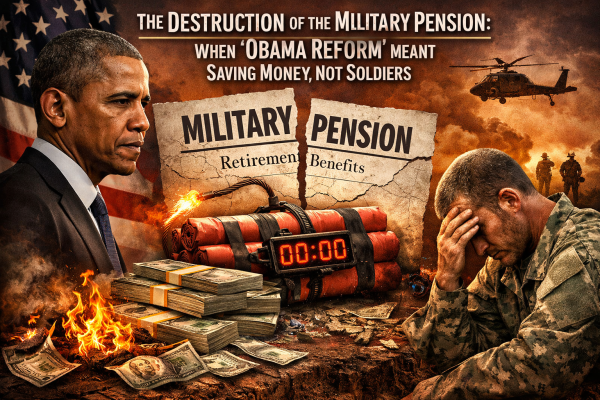
Somewhere between speeches about “supporting the troops” and glossy recruiting commercials, the United States quietly decided that a guaranteed military pension was a little too generous. Not immoral. Not unfair. Just… expensive. And so, without much noise or public debate, the traditional 50% military retirement pension was downgraded, rebranded, and sold as “modernization.” Enter the Blended Retirement System—a move justified not by improved outcomes for soldiers, but by long-term savings for the federal balance sheet.
Let’s dispense with the polite fiction first. The shift from the High-3 system to the Blended Retirement System was not designed to give service members “more options.” It was designed to reduce government liability. Full stop. Any benefit to the individual service member was incidental, conditional, and market-dependent. The benefit to the government was immediate, predictable, and actuarially delicious.
Under the old system, a career officer who made it to 20 years earned a 50% pension, inflation-adjusted, guaranteed for life. No market exposure. No “financial literacy modules.” No hoping the S&P 500 behaved itself during the first five years of retirement. It was boring, stable, and profoundly unsexy to budget analysts—which is precisely why it worked.
Under the new blended system, the pension drops to 40%, with the missing 10% replaced by a government-matched investment account that shifts risk from the institution to the individual. The Department of Defense reduces its long-term obligation. The service member assumes volatility. This is not generosity. This is risk transfer, dressed up as empowerment.
And yes, this happened under the Obama administration, formalized through legislation and sold as a reform that would “help the 80% who don’t reach 20 years.” That talking point is technically true and strategically misleading. The military has always been a pyramid. It has always relied on a core of career professionals who stayed long enough to provide institutional memory, leadership, and continuity. The traditional pension was not a bug in that system—it was the incentive that made the math work.
What happens when you weaken that incentive?
You don’t see the effects immediately. That’s the beauty of long-term cost cutting. You see them ten, fifteen, twenty years later. You see them when mid-career officers do the math and decide that staying in uniform past 15 years no longer makes financial sense. You see them when experienced majors and lieutenant colonels exit early, taking with them combat experience that can’t be replaced with PowerPoint or contractor support. You see them when retention bonuses become routine because the foundational incentive structure was quietly eroded.
This is the part no one seems eager to discuss. A pension isn’t just compensation—it’s signal. It tells the service member, “If you give us your prime years, your health, your family stability, and your geographic freedom, we will guarantee you security on the back end.” When that signal weakens, the relationship changes. Service becomes more transactional. Loyalty becomes more conditional. And the institution becomes more brittle.
The irony is rich. At the same time senior leaders publicly lament recruiting shortfalls and retention crises, the system continues to defend a retirement reform that explicitly reduced long-term commitment to those who stay. The message is incoherent: we want warriors who think in decades, but we compensate them like short-term consultants.
To be clear, this isn’t about nostalgia or entitlement. It’s about strategy. Militaries, like families and civilizations, are shaped by incentives. If you want a force built on long service, deep experience, and professional identity, you don’t design retirement systems that mimic corporate HR departments. You don’t tell soldiers that their future security depends on market timing and portfolio allocation. You especially don’t pretend that doing so was primarily for their benefit.
It wasn’t.
The blended system saved the government money. That was the point. Everything else was narrative management.
The real question isn’t whether the old system was perfect. It wasn’t. The real question is whether anyone fully considered the downstream effects of redefining military service as a cost center rather than a covenant. Whether anyone asked what happens to an all-volunteer force when the most reliable long-term incentive is quietly trimmed in the name of efficiency.
Because if history teaches us anything, it’s this: nations rarely feel the consequences of decisions like this when they’re made. They feel them later—when experience is thin, trust is frayed, and the bill comes due in places that don’t fit neatly into a spreadsheet.
Saving money is easy.
Paying the long-term price is harder.
And that bill, unlike a pension, is never guaranteed to be affordable.
If you enjoyed this article, then please REPOST or SHARE with others; encourage them to follow AFNN. If you’d like to become a citizen contributor for AFNN, contact us at managingeditor@afnn.us Help keep us ad-free by donating here.
Substack: American Free News Network Substack
Truth Social: @AFNN_USA
Facebook: https://m.facebook.com/afnnusa
Telegram: https://t.me/joinchat/2_-GAzcXmIRjODNh
Twitter: https://twitter.com/AfnnUsa
GETTR: https://gettr.com/user/AFNN_USA
CloutHub: @AFNN_USA