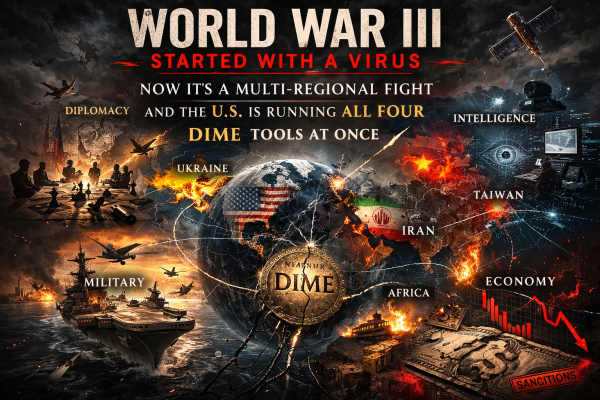
Historians will probably argue for decades about when World War III actually began, but the more you look at the timeline, the harder it is to ignore the turning point in 2020. COVID didn’t start a shooting war, but it cracked the system that had kept the world relatively stable since 1945. Once the system cracked, every pressure point that had been building for decades started pushing at the same time. What we’re living through now doesn’t feel like a world war because there isn’t one front line. There are ten of them, scattered across the globe, all connected by economics, intelligence, and politics.
The modern battlefield isn’t just military anymore. It’s what the national security crowd calls DIME — Diplomacy, Intelligence, Military, and Economy — and right now the United States is fighting on all four fronts at the same time, in multiple regions, with fewer resources than it had even ten years ago. That’s not a conspiracy theory. That’s just what happens when a superpower tries to hold together a global order that is starting to come apart.
Start with diplomacy, which used to be America’s strongest tool. For decades, the U.S. could build coalitions almost automatically. NATO, Japan, South Korea, Australia, the Gulf states — when Washington spoke, most of the world at least listened. Today, diplomacy looks more like damage control. Europe depends on the U.S. for security but doesn’t always trust its leadership. Middle Eastern partners cooperate one week and hedge with China the next. Countries that used to stay neutral now play both sides, because they’re not sure the American-led system will still exist ten years from now. Diplomacy still works, but it takes more effort, more money, and more concessions every time. That’s usually a sign the balance of power is shifting.
Then there’s intelligence, which has become the quiet center of modern conflict. The Ukraine war showed how much wars now depend on satellites, signals intercepts, cyber operations, and real-time data. The United States still dominates in intelligence capability, but the advantage is shrinking. China has built its own surveillance networks. Russia has proven it can operate effectively in cyber and information warfare. Iran has shown it can run proxy groups, influence campaigns, and asymmetric operations without needing a massive conventional army. Intelligence used to support war. Now intelligence is the war half the time, and the U.S. is spending enormous effort just to keep up.
The military front is where the strain becomes obvious. The United States still has the strongest military in the world, but it’s now stretched across multiple regions at once. Europe requires support because of Russia. The Middle East keeps pulling forces back in whenever tensions rise. The Pacific demands more ships, more aircraft, and more attention because of China. At the same time, recruiting is down, equipment is aging, and the cost of maintaining global presence keeps climbing. A superpower can handle one major theater easily, two with difficulty, and three only for so long. Right now the U.S. is trying to manage all of them while pretending this is normal.
The economy is the part nobody wants to talk about, because that’s where wars are really won or lost. The global financial system still runs on the dollar, which gives the United States enormous power, but it also gives the United States enormous responsibility. Debt levels are at historic highs. Interest payments are rising. Sanctions are used so often that other countries are actively looking for ways around the dollar system. When your main economic weapon is the same tool holding your own system together, every move becomes risky. You can pressure your enemies, but you also risk weakening the structure you depend on. That’s not a comfortable place for an empire to be.
Put all four parts of DIME together, and the picture starts to look less like isolated crises and more like one long, grinding global conflict. Russia in Ukraine. China watching Taiwan. Iran testing the Middle East. Proxy fights in Africa. Cyber attacks everywhere. Economic warfare running constantly in the background. None of these alone looks like World War III. All of them together start to.
That’s why a larger war with Iran wouldn’t feel like the start of something new. It would feel like another expansion of something already in progress. Another region added to a list that keeps getting longer. Another reminder that the post-Cold War world is over, even if nobody officially announced it.
World wars used to begin with declarations.
If you enjoyed this article, then please REPOST or SHARE with others; encourage them to follow AFNN. If you’d like to become a citizen contributor for AFNN, contact us at managingeditor@afnn.us Help keep us ad-free by donating here.
Substack: American Free News Network Substack
Truth Social: @AFNN_USA
Facebook: https://m.facebook.com/afnnusa
Telegram: https://t.me/joinchat/2_-GAzcXmIRjODNh
Twitter: https://twitter.com/AfnnUsa
GETTR: https://gettr.com/user/AFNN_USA
CloutHub: @AFNN_USA