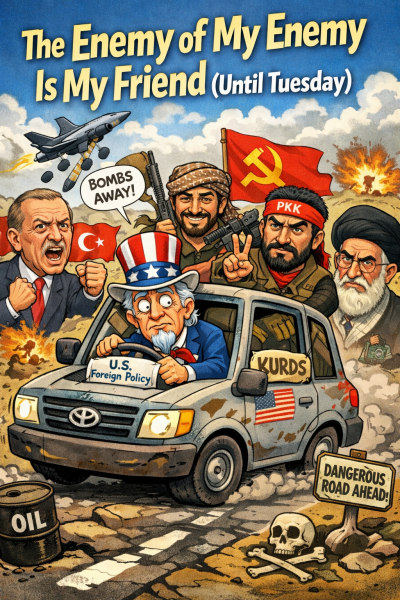
In the Middle East, alliances are less like marriage and more like temporary carpool arrangements during a thunderstorm. Everyone piles in together while the lightning is striking, but the moment the storm passes, people start asking, “Wait… why am I in a car with this guy?”
That, in a nutshell, explains America’s relationship with the Kurds.
For many Americans, the story is simple. Saddam Hussein gassed the Kurds in the 1980s—most infamously at Halabja. They suffered horribly. When the United States eventually removed Saddam from power in 2003, the Kurds were portrayed as natural allies: brave fighters, pro-Western, reliable partners in a messy region.
And to a degree, that’s true.
But if you stop the story there, you’re missing the entire geopolitical soap opera that surrounds them.
The first thing most people don’t realize is that “the Kurds” aren’t a country. They’re an ethnic group—roughly 30–40 million people—spread across four different nations: Turkey, Iraq, Iran, and Syria. Think of it as a nation without a state. They’ve wanted their own country, Kurdistan, since the collapse of the Ottoman Empire after World War I. Unfortunately for them, the lines on the map went another direction.
That left Kurdish populations inside countries that were not exactly thrilled about separatist movements.
Turkey, for example, has spent decades fighting Kurdish insurgents. Iran has its own Kurdish rebellions. Syria has Kurdish regions with semi-autonomous forces. Iraq has the Kurdistan Regional Government, which operates like a mini-state with its own army, the Peshmerga.
So when Americans say, “the Kurds are our friends,” the first question a regional expert asks is: Which Kurds?
Because the answer matters.
The Kurdish leadership in northern Iraq—the Kurdistan Regional Government—is generally the group Americans are talking about. They’ve cooperated with the United States for decades, particularly during the fight against ISIS. Kurdish fighters were among the most effective ground forces against the Islamic State when many other armies collapsed or fled.
From Washington’s perspective, that made them valuable partners.
But alliances in the Middle East rarely come with halo lighting.
Some Kurdish political movements—particularly the PKK, a Kurdish militant group operating primarily against Turkey—have roots in Marxist revolutionary ideology. They began as a communist insurgency in the Cold War era. Today the PKK is still considered a terrorist organization by the United States and NATO.
Which creates one of those classic geopolitical contradictions.
Turkey is a NATO ally.
The PKK is Turkey’s enemy.
The PKK is Kurdish.
The U.S. supports Kurdish groups in some places while condemning them in others.
To the average American voter, that sounds confusing. To a Middle East analyst, it sounds like Tuesday.
Then there’s the uncomfortable reality that Kurdish politics—like politics anywhere—can be messy, tribal, corrupt, and occasionally ruthless. The Kurdish region in Iraq has two dominant political parties that spent years fighting each other in what amounted to a Kurdish civil war during the 1990s. Power is still heavily tied to political families, patronage networks, and internal rivalries.
In other words, they are not the Middle Eastern version of the Swiss.
They’re a regional power bloc trying to survive.
And survival in that neighborhood requires flexibility.
The Kurds cooperate with the United States when it benefits them. They negotiate with Baghdad when they must. They trade with Turkey when it’s profitable. They cautiously deal with Iran when geography demands it.
That’s not betrayal.
That’s geopolitics.
Meanwhile, American public understanding of the region often runs on a simplified moral storyline: good guys versus bad guys. The Kurds fit nicely into the “good guys” box because they were victims of Saddam Hussein’s brutality and because they fought ISIS alongside Western forces.
Both of those things are real.
But they don’t mean Kurdish leadership automatically shares America’s long-term goals.
The Kurds ultimately want something Washington has always been reluctant to openly support: an independent Kurdish state. That ambition collides directly with the interests of Turkey, Iraq, Iran, and Syria—four countries that would all prefer the map to stay exactly as it is.
Which leaves the United States walking a diplomatic tightrope.
Support the Kurds too much and you anger Turkey, a NATO member that controls critical geography and military access.
Ignore the Kurds and you risk abandoning one of the few pro-Western forces in the region.
So Washington does what Washington often does best in complicated regions: it muddles through.
The relationship becomes transactional.
The Kurds are useful partners when fighting jihadist groups.
They are less convenient when pushing for independence referendums that could ignite a regional war.
And that’s why the phrase “the enemy of my enemy is my friend” works perfectly—as long as you remember the fine print.
In geopolitics, friendships are rarely permanent. They are temporary alignments of interest.
The Kurds know that.
The Turks know that.
The Iranians know that.
And deep down, Washington knows it too.
Because in the Middle East, alliances aren’t written in stone.
They’re written in pencil.
And everyone keeps an eraser handy.
If you enjoyed this article, then please REPOST or SHARE with others; encourage them to follow AFNN. If you’d like to become a citizen contributor for AFNN, contact us at managingeditor@afnn.us Help keep us ad-free by donating here.
Substack: American Free News Network Substack
Truth Social: @AFNN_USA
Facebook: https://m.facebook.com/afnnusa
Telegram: https://t.me/joinchat/2_-GAzcXmIRjODNh
Twitter: https://twitter.com/AfnnUsa
GETTR: https://gettr.com/user/AFNN_USA
CloutHub: @AFNN_USA