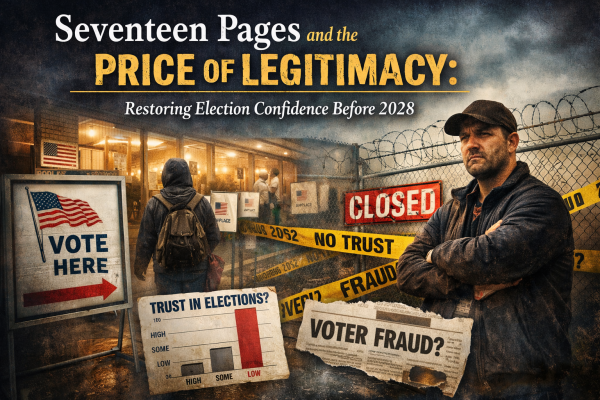
Governments do not endure on procedure alone. They endure on legitimacy. In a constitutional republic, legitimacy flows from elections that the public believes are lawful, transparent, and fairly administered. When that confidence erodes—whether justified or not—the system itself becomes fragile.
In recent election cycles, public trust in the electoral process has measurably declined. Surveys from multiple institutions show that large portions of the electorate—across party lines—harbor doubts about integrity, administration, or transparency. That reality, by itself, is destabilizing. It does not require proof of systemic fraud to create risk. It only requires sustained disbelief.
Against that backdrop, a reported seventeen-page draft executive order focused on federal election integrity has drawn intense scrutiny. Critics characterize it as overreach. Supporters argue it is a necessary step to restore credibility before the next presidential cycle. Before dismissing it reflexively, it is worth examining the structural context.
Under Article I of the Constitution, states administer elections. Congress retains authority to regulate federal contests. The President does not control state election machinery. However, the executive branch does have responsibility for enforcing federal election law, protecting against foreign interference, and coordinating among federal agencies where national interests are implicated.
An executive order cannot rewrite state statutes. It cannot nullify constitutional limits. What it can do—within bounds—is direct federal agencies to prioritize enforcement, improve interagency coordination, enhance data-sharing regarding citizenship verification where permitted by law, clarify compliance standards tied to federal funding, and strengthen oversight mechanisms already authorized by statute.
Those are not novel concepts. They fall squarely within the traditional use of executive orders to guide executive branch enforcement priorities.
Why would such action be considered necessary?
First, the United States operates under highly decentralized election procedures. Rules governing voter identification, mail ballots, signature verification, ballot curing, drop boxes, and auditing vary widely among states. Decentralization was designed to prevent centralized control, and it has served that purpose well. However, it also creates unevenness that can become contentious in close national elections.
Second, the modern information environment amplifies disputes rapidly. Social media platforms accelerate narrative formation. Legal advocacy groups mobilize quickly. Protest infrastructures are well established across ideological lines. In this environment, even minor procedural ambiguities can escalate into national controversies.
Third, foreign influence operations targeting U.S. elections are not speculative. Intelligence assessments across administrations have acknowledged ongoing attempts by adversarial states to exploit domestic divisions. While such operations do not equate to control over ballots, they heighten the importance of visible safeguards and public reassurance.
History provides examples of how disputed elections combined with organized mobilization can destabilize political systems. In Serbia in 2000, contested results contributed to mass demonstrations that ultimately ended Slobodan Milošević’s rule. In Ukraine in 2004 and 2014, election disputes became catalysts for large-scale political upheaval. The United States is not those nations; its institutions are stronger and its constitutional framework more durable. Still, the underlying lesson is consistent: legitimacy disputes can generate sustained instability.
The argument for preventive action is therefore not rooted in alarmism but in prudence. If measurable distrust exists, and if vulnerabilities—whether procedural or perceptual—can be addressed within constitutional limits, early intervention may reduce the likelihood of post-election crises.
Of course, executive authority has limits. Any executive order touching election enforcement would face immediate judicial review. Courts would assess statutory authority, federalism constraints, and constitutional compliance. That review process is not a flaw in the system; it is a safeguard.
The more substantive question is whether Congress should act instead. Ideally, durable election reform would emerge legislatively with bipartisan support. Congressional action carries greater democratic legitimacy and is less vulnerable to reversal by future administrations. However, legislative gridlock has frequently stalled national election proposals. In that vacuum, the executive branch often turns to the authorities it already possesses.
Reasonable people can disagree on whether a particular executive order is appropriately scoped. What is harder to dispute is the central premise: sustained public distrust in elections poses a risk to constitutional stability. Ignoring that risk does not make it disappear.
The goal of any reform—executive or legislative—should be straightforward: increase transparency, clarify standards, ensure uniform enforcement of existing federal law, and provide visible reassurance that lawful votes determine outcomes. If a seventeen-page directive meaningfully advances those objectives within constitutional bounds, it deserves evaluation on its merits rather than dismissal by reflex.
A republic’s strength is measured not only by the fairness of its elections but by the public’s confidence in them. When confidence weakens, prudent governments respond before crisis, not after it.
If you enjoyed this article, then please REPOST or SHARE with others; encourage them to follow AFNN. If you’d like to become a citizen contributor for AFNN, contact us at managingeditor@afnn.us Help keep us ad-free by donating here.
Substack: American Free News Network Substack
Truth Social: @AFNN_USA
Facebook: https://m.facebook.com/afnnusa
Telegram: https://t.me/joinchat/2_-GAzcXmIRjODNh
Twitter: https://twitter.com/AfnnUsa
GETTR: https://gettr.com/user/AFNN_USA
CloutHub: @AFNN_USA