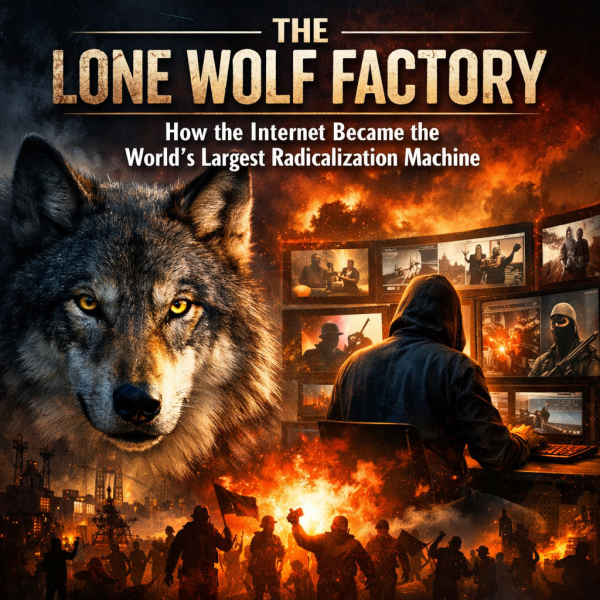
Once upon a time, if you wanted to radicalize someone into violent extremism, you had to put in some serious legwork. You needed a smoky back room, a stack of ideological pamphlets, a recruiter who could give a fiery speech, and probably a couple guys standing outside looking suspicious. It was inefficient, risky, and required real human contact. In other words, it was the Blockbuster Video model of revolution.
Then the internet showed up and said, “Hold my beer.”
Today the world’s largest radicalization engine runs twenty-four hours a day, recruiting globally with the efficiency of an Amazon warehouse. You don’t need a secret meeting. You don’t need a physical training camp. You need Wi-Fi and a keyboard. Congratulations — you now have access to what might be called the Lone Wolf Factory, where the raw materials are grievance, identity crisis, and algorithmic amplification.
Security researchers, including analysts at the RAND Corporation and investigators at the Federal Bureau of Investigation, have spent the last two decades trying to understand why lone-actor extremists keep appearing like ideological mushrooms after a rainstorm. The answer is both fascinating and uncomfortable: radicalization spreads less like a conspiracy and more like a disease. It behaves like a mind virus.
Imagine a pyramid. At the bottom are sympathizers — people who share grievances, repost angry memes, and believe the system is corrupt, evil, or illegitimate. They’re not violent. They’re just mad. Above them are activists who spread propaganda, recruit others, and amplify the narrative. At the very top are the operational actors, the tiny fraction who actually pick up weapons or build bombs. The key insight researchers keep coming back to is that the violent actors are the smallest part of the ecosystem. For every person willing to pull a trigger, there may be thousands creating the ideological swamp that produced them. The mosquito gets the headlines, but the swamp is the real problem.
This is why modern analysts sometimes describe radicalization using epidemiology. Ideas spread through social networks the same way viruses spread through populations. A susceptible person encounters a narrative explaining why their life feels unfair. The narrative identifies villains. It promises meaning, belonging, purpose. Once the idea sticks, the person begins hunting for reinforcement — videos, podcasts, forums, influencers. The algorithm happily obliges, feeding them more of the same because outrage is excellent for engagement metrics. Eventually the ideology stops being something they follow and becomes something they are. Psychologists call this identity fusion. In plain English, it means the cause and the person have become the same thing.
Enter the internet, humanity’s greatest ideological amplifier. Twenty years ago extremist groups had to recruit in person and distribute propaganda like contraband literature. Today they have encrypted messaging apps, endless video platforms, and recommendation algorithms that quietly steer users deeper into ideological rabbit holes. One charismatic radicalizer can influence thousands of people at once without leaving his basement. No secret cell meeting required. The system recruits itself.
This leads to one of the more unsettling ideas in modern security analysis: stochastic terrorism. The term sounds like something a mathematician invented after three espressos, but the concept is simple. If you broadcast narratives that frame violence as justified often enough and loudly enough, statistically someone will eventually act on it. No direct command is required. Nobody needs to issue orders. It’s like shaking a jar full of popcorn kernels. You don’t know which one will pop, but if the heat stays on long enough, eventually one does.
Anyone who spent time watching insurgencies overseas has seen this dynamic play out. In Iraq over the last twenty years, violence rarely came from some tidy hierarchical army with a clean chain of command. It came from networks of believers connected by narrative. A sermon here. A propaganda video there. A charismatic recruiter explaining why resistance was righteous. Before long ordinary young men who had never fired a rifle outside a wedding celebration were planting roadside bombs or launching attacks. They weren’t necessarily ordered to do it. They were produced by the ecosystem around them.
That’s the part people miss when they talk about “lone wolves.” The wolf might be alone when the attack happens, but the ideas that shaped him rarely are. Lone actors are usually the final output of a much larger ideological supply chain. The internet simply industrialized that supply chain. Instead of radicalization happening slowly inside small physical networks, it now occurs inside massive digital ones where millions of people interact with the same narratives at the same time.
Which brings us to the uncomfortable conclusion. Stopping extremist violence is not just about arresting the person who finally snaps. Law enforcement can disrupt plots, track suspects, and dismantle organizations. What it cannot easily dismantle is a contagious idea bouncing around the global information ecosystem at the speed of fiber-optic cable.
The real battlefield isn’t just physical territory. It’s the narrative environment — the stories people believe about the world, about injustice, about enemies and identity. When those stories become toxic enough, the Lone Wolf Factory starts humming. And when that machine spins up, the next “lone” attacker isn’t really a mystery.
He’s just the next kernel in the jar that finally popped.
The United States spent two decades studying insurgencies abroad and learning how ideology can transform ordinary populations into recruitment pools for violence. The lesson was simple and brutally consistent: once radicalization becomes contagious, containing it is far harder than preventing it in the first place.
Which is why the most dangerous weapon in modern insurgency may not be a rifle or a bomb.
It may be a narrative with good Wi-Fi.
If you enjoyed this article, then please REPOST or SHARE with others; encourage them to follow AFNN. If you’d like to become a citizen contributor for AFNN, contact us at managingeditor@afnn.us Help keep us ad-free by donating here.
Substack: American Free News Network Substack
Truth Social: @AFNN_USA
Facebook: https://m.facebook.com/afnnusa
Telegram: https://t.me/joinchat/2_-GAzcXmIRjODNh
Twitter: https://twitter.com/AfnnUsa
GETTR: https://gettr.com/user/AFNN_USA
CloutHub: @AFNN_USA