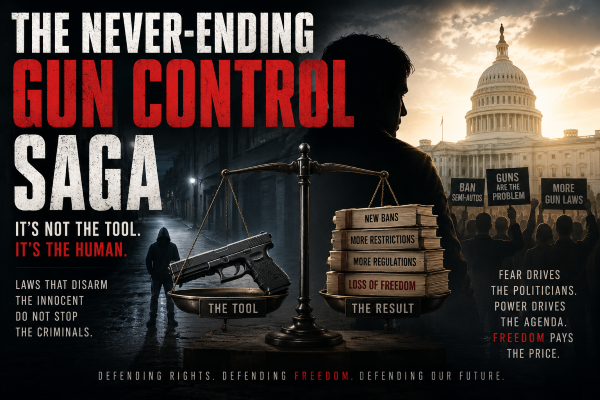
Gun control is one of the few political debates in America that never seems to end. Decade after decade, law after law, tragedy after tragedy, the same arguments return with remarkable predictability. A crime occurs. Politicians hold press conferences. Advocacy groups demand action. Legislators promise that this new restriction, this new regulation, this new ban will finally make people safer.
And then the cycle begins again.
The reason is simple, though many refuse to admit it. The problem has never been the tool. The problem has always been the human being using it.
A firearm has no intentions. It possesses no morality. It cannot decide to commit murder, rob a store, assault a victim, or terrorize a neighborhood. Like a hammer, a chainsaw, a car, or a kitchen knife, it is an object. The object only becomes dangerous when placed into the hands of someone who intends harm.
Yet much of modern gun control is built on the opposite assumption. Instead of focusing on criminals, lawmakers increasingly focus on hardware. Instead of asking why someone commits violence, they ask how to redesign, regulate, restrict, or prohibit the tool itself.
The latest example comes from Maryland’s effort to target Glock-style pistols based on internal design features. Supporters argue such laws may make certain firearms harder to illegally modify. Critics see something else entirely: another step in a decades-long pattern of regulating common firearms not because of what they do, but because of what someone might theoretically do with them.
For lawful gun owners, that distinction matters.
Every major gun control effort is sold as limited, reasonable, and narrowly tailored. It is always described as affecting only a specific firearm, a specific accessory, a specific magazine, or a specific feature. The public is assured that ordinary gun owners have nothing to worry about.
Then the target moves.
A particular rifle becomes unacceptable. Then a magazine capacity. Then a brace. Then a trigger component. Then a manufacturing process. Then a category of firearm. Each restriction is presented as the final solution, yet none ever seem to be final.
This is why many gun owners have grown skeptical. They have watched the debate long enough to recognize the pattern. The argument is rarely that criminals should face harsher punishment. It is rarely about prosecuting repeat offenders. It is rarely about improving mental health systems or addressing the social breakdown that often precedes violence.
Instead, the conversation returns again and again to restricting the rights of people who have committed no crime.
What frustrates many Americans is that the same individuals demanding new gun laws often appear unwilling to acknowledge the defensive role firearms play. Every year, countless citizens use firearms to protect themselves, their families, and their property. Most of those incidents never become national news because nothing sensational happened. A criminal fled. A victim survived. A crime was prevented.
Those stories generate few headlines.
The reality is that self-defense is not a theoretical concept. It is a natural right recognized long before the Constitution existed. The Second Amendment did not create that right. It merely acknowledged that government should not infringe upon it.
Yet there remains a small but determined group of anti-gun activists who seem incapable of accepting that principle. No restriction is ever enough. No regulation is ever sufficient. No compromise is ever permanent. Their objective may be described as public safety, but their policy preferences consistently move in only one direction: less civilian firearm ownership.
They lobby. They fund campaigns. They pressure lawmakers. They generate fear. They amplify worst-case scenarios. And with each legislative session they seek another restriction, another prohibition, another incremental reduction of a constitutional right.
Meanwhile, criminals continue doing what criminals have always done: ignoring laws.
This does not mean every firearm regulation is unreasonable. Every society establishes rules. But a free society must ask whether a law actually addresses criminal behavior or merely creates new burdens for people who already obey the law.
That distinction matters.
Because in the end, safety is not created by banning objects. Freedom is not preserved by restricting the innocent. And no amount of legislation can eliminate the reality that good and evil reside in human hearts, not in steel, polymer, springs, and trigger bars.
The never-ending gun control saga persists because many lawmakers continue treating the symptom while ignoring the disease. They regulate the tool because it is easier than confronting the far more difficult question of why some people choose violence in the first place.
Until that changes, the cycle will continue. Another law. Another promise. Another headline. Another demand for more restrictions.
And law-abiding Americans will once again be told that surrendering a little more freedom is simply the price of safety.
If you enjoyed this article, then please REPOST or SHARE with others; encourage them to follow AFNN. If you’d like to become a citizen contributor for AFNN, contact us at managingeditor@afnn.us Help keep us ad-free by donating here.
Substack: American Free News Network Substack
Truth Social: @AFNN_USA
Facebook: https://m.facebook.com/afnnusa
Telegram: https://t.me/joinchat/2_-GAzcXmIRjODNh
Twitter: https://twitter.com/AfnnUsa
GETTR: https://gettr.com/user/AFNN_USA
CloutHub: @AFNN_USA