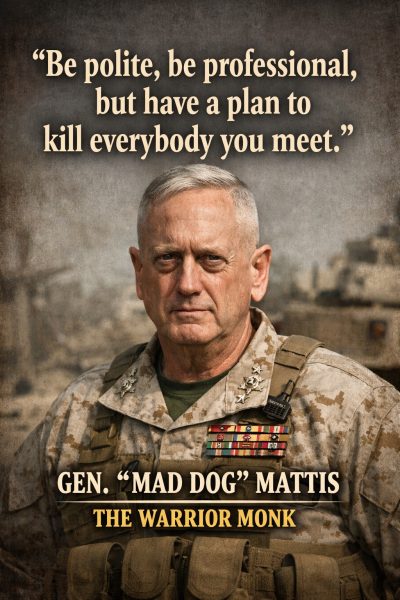
In an era where retired officials rush to cable news studios, write tell-all books, and lob political grenades at their former colleagues, James Mattis has done something unusual: he has mostly stayed quiet.
For a man famous for blunt battlefield aphorisms—“Be polite, be professional, but have a plan to kill everybody you meet”—his restraint in the political arena is striking. Mattis, often called the “Warrior Monk,” has lived up to that nickname not just through his battlefield leadership but through his discipline after leaving power.
Mattis served as Secretary of Defense under Donald Trump from 2017 until his resignation in December 2018. The immediate trigger was the president’s decision to withdraw U.S. forces from Syria, a move Mattis believed was premature and strategically risky. Rather than launching a public feud, Mattis did what professionals in uniform have traditionally done: he wrote a short, pointed resignation letter and stepped aside.
The letter itself revealed Mattis’ philosophy without descending into political theater. He wrote that the United States must treat allies with respect and remain clear-eyed about adversaries. Those who read between the lines understood the message. But Mattis never went on television to wage a public campaign against the administration.
He simply left.
Since then, Mattis has watched the world unfold in ways that might tempt almost any strategist to say the most dangerous phrase in politics: I told you so.
The Middle East remains volatile. Iranian influence continues to spread through proxy militias. The Syrian battlefield has hardly stabilized. One could easily imagine a former defense secretary giving interviews explaining how his earlier warnings had proven correct.
But Mattis hasn’t done that.
There is a reason.
For most of his adult life Mattis lived inside a profession that places extraordinary weight on civilian control of the military and institutional loyalty. American generals serve presidents they may disagree with, and when they leave office, the tradition is to allow their successors to do their jobs without running commentary from the sidelines.
It’s an ethic older than the republic itself: soldiers fight the wars, civilians debate the politics.
Mattis understands this deeply. A lifelong Marine officer who commanded troops in both Afghanistan and Iraq, he built his reputation not only on battlefield competence but on intellectual seriousness. His personal library reportedly contains thousands of books on history and warfare. He once told young officers that if they had not read widely about war, they were condemning their soldiers to learn lessons the hard way.
That intellectual discipline carries over into how he behaves in public life.
When Mattis resigned, he could have become a permanent critic of the administration. Washington would have welcomed him into the endless cycle of panels, interviews, and political commentary. Instead, he mostly returned to private life, speaking occasionally about leadership, history, and the responsibilities of military service.
This restraint frustrates some commentators who wish he would speak more loudly about current crises. After all, Mattis has strong views about the strategic threat posed by Iran and the importance of alliances in stabilizing the Middle East. His decades of experience would make him a powerful voice in any policy debate.
But Mattis appears to believe that silence can sometimes be a form of professionalism.
The Warrior Monk nickname captures this paradox well. Mattis was always known as a fierce battlefield commander, but also as a man who studied philosophy and history late into the night. The “warrior” part of that title is obvious. The “monk” part reflects his discipline—his belief that power should be exercised carefully, and words even more so.
That discipline is rare in modern political culture, where every disagreement quickly becomes a public spectacle. Mattis seems to believe that leadership sometimes requires stepping back rather than stepping forward.
So while others argue on television and social media, the Warrior Monk remains largely quiet.
He could say, I warned you.
Instead, he chooses something harder.
He chooses professionalism.
If you enjoyed this article, then please REPOST or SHARE with others; encourage them to follow AFNN. If you’d like to become a citizen contributor for AFNN, contact us at managingeditor@afnn.us Help keep us ad-free by donating here.
Substack: American Free News Network Substack
Truth Social: @AFNN_USA
Facebook: https://m.facebook.com/afnnusa
Telegram: https://t.me/joinchat/2_-GAzcXmIRjODNh
Twitter: https://twitter.com/AfnnUsa
GETTR: https://gettr.com/user/AFNN_USA
CloutHub: @AFNN_USA