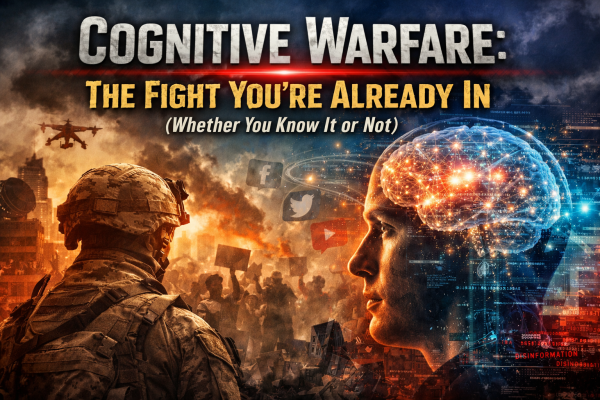
There was a time—not that long ago—when war made sense. You had terrain, objectives, and enemies who at least had the decency to shoot back. You studied maps, rehearsed battle drills, and trained on what the Army called the human dimension—how soldiers think, how leaders decide, how units hold together under stress. It wasn’t perfect, but it was tangible. You could point to it.
Then somewhere between Fallujah and Facebook, the battlefield moved—and a lot of good soldiers never got the memo.
NATO didn’t invent cognitive warfare, but they did something important: they named it. And once you name something, you can’t pretend it isn’t there. Their definition isn’t wrapped in science fiction or Hollywood nonsense. It’s blunt. Cognitive warfare is about influencing or disrupting how people think in order to shape what they do. Not just soldiers, not just leaders—everyone. Entire populations. Allies, adversaries, and increasingly, your own backyard.
That’s the shift most people miss. We didn’t leave the human dimension behind. We expanded it. What used to be a leadership problem or a training problem is now a battlespace. The objective isn’t just to build better decision-makers. It’s to compete for control of decisions themselves.
And unlike the wars most of us trained for, this one doesn’t begin with a deployment order. It doesn’t announce itself. There’s no clear transition from peace to conflict. It just starts applying pressure—quietly, persistently—on perception, belief, and trust. It shapes how events are interpreted long before anyone decides what to do about them. By the time a crisis shows up on the front page, the cognitive ground has already been prepared.
A lot of folks hear this and shrug. “Information operations,” they say. “Psychological operations. We’ve been doing that forever.” That’s comforting—and wrong. Even NATO acknowledges this isn’t just a rebranding exercise. Cognitive warfare isn’t a subset of those tools. It’s the integration of all of them, aimed at something more precise: decision advantage. The goal is not simply to persuade you. It’s to influence the way you process reality itself.
That sounds abstract until you realize how it actually works. It doesn’t require elaborate lies or exotic technology. In many cases, the information being used is accurate. That’s the uncomfortable part. Truth, selectively framed and amplified, can be just as disruptive as fiction. The real weapon isn’t misinformation—it’s friction. Enough competing narratives, enough emotional triggers, enough noise, and people stop making clear decisions. They hesitate. They argue. They fracture.
From a military perspective, that’s devastating. You don’t need to defeat an opponent if you can slow their decision cycle to a crawl. If leadership hesitates, if the public is divided, if alliances begin to question themselves, the outcome is shaped long before the first shot is fired. The enemy doesn’t need to win. They just need you to stall.
We actually saw pieces of this coming. In Iraq and Afghanistan, we embedded Human Terrain Teams to understand tribal dynamics and social structures. We emphasized key leader engagements, cultural awareness, and population-centric operations. We recognized, at least instinctively, that people—not terrain—were the center of gravity. But those efforts were local, analog, and human-intensive. They operated at the scale of villages and provinces.
What we’re dealing with now operates at the scale of societies.
The difference isn’t just size—it’s speed. What once took weeks of engagement and relationship-building now happens in real time. Narratives are tested, refined, and redistributed continuously. The terrain isn’t a city or a valley anymore. It’s the information environment itself—your phone, your feed, your conversations. The same principles apply, but the reach is global and the feedback loop is instantaneous.
That’s why a lot of experienced soldiers miss it. It doesn’t look like war. There are no formations to identify, no front lines to brief, no clear indicators and warnings. Instead, there’s a slow erosion of cohesion and confidence. Trust in institutions weakens. Shared understanding breaks down. People begin to interpret the same facts in completely different ways. And because it happens gradually, it feels like background noise rather than deliberate pressure.
But it isn’t accidental.
NATO and others now describe this as a new domain—the cognitive domain—layered on top of land, sea, air, space, and cyber. Not because it’s trendy, but because it reflects reality. Every domain ultimately feeds human decision-making. If you can influence that layer, you don’t need dominance everywhere else. You just need enough leverage to shape the outcome.
And here’s the part that should make people uncomfortable: you are not observing this from the outside. You are inside it. This isn’t something happening to “other countries” or “someone else’s population.” It’s happening continuously, everywhere information flows. Every narrative that feels engineered, every debate that escalates faster than it should, every moment where clarity gives way to confusion—that’s the environment.
No one issued you a weapon for this fight. No one gave you a briefing packet or a rules of engagement card. But the battlefield didn’t ask for your permission.
It just moved.
We used to train the human dimension to win wars. Now the war is over the human dimension—and most people don’t even realize they’re in it.
If you enjoyed this article, then please REPOST or SHARE with others; encourage them to follow AFNN. If you’d like to become a citizen contributor for AFNN, contact us at managingeditor@afnn.us Help keep us ad-free by donating here.
Substack: American Free News Network Substack
Truth Social: @AFNN_USA
Facebook: https://m.facebook.com/afnnusa
Telegram: https://t.me/joinchat/2_-GAzcXmIRjODNh
Twitter: https://twitter.com/AfnnUsa
GETTR: https://gettr.com/user/AFNN_USA
CloutHub: @AFNN_USA
Well done. This article has been shared with a very intelligent and experienced group, Dave.