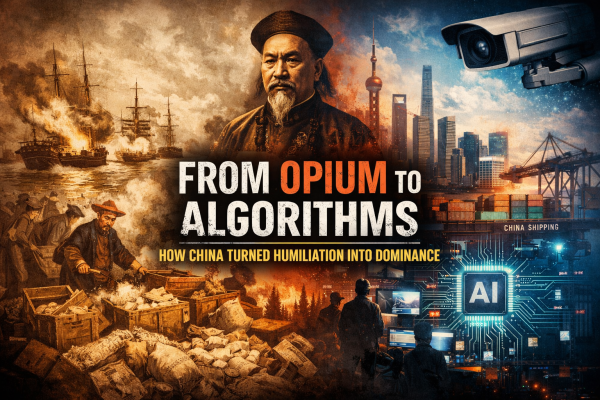
History doesn’t repeat, but it has a nasty habit of echoing—especially when humiliation is involved. The Opium Wars weren’t just another colonial skirmish. They were a civilizational shock, a moment when a confident, inward-looking China collided with an industrialized empire that understood something Beijing did not yet grasp: power in the modern world isn’t just about armies—it’s about systems, trade, and leverage.
In the early 19th century, Britain had a problem. China produced what the world wanted—tea, silk, porcelain—and demanded payment in silver. The British Empire was bleeding hard currency. Rather than accept the imbalance, Britain engineered a solution: opium. Grown in British India and smuggled into China, the drug created dependency at scale. Millions became addicted. Silver began flowing back out of China.
When Qing officials, led by Lin Zexu, tried to shut it down—confiscating and destroying thousands of chests of opium in 1839—Britain didn’t negotiate. It deployed the Royal Navy.
What followed in the First and Second Opium Wars (1839–1842, 1856–1860) wasn’t a fair fight. Steam-powered gunboats, modern artillery, and disciplined expeditionary forces shattered coastal defenses and sailed upriver into China’s economic heart. Britain didn’t need to conquer the country. It targeted choke points—ports, trade routes, and the Yangtze River—forcing Beijing to the table.
The result was the Treaty of Nanking and subsequent “unequal treaties.” China ceded Hong Kong, opened treaty ports, paid indemnities, and accepted extraterritorial legal systems that placed foreigners above Chinese law on Chinese soil. When resistance flared again, Anglo-French forces marched to Beijing and burned the Summer Palace—a message written in fire: comply or be broken.
This was not just defeat. It was humiliation. And in Chinese historical memory, it marks the beginning of what is now called the “Century of Humiliation,” a period from the Opium Wars through World War II in which foreign powers carved out influence, extracted concessions, and exposed the Qing state as incapable of defending its own sovereignty.
That memory matters—because modern China is built, in part, as a reaction to it.
Today’s Chinese leadership doesn’t talk about revenge. It talks about restoration. Under Xi Jinping, the mission is framed as national rejuvenation: China will never again be weak, divided, or dependent on foreign systems. But look closely, and the methods reveal something deeper. China has not rejected the logic used against it in the 19th century—it has studied it.
Where Britain used opium to rebalance trade, China uses manufacturing dominance and supply chains. Where Britain used gunboats to open markets, China uses infrastructure, financing, and economic dependency. The tools have changed, but the principle remains: shape the system, and you shape the outcome.
This is where the idea of fifth-generation warfare comes into play. In this framework, war is no longer declared. It is continuous, diffuse, and embedded in every domain—economic, informational, technological, and social. There are no clear battlefields, only pressure points. Victory doesn’t require invasion. It requires influence.
From that perspective, uncomfortable parallels begin to emerge.
The fentanyl crisis in the United States is not the Opium Wars in reverse. There is no credible evidence of a centralized Chinese state policy designed to addict Americans. The supply chain is fragmented: precursor chemicals produced by Chinese companies, trafficked through transnational criminal networks, and distributed by cartels. Beijing has taken some regulatory steps, including class-wide controls on fentanyl analogues.
But the structure is undeniably convenient. It offers plausible deniability at every level. The state can say—accurately, in many cases—that illicit actors are responsible. And yet, the effect is real: a strategic competitor is dealing with widespread addiction, social strain, and economic cost.
This is the gray zone where fifth-generation warfare lives. Intent is hard to prove. Effects are impossible to ignore.
China’s broader approach reinforces the pattern. It seeks centrality in global systems—rare earths, pharmaceuticals, electronics, logistics. It builds infrastructure across continents. It leverages markets, standards, and dependencies. It shapes narratives domestically and increasingly abroad. None of this looks like conquest in the 19th-century sense. It looks like something more patient, more systemic.
From Beijing’s perspective, this is not aggression. It is competence. It is what a stable, disciplined civilization does after learning hard lessons from history. The chaos, polarization, and internal vulnerabilities of Western societies are not something China needs to create. They are conditions to be observed—and, where possible, leveraged.
That is the real reversal.
In the 1800s, China faced an external power that exploited its weaknesses, dictated terms, and reshaped its system from the outside. Today, China is building a position where it can influence other systems from within—through trade, technology, and interdependence.
No gunboats required.
The Opium Wars taught China that sovereignty can be lost without total conquest, that economic imbalance can become strategic vulnerability, and that moral arguments mean little when backed by superior power. Those lessons were not forgotten. They were internalized.
And now, in a world where everything is a battleground—markets, information, supply chains, even public health (Covid-19) —the competition is no longer about who invades whom.
It’s about who designs the system everyone else has to live inside.
China intends to be that designer.
If you enjoyed this article, then please REPOST or SHARE with others; encourage them to follow AFNN. If you’d like to become a citizen contributor for AFNN, contact us at managingeditor@afnn.us Help keep us ad-free by donating here.
Substack: American Free News Network Substack
Truth Social: @AFNN_USA
Facebook: https://m.facebook.com/afnnusa
Telegram: https://t.me/joinchat/2_-GAzcXmIRjODNh
Twitter: https://twitter.com/AfnnUsa
GETTR: https://gettr.com/user/AFNN_USA
CloutHub: @AFNN_USA