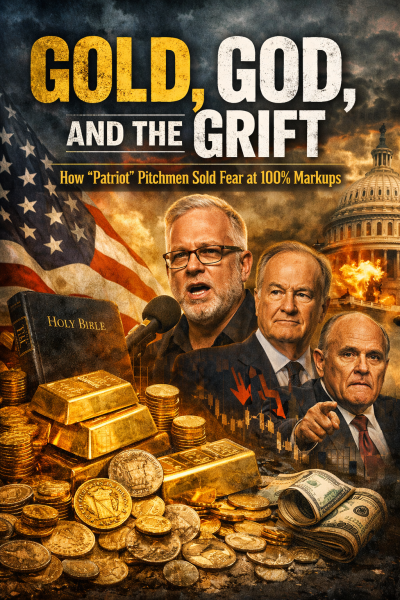
There’s a hard truth nobody likes to say out loud: this didn’t just happen because of a few shady coin dealers—it happened because trusted voices carried the water. When names like Glenn Beck, Bill O’Reilly, and Rudy Giuliani lent their platforms—directly or indirectly—to gold pitches, it wasn’t background noise. It was a credibility transfer. And when shows hosted by Laura Ingraham, Mark Levin, and Mike Huckabee ran those same ads day after day, it didn’t just sell metal—it sold trust. That trust had value, and someone cashed it.
Let’s be clear about what followed. Companies like Metals.com were shut down after massive fraud cases. Lear Capital didn’t implode for no reason—it faced multi-state investigations, bankruptcy, and was forced to pay money back to customers. Others were accused of charging 100%+ markups on basic bullion dressed up as “special” coins. The pattern wasn’t subtle: fear-based messaging, urgency, retirement rollovers, and then—quietly—the spread. That’s where the money was made.
And here’s the part that should sting: the audience wasn’t random. It was targeted. Christian, conservative, older Americans—people wired to value trust, authority, and shared belief. People who assume that if a voice they’ve listened to for years is associated with something, it’s been vetted. That assumption wasn’t just wrong—it was expensive.
Now, were these media figures sitting in back rooms plotting fraud? No. But that’s not the standard. The standard is responsibility. When you build a platform on trust—on values, on faith, on patriotism—you don’t get to shrug and say “it was just an ad read” when your audience gets burned. Ignorance isn’t a shield when you’re cashing the check. And greed isn’t a defense when the people paying for it are the same ones who believed you.
This is how the machine worked: fear gets attention, authority lowers skepticism, repetition builds familiarity, and then the sale closes. Not because the product is bad—gold is gold—but because the terms were hidden in plain sight. Markups that doubled the real value. Fees that only show up after the ink dries. Buybacks that suddenly look a lot less generous when it’s your turn to sell. That’s not investing—that’s asymmetry.
So here’s the uncomfortable question: if you trusted those voices enough to act, have you checked what you actually bought?
Pull your statements. Look at the per-ounce price you paid. Compare it to spot at the time. Factor in fees—setup, storage, custodial. Then ask what you’d get today if you sold it back. If the numbers don’t line up, don’t explain it away. Follow it.
Because at the end of the day, this wasn’t just about gold. It was about trust. And when trust gets monetized without accountability, it’s not just bad business—it’s a betrayal.
No slogans. No panic. Just math.
If you enjoyed this article, then please REPOST or SHARE with others; encourage them to follow AFNN. If you’d like to become a citizen contributor for AFNN, contact us at managingeditor@afnn.us Help keep us ad-free by donating here.
Substack: American Free News Network Substack
Truth Social: @AFNN_USA
Facebook: https://m.facebook.com/afnnusa
Telegram: https://t.me/joinchat/2_-GAzcXmIRjODNh
Twitter: https://twitter.com/AfnnUsa
GETTR: https://gettr.com/user/AFNN_USA
CloutHub: @AFNN_USA