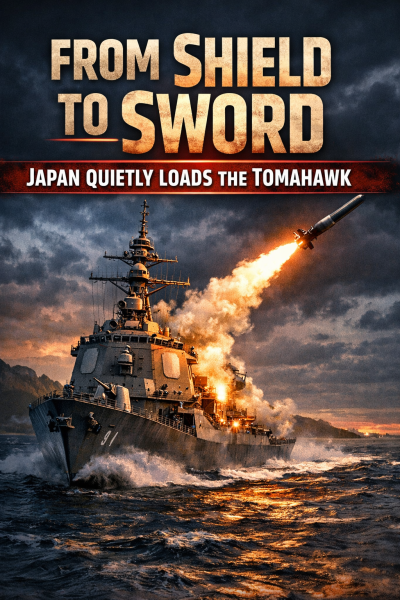
There was a time—not long ago—when the Japan Maritime Self-Defense Force operated like a disciplined sentry: alert, capable, and formidable, but fundamentally reactive. Their destroyers were built to defend sea lanes, hunt submarines, and intercept incoming threats, not to reach deep into an adversary’s homeland. That posture wasn’t an accident. It was the product of history, law, and a deliberate national choice to remain a shield in a dangerous neighborhood. But shields, as it turns out, are only comforting until someone realizes they don’t have to stand in front of them.
That equation is changing.
Japan is now integrating the Tomahawk cruise missile into its Aegis destroyer fleet, including the Kongō-class destroyer and Atago-class destroyer classes. On the surface, it looks like a technical upgrade, a matter of loading a different missile into the same vertical launch cells. But that’s like saying adding a long-range rifle to a perimeter guard is just a change in equipment. Capability changes behavior, and behavior changes strategy.
The Tomahawk is not a defensive interceptor. It is a precision land-attack weapon with a reach measured in hundreds of miles, capable of striking fixed infrastructure, command nodes, and high-value targets with little warning. Mounted at sea, it becomes even more significant. Ships move. They disperse. They complicate targeting. A fixed base can be mapped and planned against; a destroyer operating in the Western Pacific is a problem set that doesn’t sit still. Japan is not just acquiring a missile—it is acquiring options.
From a strategic perspective, this quietly shifts the center of gravity in how Japan participates in regional deterrence. For decades, the implicit understanding was that Japan would defend itself while the United States provided the long-range strike capability that held adversaries at risk. That division of labor is now blurring. A Japanese destroyer equipped with Tomahawks can independently contribute to strike operations, whether as part of a coalition or, if required, in defense of national interests. That changes alliance dynamics in subtle but important ways. Burden sharing is no longer theoretical; it is physically loaded into launch tubes.
Diplomatically, this move carries weight without requiring rhetoric. Japan has been careful to frame this capability as “counterstrike,” a term chosen with surgical precision to remain within the boundaries of its constitutional constraints. But in practice, the distinction between counterstrike and preemption depends on timing, intelligence, and interpretation. Regional actors understand this. They don’t need a press conference to grasp what a mobile, survivable, long-range strike capability represents. It signals that Japan is no longer content to absorb the first blow without the ability to respond in kind at distance.
Militarily, the implications are more direct. Adversary planners must now account for Japanese naval platforms as strike assets, not just defensive screens. That complicates targeting priorities and increases the number of variables in any conflict scenario. It also enhances deterrence by denial and punishment simultaneously. Denial comes from Japan’s existing missile defense capabilities; punishment now comes from the credible ability to reach back and impose costs. In operational terms, this creates a layered problem for any potential aggressor: even if you can penetrate defenses, you cannot assume sanctuary.
There is also an intelligence component that often gets overlooked. Long-range precision strike requires accurate, timely targeting data. By fielding Tomahawks, Japan is implicitly committing to expanding its intelligence, surveillance, and reconnaissance capabilities. Satellites, maritime patrol aircraft, signals intelligence—these are no longer supporting elements; they are prerequisites. This deepens integration with allied intelligence networks and reinforces Japan’s role as a full-spectrum contributor to regional security.
Economically and financially, the calculus is straightforward. The cost of acquiring and fielding Tomahawks is significant, but it is dwarfed by the cost of strategic vulnerability. Deterrence, when credible, is a cost-saving measure. It forces potential adversaries to invest more in defense, dispersal, and hardening, raising the price of aggression before a shot is ever fired. In that sense, the missile is less a weapon of war than a tool of prevention.
The legal and political balancing act remains delicate. Japan must maintain the narrative that this capability is consistent with its defensive doctrine. That will require careful articulation of rules of engagement, command authority, and the conditions under which such weapons would be employed. But capability has a way of shaping interpretation. Once a nation possesses the means to act, the debate shifts from “can we” to “when would we.”
The bottom line is this: Japan has not abandoned its identity as a defensive power, but it has redefined what defense means in a world where threats travel faster and farther than ever before. A shield that cannot reach beyond its own perimeter invites pressure. A shield backed by a precise, mobile, and credible strike capability changes the conversation entirely. Quietly, without theatrics, Japan has taken a step that ensures it will no longer be viewed as a nation that can only absorb risk. It can now impose it.
If you enjoyed this article, then please REPOST or SHARE with others; encourage them to follow AFNN. If you’d like to become a citizen contributor for AFNN, contact us at managingeditor@afnn.us Help keep us ad-free by donating here.
Substack: American Free News Network Substack
Truth Social: @AFNN_USA
Facebook: https://m.facebook.com/afnnusa
Telegram: https://t.me/joinchat/2_-GAzcXmIRjODNh
Twitter: https://twitter.com/AfnnUsa
GETTR: https://gettr.com/user/AFNN_USA
CloutHub: @AFNN_USA