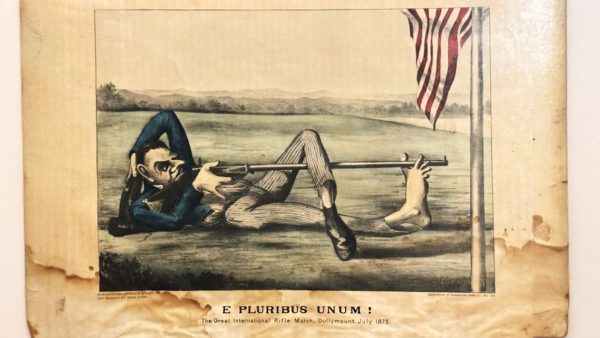
The year was 1875, and long before ESPN, endorsement deals, or even organized leagues as we know them, one of the most electric sporting events on earth unfolded on a windswept stretch of Irish coastline at Dollymount, just outside Dublin. This was the Great International Rifle Match—a transatlantic clash that, for a brief window in history, made precision rifle shooting a premier spectator sport.
The buildup alone felt like a championship bout. Unlike today’s Palma Team USA—which flies overseas with Pelican cases and airline itineraries—the American team of 1875 crossed the Atlantic by steamship. Rifles, ammunition, gear, and men committed to weeks at sea before ever firing a shot in competition. Waiting for them were Ireland’s finest marksmen, backed by the prestige of the National Rifle Association of Ireland, along with challengers from England and Scotland. Four nations. One firing line. No shortcuts getting there.
And the crowds? Thousands. Not dozens—thousands. They gathered along the range as if attending a modern playoff game, watching in silence as shooters settled in for shots that could take minutes to break. Targets sat at distances of 800, 900, and 1,000 yards—distances that still define elite long-range shooting today. But the tools were vastly different. These men shot black powder rifles—large, heavy, smoke-belching machines that filled the air with haze after every trigger pull. Each shot required patience, recovery, and a moment for the smoke to drift clear before the next attempt.
Wind wasn’t a factor—it was the factor. Rolling in off Dublin Bay, it shifted, curled, and punished indecision. There were no Kestrels, no ballistic solvers, no Doppler data. Just flags, mirage, grass movement, and instinct honed through repetition. Every shot was a calculation made in real time, with no undo button.
The firing line itself looked nothing like what we’d recognize today. This was before modern prone was standardized, and the positions—captured in those famous engravings—ranged from efficient to borderline acrobatic. Americans tended toward a flatter, more stable approach, while others experimented with elevated torsos, odd arm placements, and improvised support. It wasn’t pretty, but it was innovation under pressure. The sport was still inventing itself.
What many forget is that this wasn’t just a one-off spectacle in Ireland. The United States had already hosted its own version of long-range drama at Creedmoor, on Long Island—home to a 1,000-yard rifle range just outside New York City. Let that sink in: a full-distance long-range facility within reach of one of the world’s largest cities. The matches at Creedmoor helped establish the format and prestige that Dollymount would amplify on the international stage.
And when the smoke settled—literally and figuratively—the Americans emerged victorious. It wasn’t just a win; it was a declaration. The New World had arrived in a sport long dominated by European tradition, and it did so not with flash, but with discipline, precision, and the ability to read the wind better than the next man.
Today, long-range shooting lives on through disciplines like Palma, still stretching to 1,000 yards, still demanding the same core skills. But Dollymount reminds us of something we’ve largely lost: a time when this sport stood in the spotlight, when thousands gathered to watch a man lie in the grass, breathe, wait, and send a single bullet across nearly half a mile—with nothing but black powder, iron sights, and conviction.
For a moment in 1875, marksmanship wasn’t niche. It was the main event.
If you enjoyed this article, then please REPOST or SHARE with others; encourage them to follow AFNN. If you’d like to become a citizen contributor for AFNN, contact us at managingeditor@afnn.us Help keep us ad-free by donating here.
Substack: American Free News Network Substack
Truth Social: @AFNN_USA
Facebook: https://m.facebook.com/afnnusa
Telegram: https://t.me/joinchat/2_-GAzcXmIRjODNh
Twitter: https://twitter.com/AfnnUsa
GETTR: https://gettr.com/user/AFNN_USA
CloutHub: @AFNN_USA