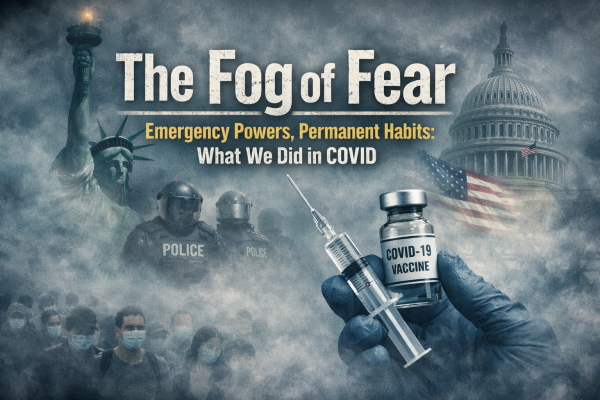
You don’t need 800 pages to explain what just happened—you need about 800 words, a memory longer than a news cycle, and a willingness to admit that fear makes otherwise rational people do very irrational, very coercive things.
The COVID era didn’t begin as tyranny. It began as uncertainty. A novel virus, incomplete data, models that ranged from sobering to apocalyptic, and leaders who—whether you agree with them or not—were operating in a fog of incomplete information. That part is understandable. What followed is where things went sideways.
By late 2020, vaccines arrived under emergency authorization. That should have been the turning point—the moment where risk became individualized again. Instead, the dial kept turning in one direction: more control, more pressure, more compliance. By September 2021, the federal government, under Joe Biden, pushed for sweeping mandates, including a requirement aimed at large employers through OSHA. It was framed as necessity. It was enforced as urgency. And it was received, in many corners, as coercion.
Now here’s where the story stops being about public health and starts being about power.
Employers—corporations, hospitals, bureaucracies that normally move at glacier speed—suddenly moved with lightning precision when it came to mandates. Policies were rolled out with all the nuance of a sledgehammer. Exemptions? Technically available. Practically? Often treated like a nuisance. Religious accommodation—a concept baked into federal law for decades—became something to “process,” not something to respect.
Fear doesn’t just make people cautious. It makes them rigid. And rigidity, when paired with authority, looks a lot like overreach.
Fast forward to today, and we’re starting to see the legal system do what it was designed to do: apply friction. One of the more visible examples is the case against Blue Cross Blue Shield of Michigan, where a federal jury found that an employee was wrongfully terminated after a denied religious exemption. The headline number—roughly $12.7 million—grabbed attention, especially the punitive damages. Yes, those numbers will likely be reduced due to statutory caps. That’s not the point.
The point is this: a jury looked at the facts and said, “You went too far.”
That’s the correction phase. It’s slow, imperfect, and years late—but it’s happening. Lawsuits are not about relitigating the virus. They’re about process. Did employers follow the law? Did they meaningfully consider exemptions? Or did they operate under a kind of institutional panic where the only acceptable answer was compliance?
And that’s the uncomfortable truth—many organizations didn’t just comply with government guidance, they amplified it. They became enforcers. Not because they were evil, but because they were afraid: afraid of liability, afraid of public backlash, afraid of being the outlier in a herd that had already decided what “responsible” looked like.
But fear is not a legal standard. And it’s certainly not a constitutional one.
The American system—messy, slow, often frustrating—is intentionally designed to resist exactly this kind of momentum. Rights aren’t supposed to disappear when things get hard. They’re supposed to be tested, weighed, and preserved unless there’s a compelling, narrowly tailored reason to override them. That’s the theory. In practice, during COVID, we saw how quickly that balance can tilt.
Now comes the real question: have we learned anything?
History suggests… not much.
Every crisis comes with its own flavor—terrorism, financial collapse, pandemics—and each one produces the same pattern. Initial shock. Rapid consolidation of authority. Public buy-in driven by fear. Then, years later, a slow unwind where courts, analysts, and historians start asking, “Was all of that necessary?”
Sometimes the answer is yes. Often, the answer is “some of it.” Rarely is the answer, “We nailed that perfectly.”
What’s different this time is the scale of everyday impact. This wasn’t just airport security or overseas policy. This reached into workplaces, schools, churches—into ordinary people’s ability to make decisions about their own bodies and livelihoods. That proximity is why the backlash feels sharper now.
But backlash isn’t the same as reform.
If you’re looking for evidence that we’ve internalized the lessons, you’d expect to see clearer guardrails, more precise legal standards, and a cultural shift toward skepticism of broad, one-size-fits-all mandates. Instead, what you mostly see is polarization—two sides arguing about whether anything was wrong at all.
That’s not learning. That’s entrenchment.
The real lesson, if anyone’s willing to absorb it, is that emergency powers have a way of sticking around longer than the emergency itself. Institutions don’t naturally give power back; they have to be pushed. Courts help. Juries help. Time helps. But none of those are substitutes for a population that remembers what happened and asks harder questions the next time someone says, “This is for your safety.”
Because there will be a next time. Different crisis, same playbook.
And when it comes, the question won’t be whether we have the tools to respond. We do. The question will be whether we have the discipline to use them without steamrolling the very rights those tools are supposed to protect.
If the early signs are any indication, that’s still very much an open question.
If you enjoyed this article, then please REPOST or SHARE with others; encourage them to follow AFNN. If you’d like to become a citizen contributor for AFNN, contact us at managingeditor@afnn.us Help keep us ad-free by donating here.
Substack: American Free News Network Substack
Truth Social: @AFNN_USA
Facebook: https://m.facebook.com/afnnusa
Telegram: https://t.me/joinchat/2_-GAzcXmIRjODNh
Twitter: https://twitter.com/AfnnUsa
GETTR: https://gettr.com/user/AFNN_USA
CloutHub: @AFNN_USA