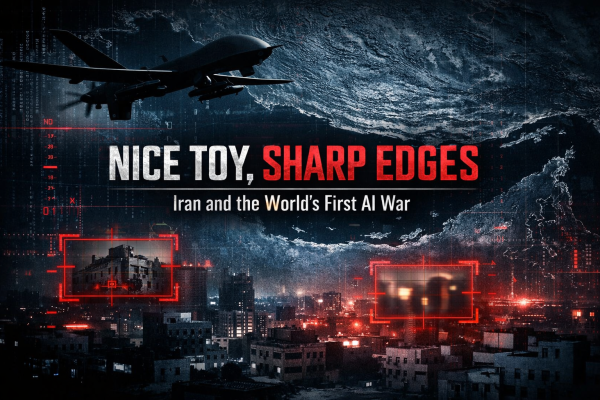
We’ve got a new toy. It’s sleek, fast, doesn’t get tired, doesn’t argue, and it can chew through more data in a minute than a staff section could in a week. We bolted it onto the most capable military on earth and told it to help us find targets. Then we dropped it into a live fight in one of the most complex battlespaces on the planet and acted surprised when the results were… mixed. Welcome to the world’s first real AI war.
This isn’t about a gadget. It’s a shift in how decisions get made. For centuries, revolutions in warfare changed how we delivered violence. The stirrup turned horsemen into shock troops and made infantry rethink their life choices. The rifled musket made neat lines of men standing shoulder to shoulder an obituary format. The machine gun turned bravery into a liability if you tried to cross open ground. Every one of those innovations rewrote tactics, and every one of them punished the side that didn’t adapt fast enough.
But they all kept one thing intact: the human sat at the center of the decision. The commander decided where to strike. The staff argued, refined, and second-guessed. Time—precious, frustrating time—existed between sensing and shooting. That time was a buffer. It allowed doubt to creep in, and doubt, inconvenient as it is, has saved a lot of lives.
Now we’ve decided time is the enemy.
Enter Palantir Technologies and its cousins, feeding systems like Project Maven. They vacuum up satellite feeds, drone video, signals intelligence, pattern-of-life data—every digital breadcrumb you can imagine—and fuse it into something a commander can act on. The pitch is simple: find targets faster, prioritize them smarter, and compress the “kill chain” from hours to minutes. In the opening phase of the Iran fight, that meant target lists appearing at a pace no human staff could match. It’s not a kill chain anymore. It’s a conveyor belt.
And it works. That’s the seductive part. You can see more, sort more, decide more—at least it feels like deciding—at a tempo that leaves your opponent reacting instead of planning. In a fight around the Strait of Hormuz, where missiles, drones, and maritime choke points collide, speed is oxygen. The side that processes faster gets inside the other guy’s decision loop and starts stacking advantages.
But here’s the part that doesn’t fit on a recruiting poster: when the machine builds the menu, the human stops asking “what should we strike?” and starts asking “which of these should we strike first?” That’s not command; that’s curation. The algorithm becomes your staff officer, except it doesn’t get tired, doesn’t push back, and doesn’t have a career to protect when it’s wrong.
We’re still learning how to use it.
And learning, historically, is expensive.
Somewhere in that learning curve sits the possibility—still argued over, still under investigation—of a strike on a girls’ school. You can already hear the arguments lining up like lawyers outside a courthouse. “The AI did it.” “The human approved it.” “The data was bad.” The truth, as usual, is uglier and more mundane. These systems don’t declare targets; they assign probabilities. High confidence looks authoritative, especially when the system has been right nine times out of ten. Under time pressure, with a fleeting window and a screen full of “high-confidence” options, the human in the loop can become a rubber stamp with a rank.
This is called automation bias if you want the academic term. Out here, it’s called trusting the tool that’s been saving your bacon all week.
Stack enough of those conditions—ambiguous data, a model that recognizes patterns but not context, a commander who doesn’t have an hour to debate, and a system designed to reward speed—and you get a mistake that moves at machine velocity. No villain twirling a mustache. No rogue AI deciding to go full science fiction. Just a chain of reasonable decisions made too quickly on top of a recommendation that looked solid until it wasn’t.
The uncomfortable truth is that this isn’t a bug; it’s a tradeoff. We optimized for tempo. We accepted less time for doubt. We told ourselves that a human remains “in the loop,” and legally that’s true. Practically, the loop has changed shape. The machine proposes, the human approves, the machine executes. Responsibility still sits on a person, but the options were framed upstream by code.
If this feels like a revolution, that’s because it is. The decisive edge is no longer just range, payload, or platform. It’s decision speed. The side that can turn data into action faster gains initiative, and initiative wins fights. That’s the promise. The cost is that the buffer between sensing and shooting—the space where a skeptical staff officer might have said “hold on, that looks off”—is getting squeezed out of existence.
And while we’re admiring our new toy, the rest of the world is taking notes. If software is central to targeting, then software companies become part of the war effort whether they like it or not. If decision speed is the advantage, then deception—feeding bad data, spoofing signatures, hiding in civilian patterns—becomes the counter. Iran doesn’t have to outbuild the United States to compete; it can try to out-confuse the system that’s doing the sorting.
History says early adopters of a new way of war get both the advantage and the bloody lessons. Cavalry charges worked until they met disciplined pikes. Massed formations worked until rifling made them targets. We’re in that awkward phase where the capability is real, the doctrine is immature, and the guardrails are still being drawn in pencil.
So yes, we have a nice, cool new toy. It’s powerful, it’s fast, and in the right hands it will change how wars are fought. But it has sharp edges, and we’re still figuring out where they are. The Iran fight isn’t just about tankers and missiles. It’s a proving ground for a system that moves faster than our habits, our laws, and sometimes our judgment.
The stirrup didn’t come with a warning label either.
If you enjoyed this article, then please REPOST or SHARE with others; encourage them to follow AFNN. If you’d like to become a citizen contributor for AFNN, contact us at managingeditor@afnn.us Help keep us ad-free by donating here.
Substack: American Free News Network Substack
Truth Social: @AFNN_USA
Facebook: https://m.facebook.com/afnnusa
Telegram: https://t.me/joinchat/2_-GAzcXmIRjODNh
Twitter: https://twitter.com/AfnnUsa
GETTR: https://gettr.com/user/AFNN_USA
CloutHub: @AFNN_USA