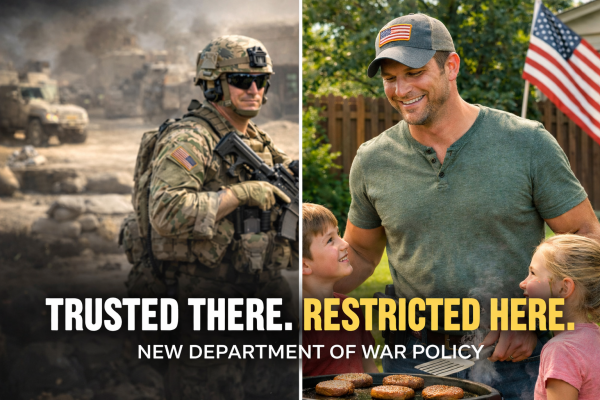
If we trust a service member overseas with a loaded rifle, real rules of engagement, and life-and-death decisions in a combat zone, it makes no sense to suddenly treat that same disciplined professional like a liability the moment they step onto a stateside installation; this policy correction acknowledges a simple truth long overdue—responsibility doesn’t evaporate at the gate. The men and women we entrust to defend the nation are trained, vetted, and held to standards far above the civilian baseline, and if we truly believe in that system, then extending reasonable trust for personal defense at home isn’t radical, it’s consistent. And if someone genuinely cannot be trusted with a firearm under controlled conditions on base, then the harder question isn’t about policy—it’s about why they’re in uniform in the first place.
Now, before the internet commandos start chest-thumping about “every E-3 packing heat in the PX,” let’s slow down and read the actual order. Defense Secretary Pete Hegseth didn’t turn Fort Everywhere into the Wild West. He signed a memo that does something far more subtle—and frankly, far more dangerous to bureaucracy than any pistol ever could: it shifts trust back toward the individual service member.
For decades, the standing policy treated military installations like sterile zones. Unless you were on duty, an MP, or actively training, your privately owned firearm was basically contraband with paperwork. The default answer was “no,” wrapped in layers of command approval, storage rules, and administrative friction that made carrying on base nearly impossible.
Hegseth didn’t eliminate command authority. He didn’t greenlight universal concealed carry. He didn’t tell commanders to hand out Glocks like CIF gear. What he did was flip the presumption. Requests to carry a privately owned firearm for personal protection are now to be considered valid by default, and denials must be justified—not the other way around.
That may sound like a small bureaucratic tweak. It isn’t. It’s a philosophical reversal.
Because here’s the uncomfortable truth the old policy never wanted to admit: military bases were effectively soft targets wrapped in a comforting illusion of control. Even Hegseth said it plainly—installations had become “gun-free zones” unless you were in a very specific category of authorized personnel. And history hasn’t been kind to that model. Fort Hood. Pensacola. Fort Stewart. Every time, the same question echoes: why are the only people with guns the ones arriving after the shooting starts?
The new policy doesn’t guarantee a perfect answer. But it at least acknowledges the question is legitimate.
Critics are already lining up, warning about increased risk—suicides, negligent discharges, escalation. And those concerns aren’t imaginary. The military already wrestles with firearm-related suicides, most involving privately owned weapons. That reality doesn’t disappear because a memo gets signed.
But here’s where Cedar Savage logic kicks in: risk didn’t magically begin with this policy—it was already there. The difference now is whether you trust the institution you’ve built.
You can’t simultaneously claim that a 22-year-old infantryman is mature enough to carry a weapon in a foreign country, make split-second decisions under fire, and represent the United States of America—and then say that same individual becomes a danger to society the moment he drives through the front gate at Fort Home Station.
That’s not policy. That’s cognitive dissonance.
And let’s talk about commanders, because this is where rubber meets road. The memo still leaves implementation in their hands, which means reality will vary wildly. One base commander will interpret this like a Second Amendment revival meeting. Another will treat it like a compliance exercise wrapped in paperwork and “additional training requirements.” Same policy—two completely different outcomes.
Welcome to the U.S. military, where the regulation is universal and the enforcement is local.
There’s also the quiet, unspoken impact: this policy forces leaders to confront their own trust calculus. Not in abstract PowerPoint slides, but in actual decisions about actual people. Do you trust your soldiers? Your airmen? Your Marines? Or do you trust the system that keeps them disarmed until something goes wrong?
Because you don’t get to have it both ways.
The deeper issue here isn’t firearms—it’s confidence in the force. Hegseth’s broader push has been about restoring what he calls a “warrior ethos,” stripping away layers of administrative caution that, in his view, diluted readiness. This policy fits squarely in that lane: less nanny-state oversight, more individual responsibility.
And that makes people uncomfortable.
Good.
Because discomfort usually means you’ve hit a nerve—and in this case, the nerve is whether we actually believe in the men and women wearing the uniform, or just the idea of them.
Bottom line: this isn’t about turning bases into armed camps. It’s about aligning policy with reality. We already trust these individuals with extraordinary responsibility. The only question left is whether we’re honest enough to admit it when they come home.
If you enjoyed this article, then please REPOST or SHARE with others; encourage them to follow AFNN. If you’d like to become a citizen contributor for AFNN, contact us at managingeditor@afnn.us Help keep us ad-free by donating here.
Substack: American Free News Network Substack
Truth Social: @AFNN_USA
Facebook: https://m.facebook.com/afnnusa
Telegram: https://t.me/joinchat/2_-GAzcXmIRjODNh
Twitter: https://twitter.com/AfnnUsa
GETTR: https://gettr.com/user/AFNN_USA
CloutHub: @AFNN_USA