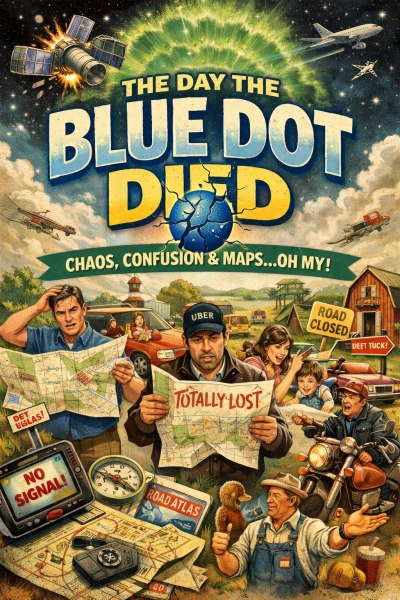
It started at 9:17 a.m., which—ironically—everyone only knew because their microwave clocks still worked.
Somewhere far above the planet, an unnamed adversary (or possibly a very angry solar flare with a sense of humor) popped off an EMP that politely but firmly unplugged every satellite we’d been leaning on since the late 20th century. GPS—born in the 1970s as a military system and later handed to civilians like candy—vanished in a blink. Along with it went the internet, streaming music, weather apps, and that calm, robotic voice that had spent decades telling Americans when to turn left.
And just like that, the blue dot disappeared.
At 9:18 a.m., the nation entered Stage One: Mild Confusion.
People stared at their phones like betrayed lovers. They refreshed apps that no longer refreshed. They tapped maps that showed nothing but a stubborn gray grid, like a blank stare. Somewhere, a guy in a Starbucks parking lot slowly rotated in place, holding his phone up like a divining rod.
“Recalculating,” he whispered, even though nothing was.
By 9:25 a.m., Stage Two began: Denial.
“I know where I’m going,” millions declared confidently, before immediately making a wrong turn into a dentist’s office parking lot. Across the country, commuters began performing the sacred ritual of the U-turn—sometimes legal, often not, occasionally involving a median, a ditch, and a deep sense of regret.
Traffic reports ceased to exist. Not because traffic disappeared—oh no—but because nobody could report on it anymore. Traffic wasn’t a condition; it was now a lifestyle.
By 10:00 a.m., Stage Three arrived: Chaos, Chaos, and Pandemonium.
Airline pilots, suddenly deprived of GPS, rediscovered a dusty concept known as “navigation.” Somewhere over Kansas, a captain leaned into the cockpit mic and said, “Does anyone remember how to use… maps?”
His co-pilot, flipping through a manual last opened during the Clinton administration, responded, “I found something called a ‘VOR.’ Is that a Pokémon?”
On the ground, Uber drivers became philosophers. One stared into the middle distance and muttered, “What is a destination, really?”
Food delivery collapsed instantly. One DoorDash driver delivered pad thai to a man in Ohio who had ordered it in Arizona. The man in Ohio accepted it anyway. It was a dark time.
Meanwhile, XM radio went silent. Millions were left alone with their own thoughts while driving—a situation previously classified as a Level 5 emergency. One commuter, hearing nothing but the hum of his tires, reportedly whispered, “So this is what my brain sounds like.”
By noon, Stage Four emerged: Improvisation.
Gas stations became intelligence hubs. People gathered around ancient, dusty map racks like archaeologists discovering a lost civilization.
“Fold it,” one man instructed confidently.
“I don’t think it folds that way,” another replied, now entangled in a paper monstrosity that had somehow become both a cube and a weapon.
Truckers—long the last guardians of pre-digital navigation—rose to power. One was seen calmly sipping coffee while giving directions like a wizard of the old ways.
“Go past the big oak tree, take a left where the Dairy Queen used to be, then follow the road until it feels right.”
And somehow… it worked.
Teenagers, previously dependent on GPS for trips longer than three blocks, began calling their parents.
“Dad… how do I get home?”
“Son,” the father said, voice trembling with purpose, “you’re about to become a man.”
By mid-afternoon, Stage Five: Acceptance.
People began to notice things. Landmarks. Street signs. The sun. One woman reportedly navigated entirely by “vibes and a church steeple,” arriving at her destination only 45 minutes late—a personal best under the circumstances.
Neighbors talked. Strangers helped. Someone used a compass app—then realized it didn’t work—and found an actual compass in a junk drawer next to expired batteries and a mysterious Allen wrench.
And slowly, miraculously, people adapted.
By evening, America had rediscovered something ancient and terrifying: spatial awareness.
The day ended not with a bang, but with millions of people successfully finding their way home using nothing but memory, luck, and vague directions involving a red barn that may or may not still exist.
Phones remained dark. Satellites remained silent. The blue dot was gone.
But somewhere, deep in the American psyche, a flicker of confidence returned.
“We made it,” people said.
Then someone asked, “Wait… how do we get to work tomorrow?”
And just like that—
Chaos, chaos, and pandemonium… resumed.
If you enjoyed this article, then please REPOST or SHARE with others; encourage them to follow AFNN. If you’d like to become a citizen contributor for AFNN, contact us at managingeditor@afnn.us Help keep us ad-free by donating here.
Substack: American Free News Network Substack
Truth Social: @AFNN_USA
Facebook: https://m.facebook.com/afnnusa
Telegram: https://t.me/joinchat/2_-GAzcXmIRjODNh
Twitter: https://twitter.com/AfnnUsa
GETTR: https://gettr.com/user/AFNN_USA
CloutHub: @AFNN_USA