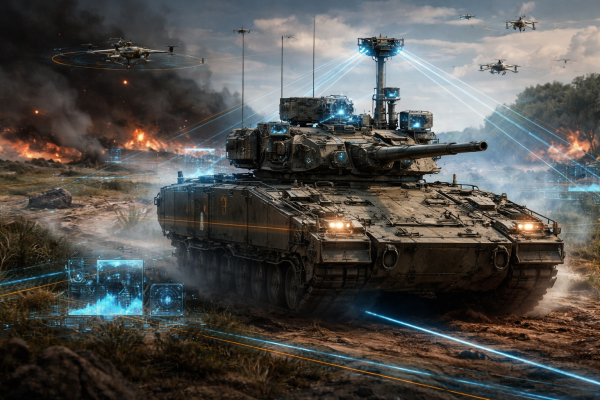
For decades, armored warfare was built on a simple, brutal equation: armor protects, firepower kills, mobility wins. Tanks and infantry fighting vehicles like the M2 Bradley were designed for a world where the biggest threat came from another armored formation across the tree line. You found the enemy, you engaged, and whoever shot first—accurately—usually won. That world is gone. Ukraine didn’t just tweak the formula; it detonated it. The battlefield now sees everything, all the time, from above, and the kill chain has compressed from minutes to seconds.
The romantic image of armored columns rolling forward under cover of smoke and artillery has been replaced by something far less cinematic: vehicles hiding, dispersing, and moving like hunted animals under constant aerial surveillance. Cheap drones—$500 quadcopters and $20,000 FPV kamikazes—are hunting million-dollar platforms with ruthless efficiency. The lesson is not subtle. If you can be seen, you can be targeted. If you can be targeted, you can be killed.
That’s the environment the XM30 Mechanized Infantry Combat Vehicle is being built for, and it tells you everything you need to know about where armored warfare is heading. Not toward thicker armor, not toward bigger guns alone, but toward something closer to a rolling node in a digital kill web. The XM30 isn’t just replacing the Bradley; it’s replacing the entire idea of what an infantry fighting vehicle is supposed to be.
Start with survivability. The old model assumed you’d take hits and survive them. The new model assumes you avoid being hit in the first place. That’s why the XM30 moves the crew into a protected “citadel” and pushes the turret out to a remote system. It’s why open architecture matters more than armor thickness. You’re not just bolting on steel; you’re constantly upgrading sensors, electronic warfare packages, and active protection systems to stay ahead of whatever drone or loitering munition shows up next month.
Because here’s the uncomfortable truth Ukraine exposed: passive armor is losing the race. You cannot bolt enough steel onto a vehicle to defeat top-attack munitions, loitering drones, and tandem-charge warheads without turning that vehicle into an immobile coffin. The answer isn’t “more armor.” The answer is not being where the enemy thinks you are, and if you are—killing the threat before it finishes its attack run.
That’s where the 50mm cannon on XM30 comes in. Not because bigger is always better, but because modern combat demands versatility. Airburst rounds for dismounted infantry. Programmable munitions for drones. Enough punch to defeat light armor at standoff. It’s not just a gun; it’s a multi-role tool for a battlefield where threats come from every direction, including straight down.
But the real shift isn’t the gun. It’s the network.
Ukraine has proven that the side with the faster kill chain wins. Not the better tank. Not the thicker armor. The faster kill chain. Drones find you. Data flows. Fires arrive. End of story. The XM30 is being built to live inside that ecosystem, not outside it. It’s designed to control drones, integrate feeds, and operate alongside unmanned systems like extensions of itself. The crew is no longer just driving and shooting; they’re managing a small robotic formation, pushing sensors forward while keeping the expensive manned platform just far enough back to survive.
That’s the future: manned-unmanned teaming, where the vehicle you see is not the one doing the riskiest work. The risk gets pushed outward—to drones, to robotic scouts, to disposable systems. The armored vehicle becomes the quarterback, not the running back.
And that leads to a hard pill for traditionalists: the era of massed armored formations may be over, at least in the way we understood them. Ukraine has shown what happens when you bunch up under persistent ISR—artillery and drones turn formations into graveyards. Dispersion is no longer optional; it’s survival. Units are spreading out, operating in smaller elements, constantly moving, constantly masking, constantly fighting for information dominance.
Armor still matters. Anyone who tells you otherwise hasn’t been paying attention. Infantry still needs protected mobility. Firepower still wins fights. But armor is no longer the centerpiece. It’s part of a system—a node in a larger network that includes drones, satellites, electronic warfare, and long-range fires. Without that system, even the best vehicle becomes just another target.
There’s also a strategic implication most people miss. The cost curve is inverted. We’re fielding multi-million-dollar platforms that can be threatened by systems that cost less than a used pickup truck. That’s not sustainable unless we change how we fight. You don’t expose your high-value assets unless the payoff justifies the risk. You use them selectively, deliberately, and with overwhelming information advantage.
Which brings us back to XM30. It’s not a silver bullet. It won’t magically make armored warfare safe again. But it represents a recognition—finally—that the battlefield has changed faster than our doctrine. Open architecture, remote systems, drone integration, reduced crew exposure—these are not luxuries. They are survival requirements.
The future armored fight will not be decided by who has the best tank. It will be decided by who sees first, processes faster, and strikes before the other side can react. Ukraine didn’t just show us that. It burned it into the landscape in twisted steel and shattered hulls.
Adapt or die isn’t a slogan anymore. It’s the operating manual.
If you enjoyed this article, then please REPOST or SHARE with others; encourage them to follow AFNN. If you’d like to become a citizen contributor for AFNN, contact us at managingeditor@afnn.us Help keep us ad-free by donating here.
Substack: AmericanFreeNewsNetworkSubstack
TruthSocial:@AFNN_USA
Facebook: https://m.facebook.com/afnnusa
Telegram: https://t.me/joinchat/2_-GAzcXmIRjODNh
Twitter: https://twitter.com/AfnnUsa
GETTR: https://gettr.com/user/AFNN_USA
CloutHub: @AFNN_USA