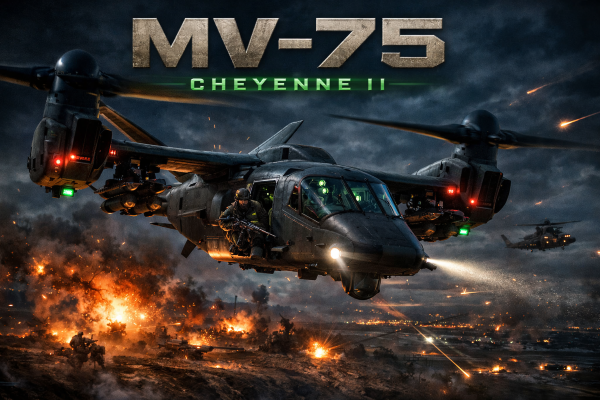
Before the acronyms, before the billion-dollar programs and PowerPoint wars, Army aviation was built on a simple idea: if you can move soldiers faster than the enemy expects, you control the fight. That idea didn’t come out of a lab—it came out of places like Vietnam, where helicopters didn’t just support the fight, they became the fight.
Watch “We Were Soldiers” and you get a glimpse of that moment at the Battle of Ia Drang. Lieutenant Colonel Hal Moore didn’t walk his men into the jungle—he flew them there. The Bell UH-1 Iroquois turned distance into irrelevance and terrain into an inconvenience. That was the birth of modern air assault, and the U.S. Army didn’t just participate in it—it pioneered it.
From the Huey came the UH-60 Black Hawk, a machine that carried that doctrine across decades of conflict. It hauled troops, evacuated wounded, delivered supplies, and absorbed punishment in ways that earned it a reputation bordering on myth. For years, if soldiers needed to get somewhere dangerous quickly, the Black Hawk was the answer.
But the battlefield kept evolving. Distances got longer. Air defenses got smarter. The margin for error shrank. And while the need for human soldiers on the ground never went away, the requirement to get them there—fast, protected, and unpredictable—became more urgent than ever.
That’s where the MV-75 comes in.
Built by Bell Textron, the MV-75 is the Army’s Future Long-Range Assault Aircraft, and it represents the next logical step in a lineage that started with the Huey. It’s often nicknamed “Cheyenne II,” a nod to the ambitious Lockheed AH-56 Cheyenne that pushed the boundaries of speed and capability decades ago. Whether the name sticks or not, the intent is clear: this aircraft is meant to move the fight forward again.
At its core, the MV-75 is a tiltrotor aircraft. It lifts vertically like a helicopter, then rotates its rotors forward and flies like a fixed-wing aircraft. That combination changes everything. Instead of cruising at traditional helicopter speeds, it moves at roughly 280 knots, covering distances that would have required multiple legs and refueling stops in the past. With a combat range pushing beyond 500 nautical miles, it allows commanders to launch from safer distances and still arrive with speed and precision.
Inside, it carries around fourteen fully equipped troops—an air assault element ready to step off the ramp and take ground. Externally, it can move significant loads, supporting the same logistical backbone that has always been part of Army aviation’s mission. But the real advantage is not just capacity—it’s tempo. The MV-75 compresses time, reduces exposure, and limits how long it sits inside an enemy’s engagement window.
The aircraft is designed with modern systems from the ground up. Fly-by-wire controls, advanced avionics, and an open architecture mean it can evolve as technology advances. Defensive armament will include crew-served weapons for protection during insertion and extraction, and the platform is expected to grow into expanded roles with precision weapons and unmanned system integration. The direction is clear: the assault aircraft is becoming part of a larger, connected battlefield where information and speed matter as much as firepower.
And yet, for all the technology, Army aviation still comes down to people.
One of the most distinctive aspects of Army aviation is who flies these machines. Unlike other services that require commissioned officers with college degrees to sit in the cockpit, the Army has long trusted its warrant officers—technical experts who rise through the ranks based on skill, performance, and mastery of their craft. A soldier can become an Army aviator without a traditional four-year degree, stepping into one of the most demanding roles in the military through competence and training rather than credentials alone.
That matters. It creates a culture where the person flying the aircraft is often a specialist in that aircraft first and foremost—a professional focused on execution, not just leadership from above. It’s part of what has made Army aviation effective from the jungles of Vietnam to the deserts and mountains of more recent conflicts.
The MV-75 builds on that legacy. It gives those aviators a machine that matches the demands of the modern battlefield. Faster ingress means less time exposed. Greater range means fewer vulnerable staging points. Advanced systems mean better awareness and coordination. It doesn’t replace the soldier—it empowers the soldier.
Programs like this don’t come cheap. Estimates place the aircraft somewhere in the tens of millions per unit, with the broader program reaching into the tens of billions over time. But in context, it’s an investment in maintaining an advantage that has defined Army operations for decades: the ability to put soldiers where they need to be, when they need to be there, with overwhelming effect.
From the Huey lifting troops into Ia Drang, to the Black Hawk defining modern air mobility, to the MV-75 extending that reach across vast and contested spaces, the story is consistent. The Army adapts. It builds on what works. And it refuses to give up the initiative.
The MV-75 isn’t just a new aircraft. It’s the continuation of a proven idea—refined, accelerated, and ready for whatever comes next.
If you enjoyed this article, then please REPOST or SHARE with others; encourage them to follow AFNN. If you’d like to become a citizen contributor for AFNN, contact us at managingeditor@afnn.us Help keep us ad-free by donating here.
Substack: American Free News Network Substack
Truth Social: @AFNN_USA
Facebook: https://m.facebook.com/afnnusa
Telegram: https://t.me/joinchat/2_-GAzcXmIRjODNh
Twitter: https://twitter.com/AfnnUsa
GETTR: https://gettr.com/user/AFNN_USA
CloutHub: @AFNN_USA