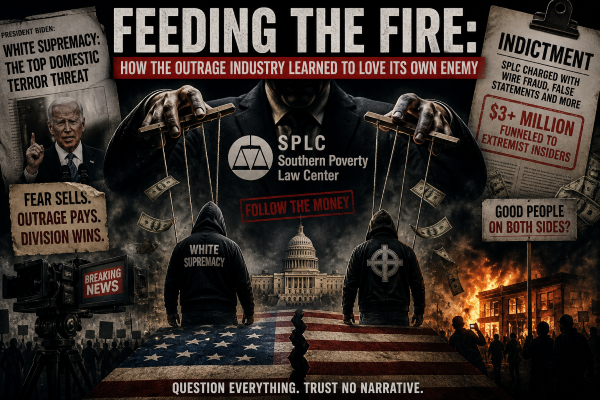
America doesn’t just have problems anymore—it has subscription services for problems. Pick your flavor, swipe your card, and congratulations: you’re now funding a permanent crisis that will never quite get solved. Because solving it would be terrible for business.
For years, Joe Biden and plenty of others in Washington have hammered the line that white supremacy is the most lethal domestic threat in America. That claim didn’t come out of nowhere—there have been real attacks, real victims, real investigations. But here’s the part nobody in the press briefings wants to touch: once a threat becomes a political and financial centerpiece, it stops being just a problem. It becomes a product.
And products need demand.
Enter the Southern Poverty Law Center—the self-appointed referee of American morality, complete with glossy reports, media hits, and a fundraising pipeline that runs hotter than a July asphalt range at Camp Perry. For decades, SPLC has made a name cataloging hate groups and ringing the alarm bell. Sometimes accurately. Sometimes… generously. Critics have been pointing out the overreach for years.
But now the conversation has shifted from “are they exaggerating?” to something far more uncomfortable: did money tied to this anti-extremism machine end up flowing into the very extremist ecosystems it claims to fight?
That’s not a fringe blog question anymore. There are serious allegations and reporting suggesting funds were used to pay or support insiders embedded in extremist groups. SPLC’s defense is what you’d expect: this was infiltration, intelligence gathering, the dirty work required to stop bad actors. Fair enough—law enforcement has used informants since before your grandfather figured out how to lie about his age to enlist.
But here’s the problem, and it’s not a small one: when you start paying people inside a movement, you’re no longer just observing it. You’re financially entangled with it.
And that’s where the narrative machine starts coughing up smoke.
Because the modern outrage economy isn’t designed to resolve threats—it’s designed to sustain attention. Media cycles, nonprofit fundraising, political messaging—they all run on the same fuel: urgency. If the threat fades, so does the money, the influence, the airtime. So the system does what systems do. It adapts. It maintains pressure. It keeps the dial turned just high enough to keep you engaged and just vague enough to avoid hard accountability.
You don’t need a shadowy cabal for this. You just need incentives.
And the incentives are brutally simple: fear pays.
That doesn’t mean white supremacy is fake. It isn’t. It doesn’t mean attacks were staged. They weren’t. It means something more irritating than a conspiracy—it means the people selling you the alarm may have developed a vested interest in keeping the alarm ringing.
Politicians amplify the threat because it justifies policy and consolidates power. Media amplifies it because fear drives clicks. Nonprofits amplify it because fear drives donations. Round and round it goes, like a bureaucratic merry-go-round powered by outrage and caffeinated interns.
So when an organization like SPLC—sitting right in the middle of that ecosystem—gets tied to funding streams that touch extremist insiders, even under the banner of “infiltration,” it doesn’t prove everything was staged. That’s fantasy. But it does expose something real and a lot less comfortable: the line between fighting a threat and feeding off it can get blurry when your business depends on its survival.
And once that line blurs, trust doesn’t just erode—it collapses.
Meanwhile, the average American gets front-row seats to the show. One side screams existential threat. The other screams hoax. Both sides rake in donations, airtime, and political capital. And you? You get to pick which version of reality you’d like to be angry about today.
It’s not that Americans are being lied to wholesale. It’s that we’re being managed—nudged into permanent outrage, nudged into camps, nudged into seeing every issue as a five-alarm fire. Because a calm, skeptical public doesn’t open wallets or vote in panic.
So no, “everything was staged” isn’t supported by the evidence. But here’s the more grounded—and frankly more damning—truth:
The anti-extremism industry may have grown so comfortable monetizing the threat that it drifted into a symbiotic relationship with it.
Not a grand conspiracy. Not a Hollywood plot. Just a system that realized the fire was profitable—and decided it didn’t mind getting a little closer to the flames.
If you enjoyed this article, then please REPOST or SHARE with others; encourage them to follow AFNN. If you’d like to become a citizen contributor for AFNN, contact us at managingeditor@afnn.us Help keep us ad-free by donating here.
Substack: American Free News Network Substack
Truth Social: @AFNN_USA
Facebook: https://m.facebook.com/afnnusa
Telegram: https://t.me/joinchat/2_-GAzcXmIRjODNh
Twitter: https://twitter.com/AfnnUsa
GETTR: https://gettr.com/user/AFNN_USA
CloutHub: @AFNN_USA