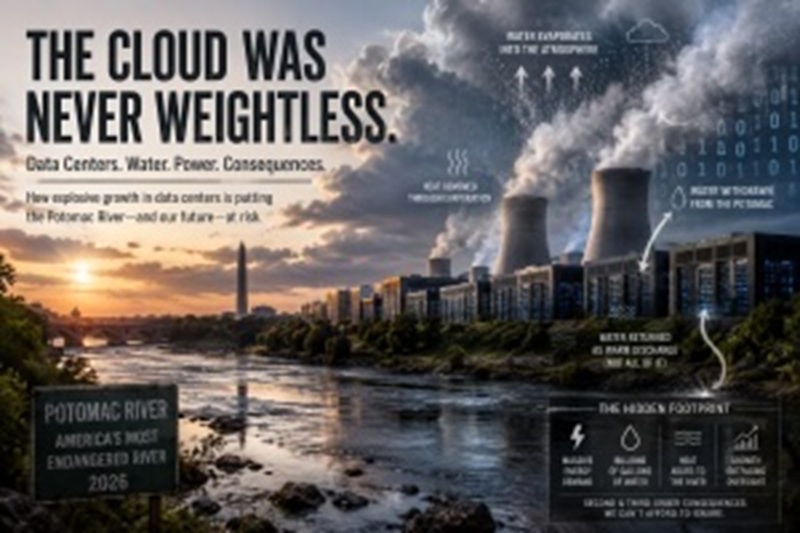
The Potomac River has found itself on a list nobody wants to be on. In 2026, American Rivers named it the most endangered river in the United States, citing two primary concerns: a massive sewage spill and the explosive growth of data centers throughout the watershed. The sewage spill made headlines. The data centers should make us think. According to the report, more than 300 data centers already operate within the Potomac watershed, and the number could approach 1,000 facilities if currently proposed projects are approved. That is not a typo. A thousand. The very infrastructure powering artificial intelligence, cloud computing, streaming video, and the modern digital economy may become one of the defining environmental and infrastructure questions of the next decade.
The funny part is that most people still think of the internet as something that exists nowhere. We call it “the cloud” because it sounds soft, clean, and harmless. The name itself is a masterpiece of marketing. Nobody would have embraced “the warehouse full of computers consuming electricity like a small city.” Cloud sounds much nicer.
The problem is that reality does not care about branding.
Behind every AI-generated image, every cloud backup, every online meeting, and every late-night doom scroll sits a building filled with servers generating incredible amounts of heat. Heat is the enemy of electronics. To keep those systems alive, engineers must continuously remove that heat, and one of the most effective ways to do that is with water.
Lots of water.
Northern Virginia’s data centers consumed nearly two billion gallons of water in 2023 alone, a figure that increased more than sixty percent in just four years. Some proposed facilities elsewhere in Virginia are projected to require between two and eight million gallons of water every day. Not per year. Per day. These are numbers usually associated with manufacturing plants, power stations, or major municipalities. Yet most people have never considered the water footprint of sending a text message or asking artificial intelligence to generate a picture of a sasquatch scuba diving, or a Teddy Roosevelt riding a moose through a thunderstorm carrying an AR15.
This is where things become interesting.
The concern is not necessarily that data centers are polluting rivers. In many cases they are not. The concern is that they are consuming resources in ways that few people anticipated. Many cooling systems use evaporation to remove heat. The water does not simply cycle through and return to the river unchanged. Much of it literally disappears into the atmosphere as vapor. The heat leaves with it. The process works beautifully. It is also thirsty.
Of course, defenders of the industry are not wrong either. Data centers are not luxury projects. They are becoming critical infrastructure. Hospitals rely on them. Financial institutions rely on them. Government agencies rely on them. Businesses rely on them. Increasingly, artificial intelligence relies on them. The digital economy would collapse without them.
That is exactly why the Potomac story matters.
History teaches that civilizations rarely struggle with the problems they anticipate. They struggle with the problems created by solutions that worked too well.
The automobile solved transportation and created traffic congestion.
Cheap fertilizer solved food shortages and created runoff problems.
Social media solved communication and created an epidemic of outrage addiction.
Now artificial intelligence and cloud computing are solving countless problems while creating demands for water, electricity, land, and infrastructure that were barely discussed ten years ago.
The Potomac River may simply be the first place where people are noticing the bill arriving.
What makes this situation different is the speed. Previous industrial revolutions unfolded across generations. The AI revolution is unfolding across quarterly earnings reports. Every major technology company is racing to build more capacity. Every utility is trying to forecast power demand that seems to grow faster than anyone predicted. Every local government wants the jobs and tax revenue. Everyone is chasing the benefits.
Very few people are asking about the second and third-order consequences.
That does not make the data centers evil. It does not make artificial intelligence evil. It does not mean progress should stop.
It means adults should be asking adult questions.
What happens during prolonged droughts? What happens when electrical demand exceeds available generation? What happens when hundreds more facilities come online? What happens when communities discover that their newest industrial neighbor produces no visible smoke, no visible product, and yet consumes enough resources to rival traditional heavy industry?
The Potomac debate may ultimately have less to do with one river than with a larger realization. The cloud was never weightless. The digital economy was never detached from the physical world. It runs on power plants, transmission lines, cooling towers, concrete, copper, and rivers.
The miracle of the digital age is real.
So are the consequences.
The challenge before us is making sure we understand both before the river tells us the answer.
If you enjoyed this article, then please REPOST or SHARE with others; encourage them to follow AFNN. If you’d like to become a citizen contributor for AFNN, contact us at managingeditor@afnn.us Help keep us ad-free by donating here.
Substack: American Free News Network Substack
Truth Social: @AFNN_USA
Facebook: https://m.facebook.com/afnnusa
Telegram: https://t.me/joinchat/2_-GAzcXmIRjODNh
Twitter: https://twitter.com/AfnnUsa
GETTR: https://gettr.com/user/AFNN_USA
CloutHub: @AFNN_USA