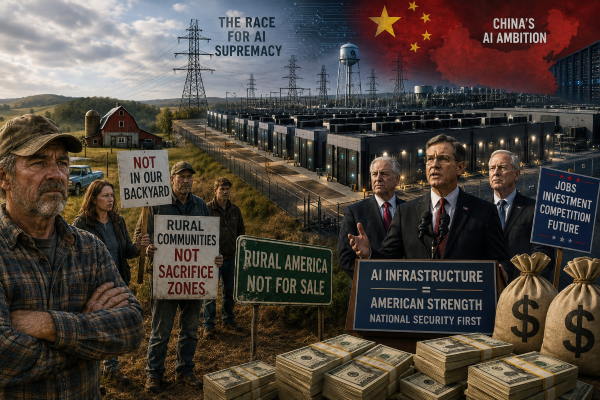
For the last twenty years, Americans have been told what was supposed to divide us. Race. Guns. Immigration. Climate change. Vaccines. Pick your poison. Every election cycle comes with a new list of reasons why your neighbor is either a threat to democracy or a complete idiot.
Now, quietly emerging over the horizon like a convoy of diesel generators and high-voltage transmission lines, comes another fault line. This one may be harder to solve because both sides think they’re defending America.
Welcome to the Data Center Wars.
The pitch sounds simple enough. America is in a race against China. Artificial intelligence will determine military superiority, economic dominance, technological leadership, and perhaps the future balance of power itself. If China wins, we’re told, America loses. Therefore, we must build. Build data centers. Build transmission lines. Build substations. Build cooling systems. Build faster than the other guy.
Fear has always been an effective sales tool.
The challenge is that most of the people demanding more AI infrastructure don’t want it built next to their own homes. They want it built somewhere else. Preferably somewhere with cheap land, fewer lawyers, fewer zoning restrictions, and fewer people.
In other words, rural America.
The same communities that have spent decades watching factories close, schools consolidate, and young people leave are suddenly being told they are strategically important again. Not because someone discovered the value of small-town life. Not because policymakers suddenly care about rural communities. No, they’re important because they have something Silicon Valley needs: land, water, and electricity.
Lots of electricity.
The modern AI economy doesn’t float in the cloud. The cloud is just someone else’s building. Behind every clever chatbot and every AI-generated image sits an industrial facility consuming enough power to rival a small city.
And that’s where the friction begins.
The white-collar knowledge worker in Northern Virginia, Austin, Seattle, or San Francisco sees opportunity. Faster tools. Better productivity. New industries. New jobs. National competitiveness. To them, data centers are the equivalent of railroads, interstate highways, or shipyards during previous generations.
The farmer, hunter, fisherman, or rural homeowner often sees something different.
They see a massive industrial structure where a field used to be.
They see additional strain on local water supplies.
They see transmission corridors cutting through forests and farmland.
They see promises of jobs that largely disappear once construction crews leave town.
Most importantly, they see outsiders making decisions for them.
The conversation quickly turns ugly.
Anyone questioning a project gets labeled a NIMBY. Not In My Backyard.
That’s a convenient insult because it allows people to dismiss concerns without addressing them. Ask about water consumption? NIMBY. Ask about environmental impacts? NIMBY. Ask whether a river, aquifer, or wetland might be affected? NIMBY.
But here’s the uncomfortable truth: asking questions about a billion-dollar industrial project being built in your backyard isn’t unreasonable. It’s exactly what citizens are supposed to do.
Likewise, the anti-data-center crowd occasionally falls into its own trap. Every proposal becomes a conspiracy. Every facility becomes a surveillance hub. Every executive becomes a cartoon villain twirling a mustache while plotting the destruction of local communities.
Reality is more complicated.
America genuinely does face strategic competition from China. AI will almost certainly play a major role in military planning, intelligence analysis, logistics, cyber operations, and economic growth. Pretending otherwise is wishful thinking.
But recognizing that reality does not require blind acceptance of every project placed before every township board and county commission.
This is where the issue becomes fascinating.
The traditional political coalitions don’t fit neatly anymore.
Conservatives who usually support business development suddenly find themselves standing shoulder-to-shoulder with environmental activists opposing industrial expansion.
Progressives who normally champion environmental causes suddenly find themselves defending massive energy-intensive facilities in the name of technological advancement.
Nobody knows exactly where the political lines belong because the issue cuts across existing tribes.
And perhaps that’s the warning.
America has developed a habit of framing every disagreement as a battle between good people and bad people. Data centers risk becoming another chapter in that endless story.
The reality is that most people on both sides want the same thing. They want prosperity. They want security. They want a future for their children. They want America to remain competitive.
The disagreement is over who bears the costs.
The software engineer using AI to write code receives the benefit.
The rural community hosting the facility receives the infrastructure.
Those are not always the same people.
If we are not careful, AI will create a new political divide between those who experience artificial intelligence as convenience and those who experience it as construction.
One side sees a miracle of innovation.
The other sees another industrial project arriving with promises, consultants, PowerPoint presentations, and assurances that everything will be fine.
Perhaps everything will be fine.
Perhaps America truly does need this infrastructure.
But if the future of AI requires asking rural communities to sacrifice land, water, scenery, and peace of mind, then they deserve more than lectures about national security and accusations of backwardness.
Because the fastest way to divide a nation is to tell one group they should carry the burden while another group enjoys the benefit.
And if there’s one thing Americans have never enjoyed, it’s being told they’re taking one for the team while somebody else cashes the check.
If you enjoyed this article, then please REPOST or SHARE with others; encourage them to follow AFNN. If you’d like to become a citizen contributor for AFNN, contact us at managingeditor@afnn.us Help keep us ad-free by donating here.
Substack: American Free News Network Substack
Truth Social: @AFNN_USA
Facebook: https://m.facebook.com/afnnusa
Telegram: https://t.me/joinchat/2_-GAzcXmIRjODNh
Twitter: https://twitter.com/AfnnUsa
GETTR: https://gettr.com/user/AFNN_USA
CloutHub: @AFNN_USA
The billionaires who own outfits that should be broken up under anti-trust and RICO aren’t doing themselves any favors in these debates. They evaporate the water used to cool the computers, sucking water out of local aquifers. If instead they condensed the vapor back into water, cooled it, and put it back into the aquifer, there would be less objection. My county has banned the creation of data centers, but if neighboring counties allow them, the billionaires will still suck our aquifers dry with no accountability. Also, these data centers don’t really create that many jobs in a local community — 50 or 100 maybe. Is it worth 50 jobs to destroy our local environment. Why don’t we make them desalinate sea water for these data centers instead of consuming water needed for people and agriculture?