For generations we’ve been told there is a great war between science and Christianity.
The story goes something like this: science explains reality, religion explains fairy tales, and eventually one will defeat the other. Pick a side. Join the tribe. Enjoy the food fight.
Yet the deeper you look, the stranger that narrative becomes.
Take a simple question: Why are humans different?
Not better than every creature in every way. A hawk sees better. A bear is stronger. A dolphin swims better. A bloodhound can find things the FBI wishes it could.
Yet humans are unique.
We are the only known species that intentionally builds a better world for descendants we will never meet.
A farmer plants an orchard knowing someone else will harvest the fruit.
An engineer designs a bridge that may outlive him by a century.
A teacher pours knowledge into students she may never see again.
A parent works overtime so a child can have opportunities they never had.
Human civilization itself is a giant relay race between the living, the dead, and the unborn.
Biology recognizes this.
Anthropologists call it cumulative culture. Each generation inherits knowledge and adds to it. We do not simply inherit genes. We inherit language, history, technology, traditions, stories, skills, and institutions.
A beaver builds a dam.
A human builds a dam, writes a textbook about building dams, improves the design, trains apprentices, passes laws governing dams, and leaves instructions for people who won’t be born for another hundred years.
No other known species does this.
Science observes the phenomenon.
Christianity explains it.
The Bible begins with a startling claim. Human beings are made in the image of God.
For many people, that phrase has become so familiar that its revolutionary meaning has been lost.
The image of God is not merely intelligence.
It is vocation.
It is purpose.
It is responsibility.
The first humans were not placed in a garden to consume it. They were placed there to cultivate it.
Build.
Create.
Steward.
Improve.
Take what is good and make it better.
In other words, humanity’s first job description sounds remarkably similar to what biology observes humans doing.
The conflict appears when we ask why.
Science can tell us how human beings developed extraordinary capacities. It can describe language, cooperation, culture, and cognition.
What it cannot answer is why these things matter.
Why should we care about future generations?
Why should we sacrifice for strangers?
Why should we leave the world better than we found it?
Why is selfishness wrong and stewardship right?
Biology can explain behavior.
It cannot provide moral obligation.
For that, we enter the realm of philosophy and theology.
This is where Christianity offers something modern society desperately lacks: a mission.
Today we are drowning in information and starving for meaning.
We know how to split atoms but struggle to define wisdom.
We know how to manipulate genes but cannot agree on what human flourishing looks like.
We have more technology than any civilization in history, yet loneliness, anxiety, and social fragmentation continue to rise.
The problem is not knowledge.
The problem is purpose.
We have become experts at understanding the machinery while forgetting the mission.
The biblical worldview offers a different answer.
Human beings are not accidents wandering through a meaningless universe.
Nor are we gods who can redefine reality according to our preferences.
We are stewards.
Temporary caretakers.
Managers, not owners.
The farm is not ours.
The nation is not ours.
The church is not ours.
Even our children are not ours in the ultimate sense.
Everything has been entrusted to us for a season.
That perspective changes everything.
If life is merely about consumption, then the goal becomes maximizing comfort.
If life is stewardship, the goal becomes maximizing faithfulness.
One worldview asks, “What can I get?”
The other asks, “What can I leave behind?”
One produces consumers.
The other produces builders.
And perhaps that is where biology and Christianity shake hands.
Biology reveals a creature unlike any other on Earth—a species capable of understanding truth, creating beauty, transmitting wisdom, planning centuries into the future, and sacrificing for people not yet born.
Christianity says that should not surprise us.
That is exactly what image-bearers would look like.
Of course, the Bible also teaches that humanity is fallen. History confirms that as well. The same species that builds hospitals builds death camps. The same mind that discovers antibiotics invents chemical weapons.
We possess tremendous power, but not always tremendous wisdom.
Which brings us back to the central question.
What is humanity for?
The answer may be simpler than we think.
Plant the tree.
Teach the child.
Tell the truth.
Build something that lasts.
Protect what has been entrusted to you.
Leave the campsite cleaner than you found it.
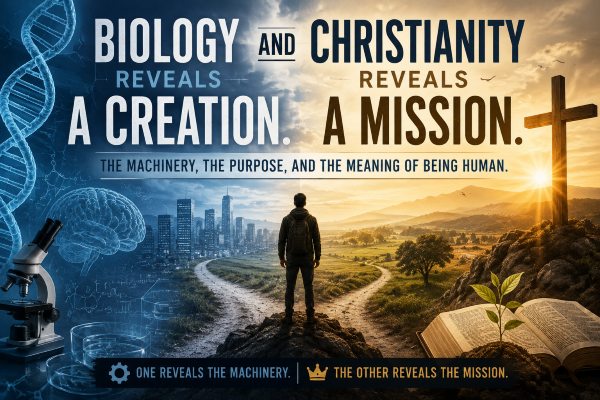
Biology reveals a creation capable of stewardship.
Christianity reveals the Creator who gave it that mission.
One explains the machinery.
The other explains why the machinery exists in the first place.
If you enjoyed this article, then please REPOST or SHARE with others; encourage them to follow AFNN. If you’d like to become a citizen contributor for AFNN, contact us at managingeditor@afnn.us Help keep us ad-free by donating here.
Substack: American Free News Network Substack
Truth Social: @AFNN_USA
Facebook: https://m.facebook.com/afnnusa
Telegram: https://t.me/joinchat/2_-GAzcXmIRjODNh
Twitter: https://twitter.com/AfnnUsa
GETTR: https://gettr.com/user/AFNN_USA
CloutHub: @AFNN_USA