This may sound like heresy in Washington, but perhaps it’s time to ask an obvious question:
Why do we still have the Lincoln Memorial Reflecting Pool?
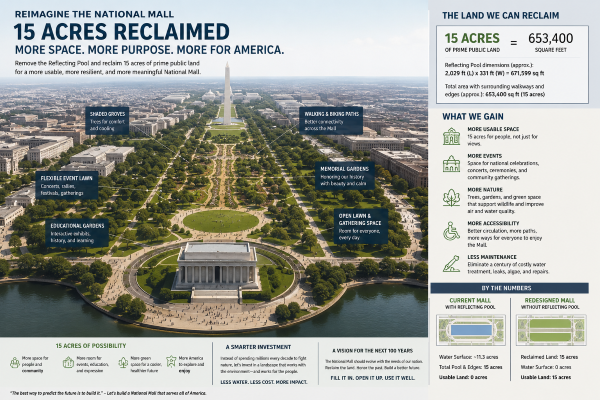
The Reflecting Pool was built in 1922–1923 as part of the grand design of the National Mall. Its purpose was simple: create a dramatic visual reflection between the Lincoln Memorial and the Washington Monument. For postcards and photographs, it has been spectacular. For public use, however, it occupies more than 15 acres of some of the most valuable public land in America while providing little function beyond being something to look at.
For more than a century, the pool has suffered from leaks, algae blooms, sediment accumulation, water-quality issues, structural deterioration, and costly repairs. In 2012, taxpayers spent roughly $35 million rebuilding the facility. Yet algae and maintenance problems quickly returned. Today, new controversies over water quality and coatings once again dominate the headlines.
At some point, a reasonable person has to ask whether the problem isn’t the contractor, the filtration system, the chemicals, the weather, or the administration in power. Perhaps the problem is the giant artificial pond itself.
The site sits on what was historically low-lying Potomac floodplain and wetlands. Nature has spent a hundred years trying to remind us of that fact. Every algae bloom, every maintenance project, every expensive rehabilitation effort is another chapter in a long-running battle against geography.
Meanwhile, the National Mall continues to host protests, celebrations, concerts, festivals, ceremonies, educational events, and millions of annual visitors. Open space is often at a premium. Yet a large section of the Mall remains occupied by a shallow body of water that people largely walk around rather than use.
Imagine replacing the pool with something that serves the public directly. Expanded green space. Tree groves for shade. Memorial gardens. Event grounds. Walking paths. Outdoor exhibits. Amphitheater space. Areas for school groups and educational programs. Flexible public space that could accommodate the needs of the next hundred years rather than preserving a design decision made a century ago.
The irony is that Americans often criticize outdated infrastructure while fiercely defending outdated ideas. If the Reflecting Pool did not already exist and someone proposed building it today, taxpayers would likely laugh at the concept. The federal government would be proposing to excavate a massive shallow pond in a hot, humid environment, spend millions maintaining it forever, and permanently remove acres of usable public land in exchange for a nice reflection.
No engineer would call that an efficient use of space.
No city planner would call that a flexible use of land.
No taxpayer would call it inexpensive.
The Reflecting Pool has served its purpose. It helped define the National Mall for generations. But monuments should honor history, not become prisoners of it.
Perhaps the most respectful thing we can do is thank the Reflecting Pool for its century of service, fill it in, and create a public space that Americans can actually use instead of merely admire from the shoreline.
If you enjoyed this article, then please REPOST or SHARE with others; encourage them to follow AFNN. If you’d like to become a citizen contributor for AFNN, contact us at managingeditor@afnn.us Help keep us ad-free by donating here.
Substack: American Free News Network Substack
Truth Social: @AFNN_USA
Facebook: https://m.facebook.com/afnnusa
Telegram: https://t.me/joinchat/2_-GAzcXmIRjODNh
Twitter: https://twitter.com/AfnnUsa
GETTR: https://gettr.com/user/AFNN_USA
CloutHub: @AFNN_USA