Every veteran has that one piece of gear they swear by.
Some will tell you it was their Leatherman. Others will argue it was 550 cord, Hundred mph – duct tape, or a woobie. Those people are mostly wrong.
The greatest piece of military equipment ever issued weighed less than half an ounce, fit in your cargo pocket, and could transform government-issued mystery meat into something vaguely recognizable as food.
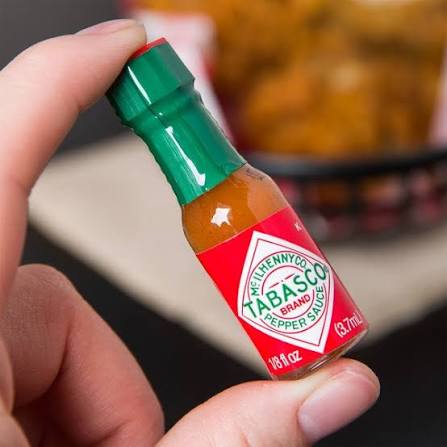
I’m talking about the legendary little glass bottle of Tabasco.
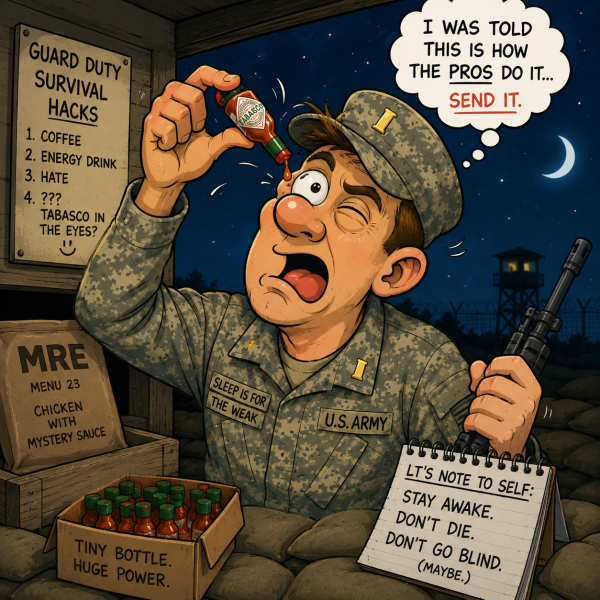
Like most military legends, there was also bad information floating around. When I was a young lieutenant, I honestly thought the little bottle was issued so you could put a few drops in your eyes to stay awake on guard duty. Looking back, I’m about 99 percent sure some salty NCO told that story just to see if a brand-new lieutenant was dumb enough to try it.
Fortunately, I valued my eyesight more than my curiosity.
The real story is far better.
The tiny bottle wasn’t dreamed up by a Pentagon procurement committee after twelve years of studies and seventeen PowerPoint presentations. It came from a Marine.
Walter Stauffer McIlhenny was the grandson of Tabasco founder Edmund McIlhenny, but he wasn’t just a businessman. He was a Marine officer who eventually retired as a brigadier general in the Marine Corps Reserve. During the Vietnam War, he understood something every infantryman, tanker, artilleryman, and cavalry scout has known since armies first marched on their stomachs.
Military rations can become painfully monotonous.
So instead of trying to sell hot sauce through television commercials, he started sending Tabasco to the troops. In 1966, the McIlhenny Company published a humorous booklet called *The Charlie Ration Cookbook*, filled with creative ways to improve the dreaded C-rations. Wrapped around each bottle of Tabasco was a booklet. Families mailed them overseas. Soldiers shared them. Word spread through the ranks.
That’s how the best military equipment often gets adopted—not because headquarters says so, but because soldiers decide it works.
Anyone who has lived on field rations understands why.
After your third day in the field, every entrée begins tasting suspiciously similar. Beef? Chicken? Pork? Who knows? By day 72 (true story), the menu card becomes more of a suggestion than a promise.
Then someone pulls out a tiny bottle of Tabasco.
Suddenly everything tastes better.
Eggs in the chow hall? Better.
Omelet MRE? Better.
Questionable spaghetti? Better.
Cold beef stew? Still questionable…but better.
Those little bottles became military currency. You could trade them. Hoard them. Slip one into a buddy’s Christmas stocking. Somewhere in America, I guarantee there is still a retired first sergeant who has three unopened bottles tucked away in a desk drawer next to an old challenge coin and an expired military ID.
By the time MREs replaced C-rations, the military had gotten the message. The tiny glass bottles became standard issue in many meal packs. They weren’t there because of a congressional mandate or a billion-dollar acquisition program.
They were there because soldiers wanted them.
Then, in one of those moments only government bureaucracy can produce, someone decided foil packets would be cheaper.
On paper, it probably looked brilliant.
No glass.
Less weight.
Lower cost.
Better logistics.
Congratulations. Another PowerPoint victory.
Unfortunately, nobody asked the troops.
The packets leaked. They tore. They disappeared into the bottom of rucksacks. Worst of all, they lacked the simple satisfaction of unscrewing that tiny cap and carefully rationing every precious drop.
Years later, reality won.
The Army eventually brought the miniature bottles back after discovering the replacement packets weren’t nearly as reliable with an acidic pepper sauce. Imagine that. Sometimes the old solution survives because it was actually the better solution all along.
There’s a lesson hidden inside that tiny bottle.
The military loves technology. We chase bigger computers, smarter drones, artificial intelligence, satellites, sensors, and gadgets that require instruction manuals thicker than a field manual.
Meanwhile, one of the most beloved items ever carried by an American soldier was a tiny glass bottle of Louisiana hot sauce.
No batteries.
No software updates.
No firmware patches.
No mandatory cybersecurity training.
Just peppers, vinegar, salt, and common sense.
Sometimes we forget that morale isn’t built by billion-dollar weapons systems alone. It’s built by the little things that remind exhausted young Americans that somebody back home actually thought about making life a little less miserable.
A hot cup of coffee.
A handwritten letter.
Dry socks.
And yes…a tiny bottle of Tabasco.
Because after twenty-five years in uniform, I’ve learned one universal military truth.
You can survive almost anything if you have enough hot sauce.
Just don’t put it in your eyes.
Trust me…or more accurately, trust the salty sergeant who was laughing when he told the new lieutenant that story.
If you enjoyed this article, then please REPOST or SHARE with others; encourage them to follow AFNN. If you’d like to become a citizen contributor for AFNN, contact us at managingeditor@afnn.us Help keep us ad-free by donating here.
Substack: American Free News Network Substack
Truth Social: @AFNN_USA
Facebook: https://m.facebook.com/afnnusa
Telegram: https://t.me/joinchat/2_-GAzcXmIRjODNh
Twitter: https://twitter.com/AfnnUsa
GETTR: https://gettr.com/user/AFNN_USA
CloutHub: @AFNN_USA