Walk into almost any American evangelical church and ask a simple question.
“Does the Bible command Christians to support the modern nation of Israel?”
You’ll probably hear a quick, confident “yes.”
Now ask the follow-up.
“Where does the New Testament actually say that?”
The silence can be deafening.
Here’s the untold story.
For nearly eighteen centuries, mainstream Christianity did not teach that believers were biblically obligated to support a future geopolitical nation-state called Israel. Christians certainly loved the Jewish people and rejected antisemitism, but the New Testament was generally understood to reveal one covenant family—believing Jews and Gentiles united together through Christ.
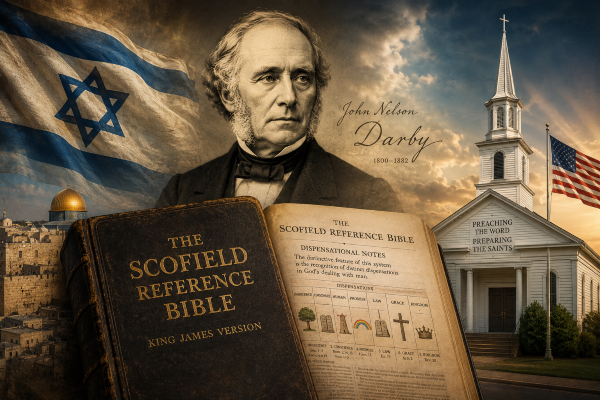
Then, in the early 1800s, an Irish lawyer-turned-preacher named John Nelson Darby proposed something entirely different.
Darby developed what became known as dispensationalism. He divided biblical history into distinct eras, sharply separated Israel from the Church, taught a pre-tribulation rapture, and argued that God had two parallel peoples with different promises—earthly promises for Israel and heavenly promises for the Church.
Whether you ultimately agree with Darby or not, one historical fact is difficult to dispute.
His system was new.
The historic churches—Catholic, Orthodox, Lutheran, Anglican, Methodist, and most Reformed denominations—did not embrace it. Many nineteenth-century theologians criticized it as an innovation because they believed the New Testament repeatedly united what Darby divided.
Darby himself was not run out of America. He made several successful preaching tours here during the 1860s and 1870s. But his theology initially found its greatest reception outside the established denominations, among independent Bible teachers, the Plymouth Brethren, Bible conference movements, and later many fundamentalist Baptist churches and independent Bible churches.
Then something happened that changed American Christianity forever.
The Niagara Bible Conferences spread Darby’s prophetic system to thousands of pastors. Then came the Scofield Reference Bible in 1909. For millions of Christians, the study notes became almost inseparable from the biblical text itself. Later, institutions like Moody Bible Institute and Dallas Theological Seminary trained generations of pastors who carried dispensational theology into pulpits across America.
Within a few generations, what had once been considered a controversial nineteenth-century theological innovation came to be viewed by many Christians as simply “what the Bible teaches.”
That’s remarkable.
It’s also why many Christians don’t realize there are faithful believers—and have been for nearly two thousand years—who have never accepted Darby’s framework.
Now fast forward to modern politics.
Politicians eventually discovered something incredibly valuable.
If millions of Christians sincerely believed supporting the modern State of Israel was a direct command from God, then foreign policy ceased being merely political. It became theological.
Questioning government policy could now be portrayed as questioning God Himself.
That’s an extraordinarily powerful political tool.
Let’s be clear.
Loving the Jewish people is biblical.
Rejecting antisemitism is biblical.
Praying for the peace of Jerusalem is biblical.
But supporting every decision made by the government of Israel simply because it is Israel is an entirely different proposition.
The Old Testament prophets certainly didn’t give Israel’s kings a free pass. Isaiah, Jeremiah, Amos, Hosea, and the rest spent much of their ministries rebuking Israel’s own rulers for injustice, corruption, oppression, and idolatry.
Loving God’s people never meant endorsing every action of their government.
The New Testament goes even further.
Paul teaches that Christ has broken down the dividing wall between Jew and Gentile. Peter calls the Church a holy nation. Everyone who belongs to Christ becomes an heir to Abraham’s promises by faith.
The emphasis shifts from an earthly kingdom to a heavenly King.
That doesn’t erase the Jewish people. It doesn’t erase God’s faithfulness to Israel. Nor does it deny Paul’s hope in Romans 11 that many ethnic Jews will one day recognize their Messiah.
But it does challenge Christians to distinguish between a covenant people and a modern nation-state.
The Israel of Scripture is part of God’s redemptive story.
The State of Israel is a modern government founded in 1948 with elections, political parties, budgets, intelligence agencies, coalition politics, and human leaders who, like every government on earth, remain accountable to God’s standards of justice.
Those are not identical categories.
Perhaps the greatest lesson is this: our allegiance belongs first to King Jesus.
Not Washington.
Not Jerusalem.
Not any political party.
Not any flag.
Christians should absolutely love the Jewish people. They should also love Palestinians, because both are image-bearers of God. They should oppose terrorism wherever it appears. And they should evaluate every government—including Israel’s, America’s, and every other nation’s—by the same biblical standard of righteousness.
Maybe it’s time to reopen our Bibles with fresh eyes.
Not our prophecy charts.
Not our favorite commentators.
Not nineteenth-century study notes.
The question isn’t whether Christians should love Israel.
They should.
The question is whether we’ve confused loving a people with granting unquestioning loyalty to a government.
History suggests that distinction has become blurred.
Scripture invites us to examine it again.
If you enjoyed this article, then please REPOST or SHARE with others; encourage them to follow AFNN. If you’d like to become a citizen contributor for AFNN, contact us at managingeditor@afnn.us Help keep us ad-free by donating here.
Substack: American Free News Network Substack
Truth Social: @AFNN_USA
Facebook: https://m.facebook.com/afnnusa
Telegram: https://t.me/joinchat/2_-GAzcXmIRjODNh
Twitter: https://twitter.com/AfnnUsa
GETTR: https://gettr.com/user/AFNN_USA
CloutHub: @AFNN_USA